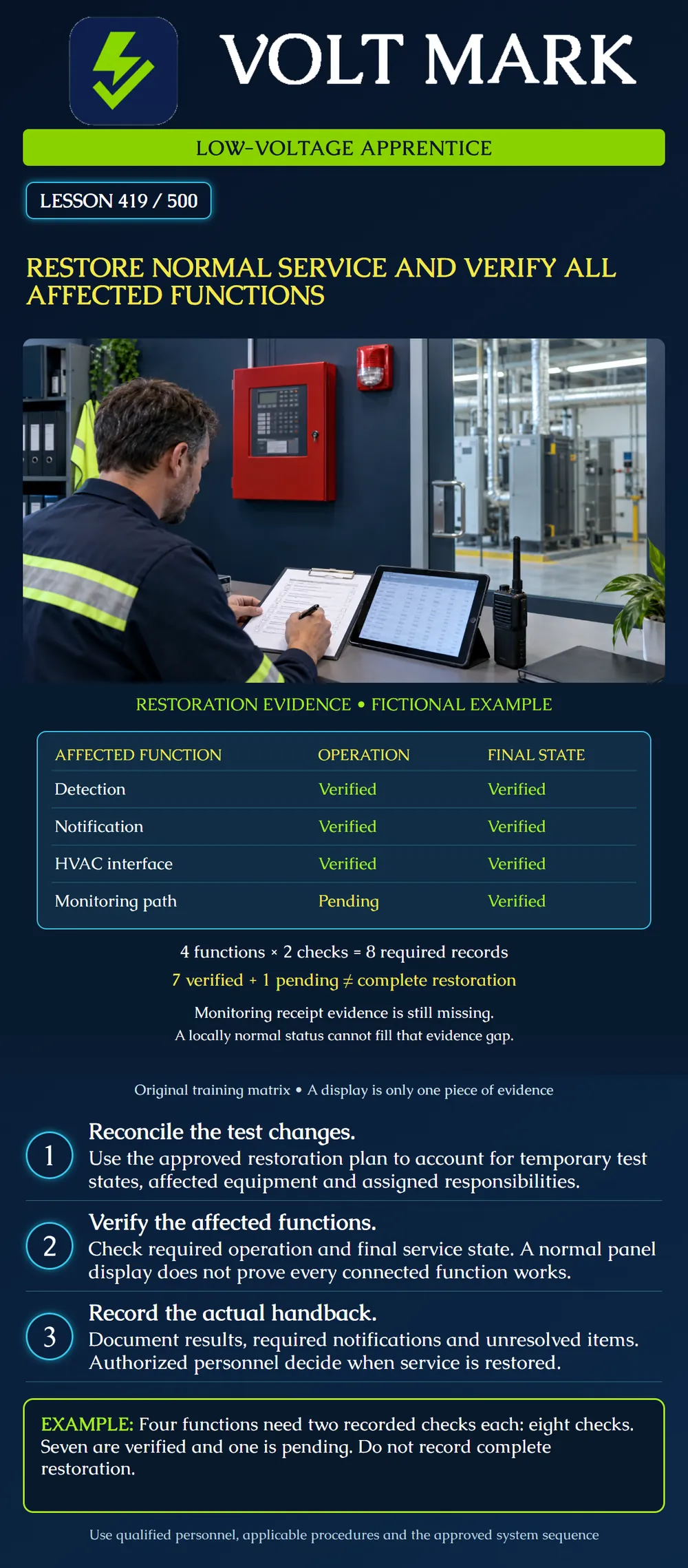
Explain why restoring normal service requires accounting for test changes, verifying affected functions and recording the actual handback. Given a fictional restoration matrix, identify missing evidence without treating a normal panel display as proof that every function works.
This lesson is a documentation and reasoning exercise for supervised apprentices. It is not a switching sequence, authorization to reset an alarm, or a procedure for re-enabling a live life-safety system. The approved site procedure, equipment instructions, applicable requirements and qualified responsible personnel determine the actual sequence. Never use this poster to operate an elevator, suppression release, smoke-control system or other interface outside your assignment.
Work can be technically finished at one device while the larger system still has an unresolved condition. The technician who worked at a detector may not be the person responsible for the connected mechanical equipment or supervising station. A service record should make those boundaries visible. “My task is finished” and “the affected system is back in its required service condition” are different claims.
A displayed normal condition is useful evidence about what that display reports. It cannot replace missing observations, missing remote records or the required checks of connected functions. Record the indication accurately, but do not expand its meaning beyond the evidence.
Before handback, reconcile the work and test records with the approved restoration plan. The responsible team identifies the equipment involved, temporary test conditions, changed settings, affected interfaces and responsibilities. Each temporary change needs a documented disposition. This is an accounting exercise, not permission for the apprentice to remove a protective measure independently.
Use identifiers rather than general phrases. “AHU-2 interface” is more useful than “fan stuff.” Record the approved configuration or sequence reference where relevant. Distinguish a deliberately retained condition under an authorized impairment process from an unnoticed test condition. Neither should disappear from the handover record.
The restoration sequence must be coordinated with the people responsible for each affected system. A technician must not assume that resetting a fire alarm panel independently authorizes another trade's equipment to restart.
Keep two questions separate: Did the required function perform correctly during the approved check? Is it now in the required final service state? A function might have passed during the test but remain in a temporary state. Conversely, a device might show a normal state without evidence that its required response was demonstrated.
For connected systems, describe the intended response using the approved sequence. Normal service does not mean every fan is running, every door is locked, or every relay is energized. Occupancy, scheduling and the approved design determine the expected state. Avoid inventing a single normal position that applies to every installation.
Testing itself can create temporary conditions. The qualified team coordinates the required final checks after testing and documents the resulting service state. An apprentice records what was actually observed, by whom, when, and against which criterion.
Keep the verification record linked to the work, deficiency and repeat-test records. Required notifications and acknowledgments belong in the handback documentation. Record the recipient, time and actual response when the procedure requires it. A message prepared, a message sent and a confirmed receipt are different events.
If a required result is missing or a condition remains unresolved, describe that fact and refer it to the responsible person under the site's protection and impairment procedures. Do not write “all restored” merely to close a work order. The required authority for restoration and any protective measures must come from the applicable procedure.
System Sensor's D4120 instructions, I56-2967-008R, section 13.2, describe post-cleaning reinstallation, restoration of power, a detector check and notification of the appropriate authorities that testing is complete and operation has resumed. That device-specific example illustrates that physical reassembly alone does not finish the process. It is not a universal restoration sequence or permission to handle its line-voltage supply. Use the instructions applicable to the installed equipment and revision.
UCSF's January 2026 bulletin requires a functional matrix in the test plan and documentation of individual and integrated system responses. It is a UCSF/California example, not a national mandate for this lesson's matrix or sign-off process. Our poster's two-column matrix and numerical exercise are original training aids.
An instructor provides four fictional functions: detection, notification, an HVAC interface and a monitoring path. The exercise requires two records per function: operation verification and final-state verification. This is a simplified exercise, not the full test scope of an actual system.
Detection: operation verified; final state verified. Notification: operation verified; final state verified. HVAC interface: operation verified; final state verified. Monitoring path: operation evidence pending; locally observable final state verified.
There are 4 × 2 = 8 required records. Seven are verified and one is pending. The monitoring-path row is deliberately incomplete: local equipment can report its expected state while the required receiving-end evidence is still missing. That does not prove the path failed, but it does mean successful operation is not yet established by this record.
The correct exercise conclusion is “restoration verification incomplete.” Do not average seven successful entries into acceptance, assume the eighth, or describe the local state as proof of receipt. Obtain the required missing evidence through the authorized process and update the record honestly.
Q1. Does a normal panel display prove every affected connected function?
System Sensor D4120 installation and maintenance instructions, I56-2967-008R, section 13.2: https://prod-edam.honeywell.com/content/dam/honeywell-edam/hbt/en-us/documents/manuals-and-guides/installation-guides/moved-ss/D4120_Manual_I56-2967.pdf UCSF Fire Prevention Design Bulletin #0003, revised January 2026, sections 4.5 and 7.2: https://ehs.ucsf.edu/fire-prevention-design-bulletin-0003-integrated-fire-protection-and-life-safety-system-testing
Device-specific and local scope are retained. The evidence matrix, scenario, arithmetic and questions are original instructional material. No nationwide notification deadline, universal reset procedure or acceptance authority is invented.
Mistake: Treating local normal status as proof of off-site reporting. Correction: Obtain the required receiving-end evidence before completing the monitoring-path row.
Mistake: Assuming every fan must run when normal service is restored. Correction: Use each function's approved operating conditions and final-state criterion.
Mistake: Ending a temporary protective measure because device work is finished. Correction: Reconcile affected functions and outstanding conditions with the authorized restoration owner before handback.
Use the four-function, two-record matrix. Now assume all four operation records are verified, but the HVAC interface final-state record and monitoring-path final-state record are pending. Calculate the verified and pending counts and write a factual handback statement.
Answer guide: six of eight records are verified and two are pending. State that operation evidence is complete for the assigned functions but final-state verification remains incomplete for the HVAC interface and monitoring path. Assign the two confirmations through the responsible process; do not declare full restoration.
Texas journeyman, 15 questions, scored by topic against the 70% mark. No card, and no account needed to start.
Free study material for low-voltage apprentices. This is a national foundation course: requirements differ by state and by local jurisdiction, and a practice that is common in one place is not a rule everywhere. Nothing here is a licence, a certification, or authority to work unsupervised, and completing it does not count as apprenticeship hours or continuing-education credit. Check the codes adopted where you are working, the licensing authority for that work, and your employer's safety programme. VoltMark is not affiliated with, endorsed by, or sponsored by NFPA, OSHA, NICET, BICSI, FOA, or any state or local licensing authority.

Electrician licensing exam prep: practice questions, timed exam simulations, and step-by-step help finding every answer in the NEC.