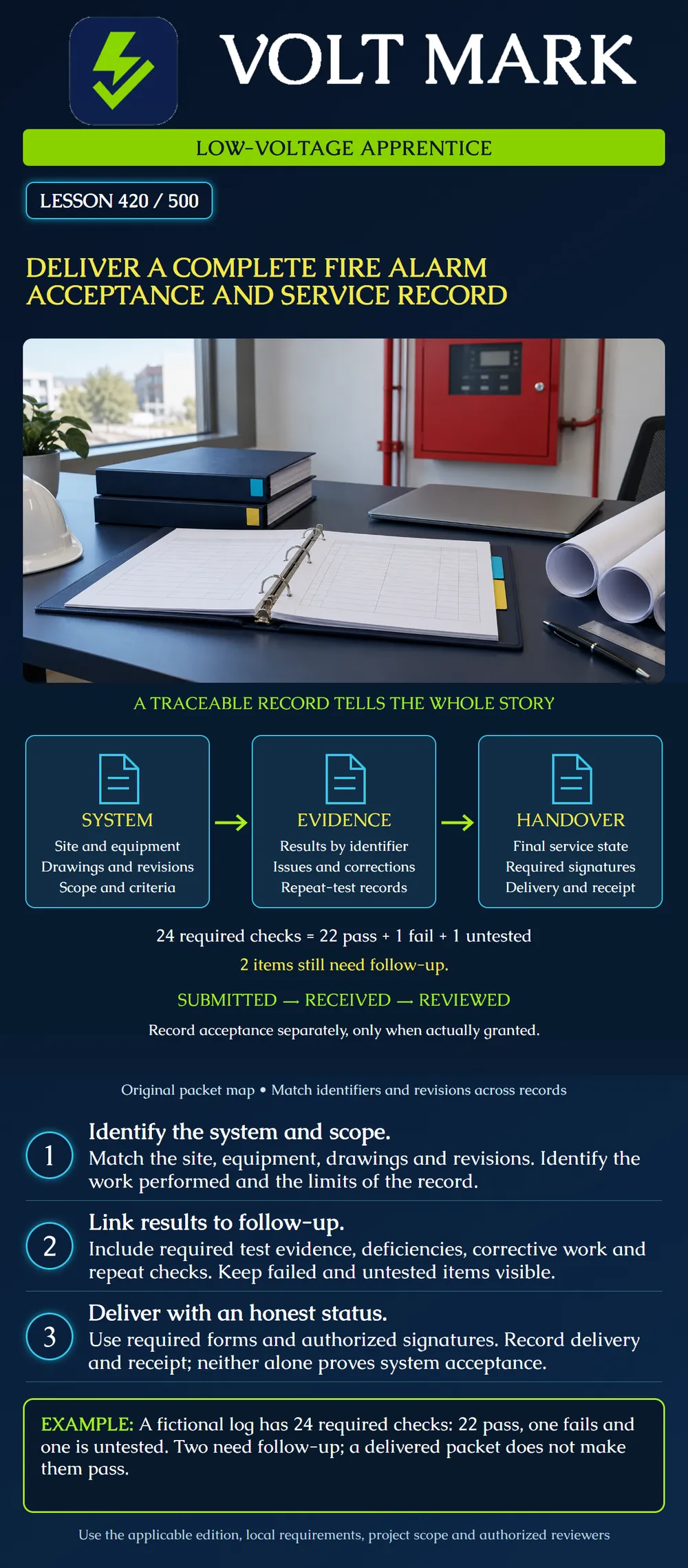
Organize a traceable fire alarm record that connects the installed system, evidence of the work and testing, unresolved items, and the actual handover status. Distinguish a completion record, a service report, test evidence and acceptance. Identify what remains incomplete in a fictional record without inventing approvals.
This is a supervised apprentice documentation lesson. It does not certify a system, authorize a signature, replace a required form or establish the submission rules of every jurisdiction. Determine the applicable adopted edition, local amendments, project requirements and responsible reviewers for the actual job. Use the forms and supporting material those requirements call for. This lesson's three-card packet map is an original teaching aid, not a national mandated packet format.
A cover page can identify a project but cannot supply all the evidence behind a claim. A test log explains what was checked and what happened. A service entry explains work performed. A deficiency record explains an unresolved or corrected condition. A completion record describes the installed system and the required completion information. The applicable acceptance process determines who reviews or accepts the work and what evidence that decision requires.
Do not silently substitute one document for another. A paid invoice is not proof of successful testing. A test checklist is not automatically a record of completion. A completed form is not, by itself, proof that the reviewing authority granted acceptance.
Use the same site and system identifiers across the packet. Include the required equipment and location information, drawing references, software or configuration revisions, and the scope of the work. Readers should be able to identify which system and revision the evidence describes.
Separate existing conditions from changes. If the work involved only an authorized modification, state that boundary and use the required documentation and testing scope for the modification. Do not describe the entire building as newly tested when the records cover only part of it.
Use an index that connects the documents. An entry might identify a drawing by number and revision, a test sheet by identifier and date, and an issue by its unique issue number. The index makes missing items visible and helps a future technician find the supporting record. Preserve superseded records according to the applicable retention process rather than confusing an old revision with the active version.
For each required test record, retain the applicable identifier, intended result, actual result and status, plus the required personnel and date information. A numerical total does not replace the underlying device or function records. Where the work involves interfaces, the evidence needs to identify the relevant systems and the scope of what was actually demonstrated.
Keep failed results, unperformed checks and missing evidence distinct. A check can be unperformed because access was unavailable; that is not a pass and not proof of equipment failure. A measured failed response is a different condition. Both need an honest disposition.
Link any corrective work to the original issue and the required follow-up verification. A service entry stating that a part was replaced does not establish that the required response subsequently passed. Retain the original finding and document the new evidence rather than deleting the history.
A service record also needs an accurate account of the final condition left at the site. Cross-reference restoration evidence and any unresolved protection or impairment arrangements handled by the responsible personnel. Do not represent an unresolved condition as normal service because the technician has left.
Confirm that required documents are present, readable and internally consistent before delivery. Check identifiers, revisions, dates, attachments and required signatures. Have the authorized responsible people complete their own certifications or approvals; an apprentice must not sign for somebody else or fill a signature with an assumed name.
Record delivery according to the actual project process. Identify the packet revision, recipient, delivery date and evidence of receipt where required. Protect configuration files and other sensitive system information using approved storage and access arrangements. A publicly shared folder is not automatically the appropriate handover method.
Keep status words precise. Prepared means the packet has been assembled. Submitted means it has been sent through the required process. Received means delivery has been acknowledged or otherwise evidenced. Reviewed means the review occurred. Accepted means the authorized acceptance decision was actually made, within its stated scope and conditions. These are distinct events, and a record should not invent any of them.
The Automatic Fire Alarm Association's acceptance checklist identifies itself as a guide that does not replace the Record of Completion. This lesson uses that document distinction only; its older field procedures, percentages and timings are not adopted as universal instructions.
Portland Fire and Rescue's forms page lists separate fire alarm completion, acceptance-checklist, inspection and test-report resources. This is a local example of different document purposes, not a rule that all states use Portland's forms or schedules. The linked form contents were not relied on in this lesson.
UCSF's January 2026 integrated-testing bulletin describes reporting test responses, keeping an issues log and corrective-action reports, and delivering completion documents after issues are resolved. It is a local institutional example. Its integrated-testing provisions are not asserted as a nationwide fire alarm acceptance procedure.
An instructor supplies a fictional log containing 24 required checks. There are 22 passes, one failure and one untested item: 22 + 1 + 1 = 24 records. 1 failed + 1 untested = 2 items needing follow-up.
The totals reconcile, but the acceptance claim does not follow. A complete and honest status report can disclose incomplete work. It must not be presented as evidence that all required checks passed.
Suppose the packet was sent Monday and receipt was confirmed Tuesday. The log still contains the failed and untested items. The learner should record submitted and received, retain those results, and leave acceptance unclaimed. Follow-up testing and any acceptance decision belong to the authorized process. These dates, counts and statuses are original teaching examples.
Using only an instructor-provided fictional packet, trace one equipment identifier from a drawing to its test entry, issue record and follow-up evidence. Find one conflicting revision or missing attachment. Write a short factual handover status that distinguishes documentation delivery from system acceptance. Do not use real credentials, perform field tests or contact recipients for this exercise.
Q1. Does an acceptance checklist automatically replace a completion record?
AFAA Acceptance Test Checklist, introductory document distinction: https://afaa.org/wp-content/uploads/2023/09/ResourcesPage-Acceptance-Test-Checklist.pdf Portland Fire and Rescue, Test report forms: https://www.portland.gov/fire/permits-inspections/test-report-forms UCSF Fire Prevention Design Bulletin #0003, revised January 2026, sections 7.2 and 7.3: https://ehs.ucsf.edu/fire-prevention-design-bulletin-0003-integrated-fire-protection-and-life-safety-system-testing
No draft NFPA committee proposals were treated as adopted requirements. Packet map, exercise, arithmetic and questions are original teaching material. No nationwide retention period, submission deadline or approval authority is invented.
Mistake: Treating a received packet as evidence of acceptance. Correction: Record delivery and receipt separately from the authorized review and acceptance decision.
Mistake: Replacing a completion record with an acceptance checklist. Correction: Use the documents required for the project and preserve their distinct purposes.
Mistake: Deleting a failed entry after corrective work. Correction: Retain the original finding and link correction, repeat verification and final disposition.
Texas journeyman, 15 questions, scored by topic against the 70% mark. No card, and no account needed to start.
Free study material for low-voltage apprentices. This is a national foundation course: requirements differ by state and by local jurisdiction, and a practice that is common in one place is not a rule everywhere. Nothing here is a licence, a certification, or authority to work unsupervised, and completing it does not count as apprenticeship hours or continuing-education credit. Check the codes adopted where you are working, the licensing authority for that work, and your employer's safety programme. VoltMark is not affiliated with, endorsed by, or sponsored by NFPA, OSHA, NICET, BICSI, FOA, or any state or local licensing authority.

Electrician licensing exam prep: practice questions, timed exam simulations, and step-by-step help finding every answer in the NEC.