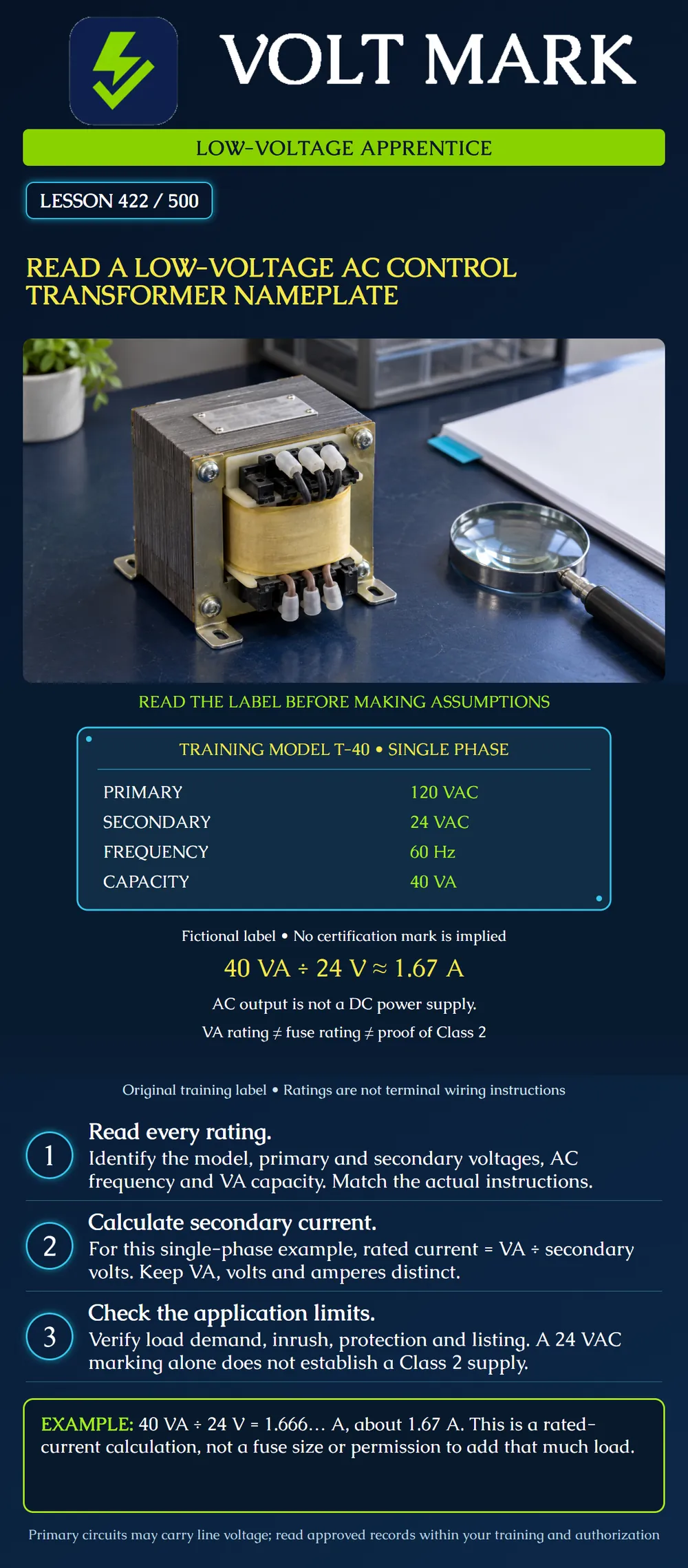
Read the essential ratings of an AC control transformer, identify the low-voltage secondary, and calculate its rated secondary current from single-phase VA and voltage. Explain why that calculation does not select protection or prove that a proposed load is suitable.
This lesson uses a fictional nameplate and paper calculations. It does not authorize access to energized equipment, primary-side connections, fuse replacement or transformer substitution. A low-voltage secondary can share an enclosure with line-voltage circuits. Use the actual product instructions, approved drawings and qualified supervision for field work. The poster is not a terminal diagram.
Start with the manufacturer and model on an actual unit. Locate the matching documentation and revision. Identify the primary rating, secondary rating, frequency and VA capacity. Also record the applicable listing or classification, protection information, environmental limits and mounting restrictions from the actual markings and instructions.
Do not identify a transformer by appearance alone. Two similar cases can have different ratings or protection arrangements. A photograph with an unreadable model or obscured rating is insufficient to justify a replacement. Record what is visible and obtain the missing information through the responsible person.
The primary is the input winding for the specified AC supply. The secondary provides the rated output for the connected application. On the original training label, primary is 120 VAC and secondary is 24 VAC. Those numbers describe different sides of the transformer. This lesson concentrates on recognizing the 24 VAC control supply; it gives no primary wiring instructions.
AC and DC are different supply types. A transformer labeled 24 VAC is not automatically a 24 VDC power supply. A load must be compatible with its actual supply and connection requirements. Similar numerical voltages do not establish interchangeability.
The training label says 60 Hz. Frequency is part of the rating, not a value to ignore because the secondary voltage looks right. If real markings and a document appear inconsistent, confirm the exact model and revision with the responsible technical source before deciding which rating applies.
VA means volt-amperes, the apparent-power rating. It is not a terminal voltage and is not an ampere rating by itself. For a single-phase secondary, the nameplate calculation is: Rated secondary current in amperes = VA rating / secondary voltage in volts.
Schneider Electric's transformer-current FAQ includes an example that converts kVA to VA before division. Keep units consistent: 1 kVA equals 1,000 VA. Do not divide a kVA number by volts and label the result amperes without converting.
The fictional T-40 nameplate is: Single phase. Primary: 120 VAC. Secondary: 24 VAC. Frequency: 60 Hz. Capacity: 40 VA.
40 VA / 24 V = 1.666666... A. Rounded to two decimal places, this is approximately 1.67 A.
This is a rating calculation at the specified secondary voltage. It is not a prediction that a connected load always draws that current, a short-circuit-current calculation, or a fuse recommendation. Retain the unrounded value during further calculations so rounding does not create extra capacity.
The T-40 is an invented training identifier, not a product order number. Its label does not show a certification mark or claim a Class 2 classification.
Functional Devices' TR40VA002US data sheet provides a real example of a 40 VA, 120-to-24 VAC transformer. It explicitly identifies Class 2 and inherently limited protection. Those are model-specific statements; they cannot be inferred for every device with a 24 VAC output.
The opened August 19, 2025 sheet shows 60 Hz in its drawing while the specifications table states 50/60 Hz. We do not use that difference to approve an actual installation or broaden a unit's marked rating. Resolve such a discrepancy using the exact equipment documentation and manufacturer clarification. The poster's 60 Hz is part of its fictional example.
Control loads can have startup demand different from their continuing demand. Schneider Electric's contactor guidance identifies both continuing load and maximum inrush as relevant to selecting a supply. Use the applicable product selection method; do not invent a single multiplier for every coil, actuator or transformer.
For an original paper exercise, suppose an instructor lists two continuous loads of 8 VA and 12 VA on the fictional 40 VA supply. Their total is: 8 VA + 12 VA = 20 VA. 40 VA − 20 VA = 20 VA of arithmetic difference.
That difference is not automatically available for any additional device. It says nothing about startup demand, simultaneous operation, allowable voltage variation, actual installation conditions or applicable design requirements. Describe it as unused nameplate VA in this simplified arithmetic exercise, not approved spare capacity.
Do not equate 40 VA with 40 W for every AC load. Apparent power and real power are different quantities; their relationship depends on the load's power factor. This lesson uses VA because that is the transformer and load-rating basis supplied in the exercise.
Record a Class 2 identification only when supported by the actual product marking, listing and applicable documentation. The numerical secondary voltage by itself does not prove it. The source, circuit arrangement and applicable requirements matter.
Similarly, rated secondary current is not enough to select a fuse. Protection depends on the actual transformer and installation requirements. Never replace a protective device with a larger rating to compensate for a load that does not operate correctly. Refer the selection or fault to the qualified responsible person.
Use an instructor-provided image or de-energized training sample. Write the model, primary voltage, secondary voltage, frequency and VA rating exactly as shown, including AC notation. Add the document reference. Mark unreadable or missing entries rather than filling them from memory.
Calculate current only for the stated single-phase rating. Explain why the result is not a wiring instruction, load approval or protective-device selection. Then identify one piece of information still needed for an actual proposed application.
Q1. Which training-label rating identifies the low-voltage output?
Functional Devices TR40VA002US data sheet, dated 2025.08.19: https://hosted.functionaldevices.com/downloads/datasheets/TR40VA002US.pdf Schneider Electric USA, transformer current formula, FA338225: https://www.se.com/us/en/faqs/FA338225/ Schneider Electric, contactor coil VA burden and supply selection, FA401816: https://www.se.com/in/en/faqs/FA401816/
The fictional label and arithmetic exercises are original. No universal protective-device size, terminal color convention, Class 2 voltage rule or license scope is invented. Model-specific frequency discrepancy is disclosed rather than resolved by assumption.
Mistake: Treating 40 VA as a 40 A secondary rating. Correction: Divide the single-phase VA by the stated secondary voltage and retain the units.
Mistake: Using the calculated 1.67 A to choose a fuse. Correction: Obtain the actual transformer and installation protection requirements; the current calculation alone does not select protection.
Mistake: Approving a 24 VAC replacement for a 24 VDC load because both say 24. Correction: Check supply type, frequency, load compatibility and documented startup requirements.
Read a fictional single-phase label stating 120 VAC primary, 24 VAC secondary, 60 Hz and 60 VA. Calculate rated secondary current. Two assigned continuing loads total 18 VA and 12 VA. Calculate their combined demand and the arithmetic VA difference. State what the numbers leave unresolved.
Answer guide: rated current is 60/24 = 2.5 A; continuing demand is 30 VA, equivalent to 1.25 A at the assumed 24 V. The arithmetic difference is 30 VA. Startup demand, supply compatibility, voltage regulation, environmental conditions and the required protection remain to be checked; no fuse size follows from these results.
Texas journeyman, 15 questions, scored by topic against the 70% mark. No card, and no account needed to start.
Free study material for low-voltage apprentices. This is a national foundation course: requirements differ by state and by local jurisdiction, and a practice that is common in one place is not a rule everywhere. Nothing here is a licence, a certification, or authority to work unsupervised, and completing it does not count as apprenticeship hours or continuing-education credit. Check the codes adopted where you are working, the licensing authority for that work, and your employer's safety programme. VoltMark is not affiliated with, endorsed by, or sponsored by NFPA, OSHA, NICET, BICSI, FOA, or any state or local licensing authority.

Electrician licensing exam prep: practice questions, timed exam simulations, and step-by-step help finding every answer in the NEC.