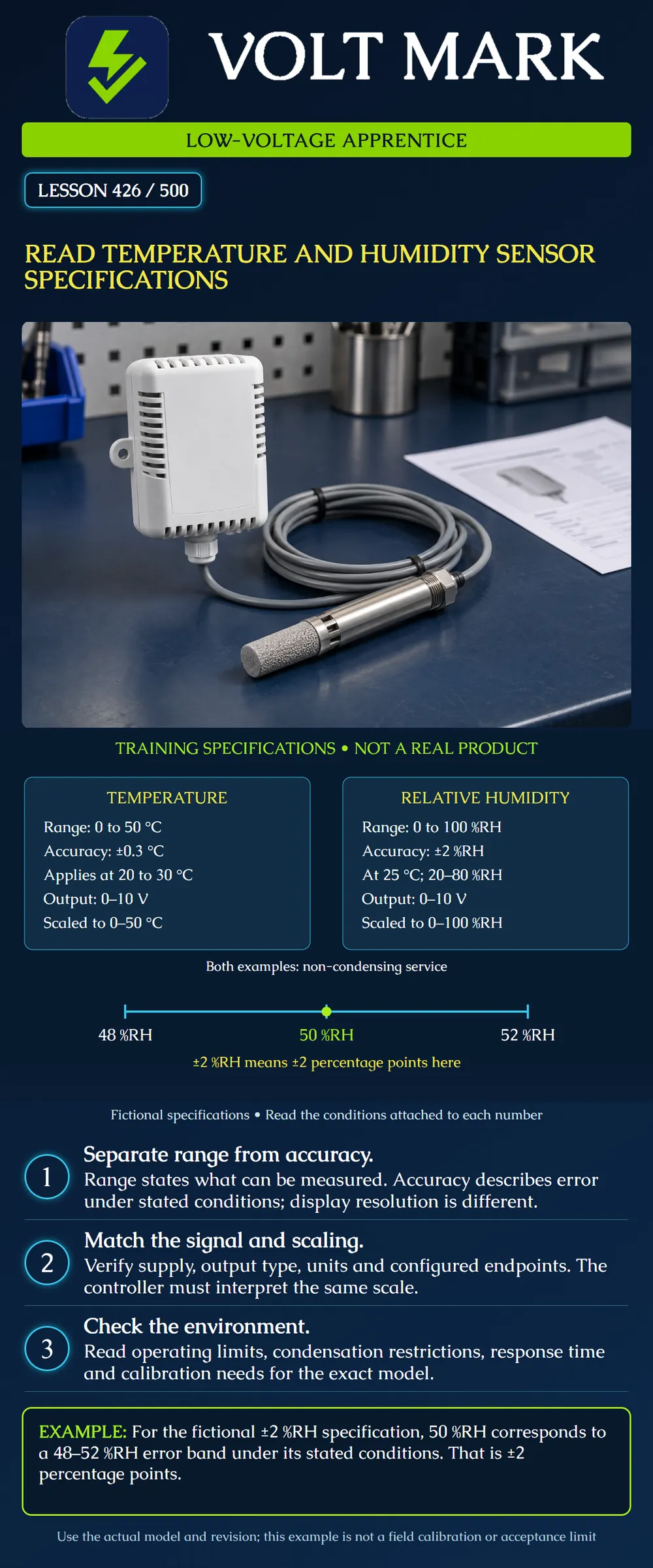
Read a temperature and relative-humidity sensor data sheet without confusing measurement range, accuracy, resolution, output scaling and operating limits. Calculate simple values from an explicitly fictional specification and identify information still needed for an actual installation.
This is a paper specification-reading exercise. It does not authorize wiring, changing controller scaling, calibrating a sensor or accepting a controlled environment. The actual model, revision, configuration and approved application requirements determine suitability.
A family name can include different outputs and supply requirements. Record the complete model identifier and document revision before comparing specifications. Identify which measured quantity each channel represents. Temperature, relative humidity and a calculated humidity parameter are not interchangeable simply because they appear on the same display.
Manufacturer context: Vaisala's HMW90 data sheet lists different current, voltage and digital models. Its humidity accuracy changes with temperature and RH region, while measurement range and operating environment appear in separate entries. That structure illustrates why one headline accuracy number is insufficient. These are product-specific distinctions; the poster's numerical specifications are invented for teaching.
Measurement range tells you the span of the measured quantity supported by the specification. Accuracy describes the stated measurement error under the specified conditions. An instrument can have a wide measurement range while its tightest accuracy applies only within a smaller region.
Resolution is the smallest displayed or reported increment. More digits do not establish a smaller measurement error. A display reading 25.00 °C does not, by itself, prove accuracy to 0.01 °C.
Read footnotes and conditions together with the accuracy claim. Temperature, humidity region, supply or other specified conditions may affect performance. If the available specification does not cover the application, mark that gap rather than extending the best rating by assumption.
The poster's training temperature channel has: Measurement range: 0 to 50 °C. Accuracy: ±0.3 °C, applicable at 20 to 30 °C. Output: linear 0–10 V scaled to 0–50 °C. Service: non-condensing.
At a training reading of 25.0 °C, the simple stated-error interval is 24.7 to 25.3 °C, assuming the fictional accuracy conditions hold. This does not include a controller's conversion error, wiring effects, calibration-reference uncertainty or installation bias.
At 45 °C, the temperature is inside the measurement range but outside the region for which the fictional sheet states ±0.3 °C accuracy. The correct conclusion is “accuracy at this condition is not supplied in the exercise.” Do not claim ±0.3 °C there.
The training RH channel has: Measurement range: 0 to 100 %RH. Accuracy: ±2 %RH at 25 °C and between 20 and 80 %RH. Output: linear 0–10 V scaled to 0–100 %RH. Service: non-condensing.
Here ±2 %RH means two percentage points of relative humidity, not two percent of the indicated number. At 50 %RH: 50 − 2 = 48 %RH. 50 + 2 = 52 %RH.
The illustration shows that simple error band. It is not a statistical confidence interval or a guarantee of total installed-system uncertainty. Do not calculate 2% of 50 and substitute ±1 percentage point; that would describe a different specification.
A reading at 95 %RH is within the fictional measurement span but outside its stated best-accuracy region. The exercise does not supply an accuracy value there. Likewise, a non-condensing specification does not authorize exposing the sensor to condensation merely because the range includes high RH.
For the fictional linear temperature output: Temperature = (signal voltage / 10 V) × 50 °C. A 5 V signal corresponds ideally to 25 °C.
For the fictional linear humidity output: RH = (signal voltage / 10 V) × 100 %RH. The same 5 V corresponds ideally to 50 %RH.
These two channels can use the same electrical output span while representing different engineering quantities. The controller needs the correct channel assignment, units and endpoints. A voltage signal alone does not tell you which physical value it represents.
Actual products may use 4–20 mA, a resistance characteristic or a digital protocol instead. Check the installed configuration rather than assuming a factory default or carrying one channel's scale into another. This lesson does not provide terminal wiring or reconfiguration instructions.
Compare the required location with the device's operating limits. Storage temperature describes storage conditions, not permission to operate at that temperature. Identify enclosure and condensation restrictions in the actual documentation.
Also look for response-time definitions and mounting instructions. A sensor does not necessarily report a changed environment immediately. For a trainer comparison, allow the conditions specified by its procedure before interpreting a difference. Avoid treating a transient mismatch or a poor mounting location as proof that the sensor itself is defective.
Vaisala's calibration guidance distinguishes comparison against a known reference from changing the measurement response. Preserve the recorded comparison before any authorized adjustment. Making two displays agree is not enough to establish a valid reference or traceable calibration.
For this lesson, simply identify the required calibration documentation and note whether it is available. No adjustment procedure is included.
For an instructor-supplied specification, make a short record of model, revision, measured quantity, range, accuracy with conditions, output type, configured scale, supply requirements and environmental limits. Mark missing information.
Then answer two questions: Does the stated accuracy cover the intended operating point? Does the receiving controller support the actual output and scale? A yes to one does not answer the other.
Q1. Does a broad measurement range guarantee the best accuracy across the entire range?
Vaisala HMW90 series data sheet, B211183EN-J: https://docs.vaisala.com/api/khub/documents/VLg8UWXM9xjYI~Z99zkPUg/content Vaisala HMW90 user guide, M211399EN-J, Calibration and adjustment: https://docs.vaisala.com/r/M211399EN-J/en-US/GUID-AB3E231F-5390-4790-9D0B-450A6404C460
Arithmetic, scenarios and questions are original teaching material. No universal calibration interval or acceptance limit is invented.
Mistake: Applying the best accuracy value across the entire measurement range. Correction: Carry the accuracy's temperature and humidity conditions with the claim; mark unsupported operating points unresolved.
Mistake: Interpreting ±2 %RH at 50 %RH as ±1 percentage point. Correction: Use the stated absolute RH band, 48–52 %RH, under the specified conditions.
Mistake: Applying the humidity conversion to the temperature channel because both output 0–10 V. Correction: Record each channel's quantity, units and endpoints before scaling the signal.
Texas journeyman, 15 questions, scored by topic against the 70% mark. No card, and no account needed to start.
Free study material for low-voltage apprentices. This is a national foundation course: requirements differ by state and by local jurisdiction, and a practice that is common in one place is not a rule everywhere. Nothing here is a licence, a certification, or authority to work unsupervised, and completing it does not count as apprenticeship hours or continuing-education credit. Check the codes adopted where you are working, the licensing authority for that work, and your employer's safety programme. VoltMark is not affiliated with, endorsed by, or sponsored by NFPA, OSHA, NICET, BICSI, FOA, or any state or local licensing authority.

Electrician licensing exam prep: practice questions, timed exam simulations, and step-by-step help finding every answer in the NEC.