Recognize when a low-voltage connection or configuration crosses into a life-safety function and identify the information and participants needed for coordinated review.
This is a recognition and document-review lesson. It provides no alarm activation, door-release wiring, elevator control, smoke-control override or power-disconnection procedure. The map illustrates possible coordination relationships, not electrical connections or a universal sequence. Not every building contains all illustrated functions.
Applicable requirements depend on the project, occupancy, adopted codes and editions, local amendments, equipment listings and authority having jurisdiction. This lesson does not establish one response sequence for every state or county.
A small relay contact, network variable or software mapping can connect functions owned by different trades. Its low voltage does not make its consequence minor. Record the originating system, receiving system, affected function and documents that define the intended behavior.
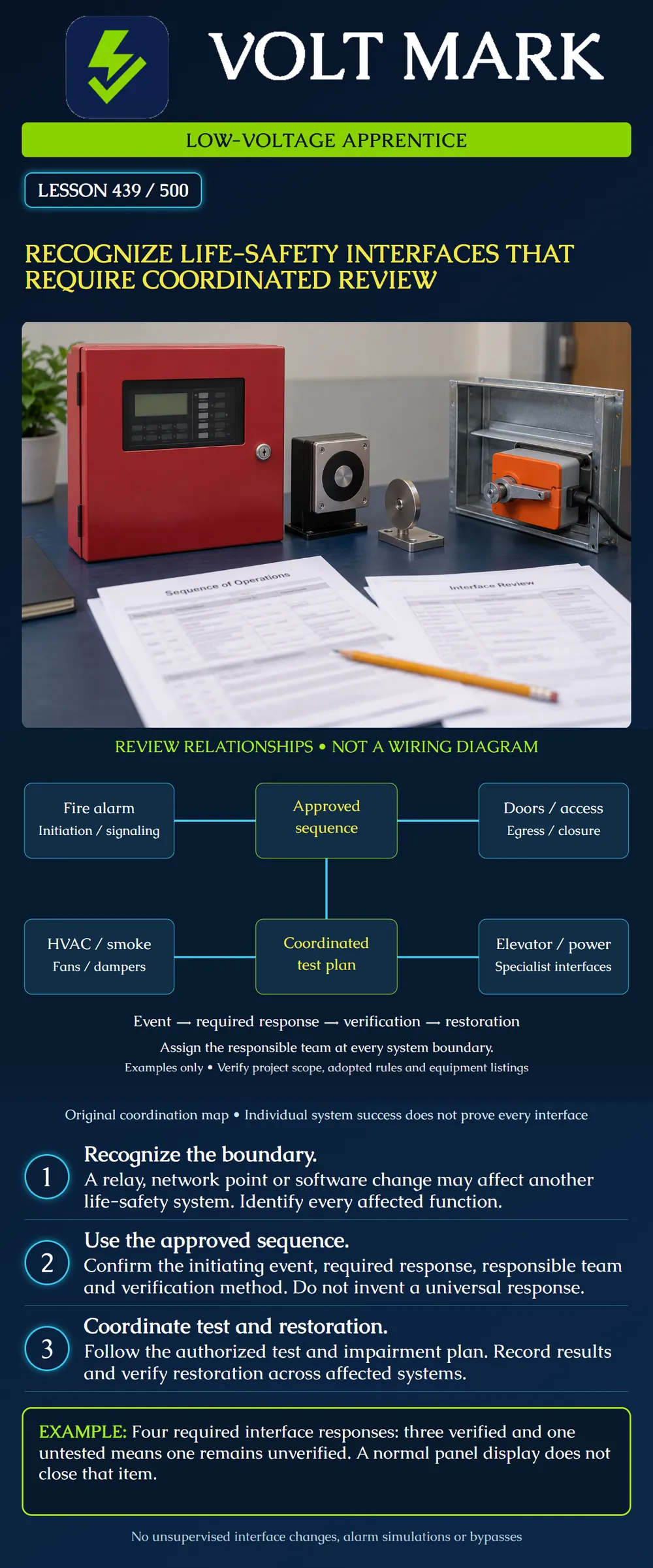
The poster groups examples: Fire alarm initiation and signaling. Doors and access-control interfaces affecting egress or closure. HVAC and smoke-control interfaces involving fans or dampers. Elevator and power interfaces requiring the relevant specialists.
The lines connect topics for review. They do not mean that all systems are directly wired together or that the building automation system is authorized to control every life-safety function.
The relevant question is what the approved sequence requires for this initiating event under this operating condition.
Do not assume that every alarm stops every fan. Do not assume that every door must unlock, or that a door releasing from a hold-open device is the same function as an access-controlled lock releasing. Closure, latching, egress and security requirements must be understood for the actual assembly.
Elevator recall and power removal are distinct functions requiring project-specific coordination. A low-voltage apprentice should recognize the interface and refer it to the responsible qualified team rather than inferring the required action from a terminal label.
These examples identify questions for review. They are not instructions to modify any system.
For an original classroom review sheet, use: Interface ID and affected equipment. Initiating event and originating system. Required receiving-system response. Applicable operating modes and prerequisites. Source drawing, narrative or matrix revision. Responsible parties on both sides. Verification method and acceptance criteria. Required notifications and impairment arrangements. Restoration method and evidence. Unresolved questions and reviewer.
Leave missing criteria explicitly unresolved. An assumed response is not an approved response. A controller point name alone does not establish the required sequence or the suitability of a device for the application.
Identify who understands each connected system and who has authority to perform the relevant actions. Depending on the actual interface, participants can include the owner or facilities representative, fire-alarm contractor, mechanical or smoke-control specialist, door/access specialist, elevator contractor, electrical contractor, designer and designated testing personnel.
Record roles rather than merely a list of company names. A person who can observe a point may not be authorized to operate another trade's equipment. The approved plan determines attendance, sequence and responsibility.
The UCSF January2026 bulletin is a concrete local example. It discusses interconnected systems, an integrated testing team, a test plan, input/output verification, deficiency documentation and completion records. Its California code references and campus approval process apply in that context. They are not treated here as nationwide rules or universal test intervals.
An individual fire-alarm panel check and a separate equipment check do not alone document the response across their connection. The interface needs evidence appropriate to the approved plan.
Original classroom scenario: The project review sheet identifies four required interface responses. ResponseA has witnessed evidence. ResponseB has witnessed evidence. ResponseC has witnessed evidence. ResponseD has no test evidence.
The count is three verified and one unverified. It is not a complete result for all four. Do not relabel responseD as passed because the panel looks normal or because the connected equipment passed a separate standalone test.
If a test was not performed, record untested rather than failed. If an observed response contradicts the criterion, record the discrepancy. Those statuses communicate different facts and require different follow-up.
A replacement relay, controller migration, point rename, network change or software revision can affect a cross-system function even if the physical cable remains in place. Review the scope of the change and its dependent functions before declaring it routine.
Original example: A contractor replaces a controller hosting a monitored status point. The new controller displays a similar label, but the interface record does not yet confirm polarity, meaning, supervision or restoration behavior. The appropriate next step is coordinated review against the approved documents, not assuming equivalence from the label.
No universal wiring or supervision arrangement is prescribed here. The exact system requirements determine what must be checked.
A coordinated test needs a defined way to restore every affected system. Record temporary test states and any authorized impairments according to the approved procedure. A local reset may not establish that all remote equipment, outputs and monitoring paths are restored.
For the classroom review, require a distinct restoration field for each interface rather than one unchecked note saying reset done. Identify who verified the result and what evidence supports it.
Do not initiate a test merely because a component is accessible. Necessary notifications, responsible personnel, system readiness and impairment controls must be established through the authorized plan.
UCSF Fire Prevention Design Bulletin0003, revisedJanuary2026: https://ehs.ucsf.edu/fire-prevention-design-bulletin-0003-integrated-fire-protection-and-life-safety-system-testing Used as a scoped local example of integrated review and testing documentation, not as nationwide law. NFPA4 official standard-development landing page: https://www.nfpa.org/codes-and-standards/nfpa-4-standard-development/4 Opened but returned no readable text. The complete standard was not reviewed through that page; no clause-level claim is based on it.
The map, interface-record structure, scenarios and questions are original instructional material. No project-specific sequence or test plan is supplied.
Mistake: Passing an interface because each connected system passed a standalone check. Correction: Link the initiating event to the required cross-system response and its evidence.
Mistake: Treating hold-open release as proof that access-control locking also behaved correctly. Correction: Identify closure, latching and lock-release functions separately for the actual opening.
Mistake: Skipping review after a controller change because the cable did not move. Correction: Reconcile point meaning, polarity, supervision and restoration with the approved interface record.
Texas journeyman, 15 questions, scored by topic against the 70% mark. No card, and no account needed to start.
Free study material for low-voltage apprentices. This is a national foundation course: requirements differ by state and by local jurisdiction, and a practice that is common in one place is not a rule everywhere. Nothing here is a licence, a certification, or authority to work unsupervised, and completing it does not count as apprenticeship hours or continuing-education credit. Check the codes adopted where you are working, the licensing authority for that work, and your employer's safety programme. VoltMark is not affiliated with, endorsed by, or sponsored by NFPA, OSHA, NICET, BICSI, FOA, or any state or local licensing authority.

Electrician licensing exam prep: practice questions, timed exam simulations, and step-by-step help finding every answer in the NEC.