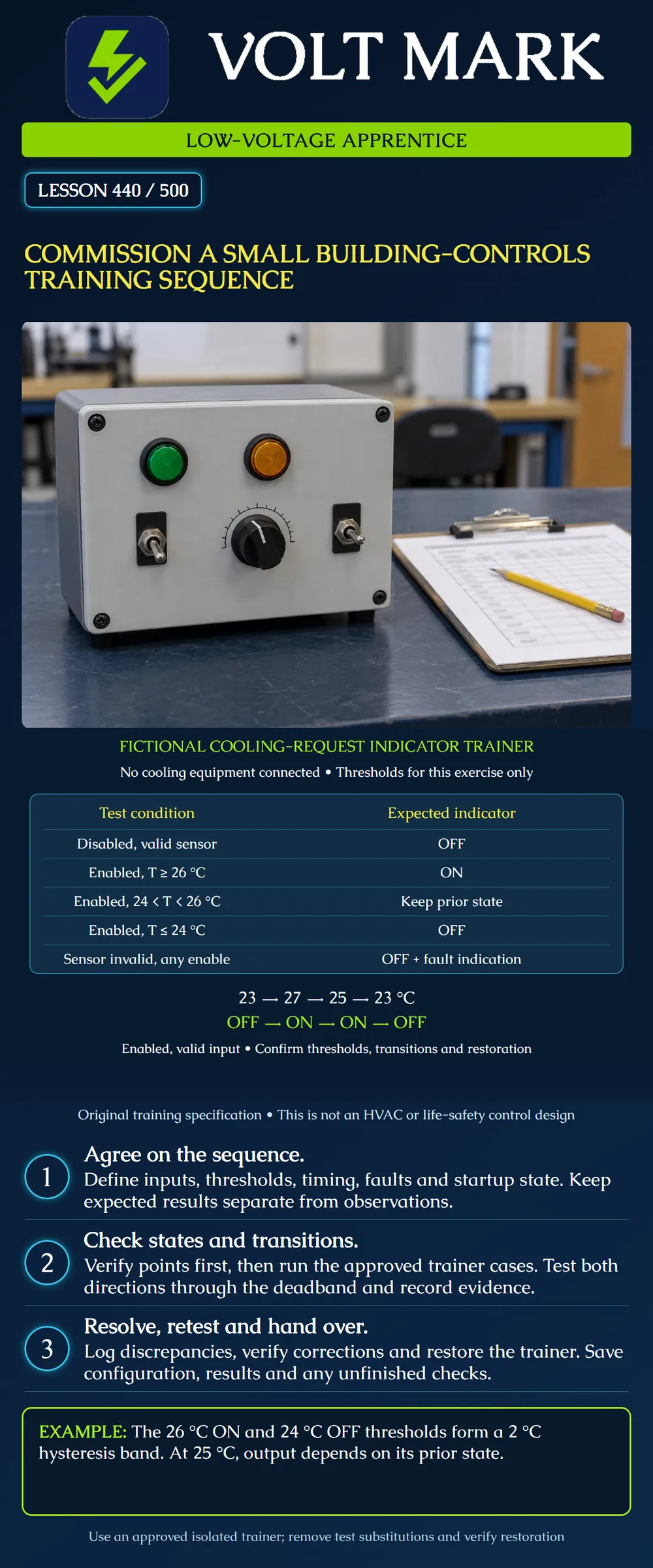
Commission a small classroom control sequence by checking its specification, inputs, states, transitions, fault behavior and restoration. Produce evidence rather than merely observing that an indicator can turn on.
This original exercise controls a cooling-request indicator only. It has no compressor, heater, fan, damper, motor, access hardware or life-safety output connected. The thresholds and response rules are fictional classroom requirements. They are not suitable as a complete HVAC equipment-control sequence.
The lesson provides expected results for an instructor-approved isolated trainer or offline simulator. No hardware was operated to create this material. A hands-on session must use its own approved equipment instructions and instructor supervision.
Inputs: Enable: Boolean. TemperatureT: numeric degrees Celsius. SensorValid: Boolean quality flag, separate from the temperature value.
Outputs: CoolingRequest: Boolean indicator. Fault: Boolean indicator.
State: Prior CoolingRequest, initializedOFF at startup.
The exercise evaluates its logic on each1-second scan after accepting the inputs. For this fictional simulator, verify the expected output by the end of the second scan after a stable input change. This allows observation without claiming an actual instrument's response time.
Priority rules: If SensorValid is false, set CoolingRequestOFF and FaultON regardless of Enable. If SensorValid is true, set FaultOFF. With a valid sensor but Enablefalse, set CoolingRequestOFF. With a valid sensor and Enabletrue, set CoolingRequestON whenTis26°C or higher. With a valid sensor and Enabletrue, set CoolingRequestOFF whenTis24°C or lower. With a valid sensor, Enabletrue and24<T<26°C, retain the current CoolingRequest state.
AnOFF caused by disable or invalid input becomes the retained state. There is no separate hidden rememberedON state. After startup or fault clearing at25°C, the indicator remainsOFF until the upper threshold is reached. After fault clearing at27°C while enabled, the rules turn the indicatorON. This behavior is explicitly part of the classroom specification, not a general equipment restart policy.
Confirm that Enable, Temperature and SensorValid reach the intended logic variables. Confirm temperature units and that the two output indicators correspond to CoolingRequest and Fault. A wrong point mapping can make a correct-looking state table misleading.
Record trainer ID, program revision, point list, display scaling, instructor and test method. For an offline simulation, save input/output traces. For hardware, record actual observations and timing using the approved method. Do not invent pass results where only the expected table exists.
With Enabletrue and SensorValidtrue, use this original expected sequence: T23°C: CoolingRequestOFF. T27°C: CoolingRequestON. T25°C: CoolingRequest remainsON. T23°C: CoolingRequestOFF. T25°C: CoolingRequest remainsOFF.
This demonstrates why a single25°C observation is insufficient. The same input can legitimately produce either state depending on the prior state.
Check the exact boundaries as separate cases: At26°C while enabled and valid, ON. At24°C while enabled and valid, OFF.
The threshold separation is26−24=2°C. It is a hysteresis band in this specified two-state logic, not a sensor accuracy tolerance or a universally recommended building setpoint.
Original caseE: Start enabled, valid,27°C with CoolingRequestON. Set Enablefalse using the approved trainer controls. Expected CoolingRequestOFF and FaultOFF.
Original caseF: Start enabled, valid,27°C with CoolingRequestON. Set the dedicated trainer SensorValid flagfalse. Expected CoolingRequestOFF and FaultON. Do not create this exercise by shorting a sensor or disconnecting unknown terminals.
Original caseG: While still invalid, change Enablefalse. Expected CoolingRequestOFF and FaultON because invalid quality has priority.
Original caseH: Restore SensorValidtrue while disabled. Expected both indicatorsOFF.
Original caseI: Enable at25°C after the output wasOFF. Expected CoolingRequest remainsOFF. Raise to26°C: expectedON.
These cases test transitions and priority, not just the steady table.
Use a case record with: CaseID and starting state. Input change and timestamp. Expected indicators and allowed observation time. Actual indicators and timestamps. Pass, discrepancy or nottested. Evidence reference. Follow-up and retest result.
The expected table is not a completed commissioning record. It becomes evidence only when observations are recorded and compared under the stated conditions.
Original discrepancy example: At25°C after27°C, the indicator turnsOFF instead of remainingON. Record the failed transition. A program that simply turnsON at26°C andOFF below26°C would predict that behavior, but inspect the actual logic before claiming this as the cause. Preserve the original trace and verified correction.
After an authorized correction, repeat the failed case and the relevant neighboring states and transitions. A changed threshold branch may affect both rising and falling behavior. Confirm the disable and invalid-input priorities still match the specification.
Do not replace the original failure record with only a green final result. Link the issue, change, retest and reviewer so another instructor can follow what occurred. If a case was skipped, retain its untested status.
For this exercise's final state, remove temporary input substitutions through the approved trainer procedure, restore its normal input source, set Enablefalse and confirm CoolingRequestOFF. Confirm the Fault indicator reflects the restored input quality, rather than hiding an unresolved quality problem.
Save the final program/configuration revision, point list, completed case records, issues and retests, and restoration evidence. If a physical trainer requires isolation for removal of test leads, follow that procedure; a softwareOFF state is not energy isolation.
DOE's Federal Energy Management Program describes commissioning as planning, investigation, implementation with retesting and final documentation. EPA's2009guidelines likewise tie functional verification to documented criteria and coordinated responsibilities. These sources inform the process approach; neither specifies this classroom logic or certifies its results.
DOE FEMP, Commissioning Process for Federal Facilities: https://www.energy.gov/cmei/femp/commissioning-process-federal-facilities EPA Building Commissioning Guidelines, January2009: https://www.epa.gov/sites/default/files/2015-09/documents/ae-guidelines_appendixb.pdf Used for process concepts, not current nationwide code requirements.
The sequence, timing, thresholds, cases and expected results are original educational material.
Mistake: Expecting one universal output at 25 °C without recording prior state. Correction: Trace the specified hysteresis: retain ON after 27 °C and OFF after 23 °C while enabled and valid.
Mistake: Clearing Fault when Enable is false even though the sensor remains invalid. Correction: Apply the stated quality priority: invalid input keeps Fault ON and CoolingRequest OFF.
Mistake: Treating a correct expected table as completed commissioning evidence. Correction: Record actual observations, timing and restoration separately, leaving unperformed cases untested.
Texas journeyman, 15 questions, scored by topic against the 70% mark. No card, and no account needed to start.
Free study material for low-voltage apprentices. This is a national foundation course: requirements differ by state and by local jurisdiction, and a practice that is common in one place is not a rule everywhere. Nothing here is a licence, a certification, or authority to work unsupervised, and completing it does not count as apprenticeship hours or continuing-education credit. Check the codes adopted where you are working, the licensing authority for that work, and your employer's safety programme. VoltMark is not affiliated with, endorsed by, or sponsored by NFPA, OSHA, NICET, BICSI, FOA, or any state or local licensing authority.

Electrician licensing exam prep: practice questions, timed exam simulations, and step-by-step help finding every answer in the NEC.