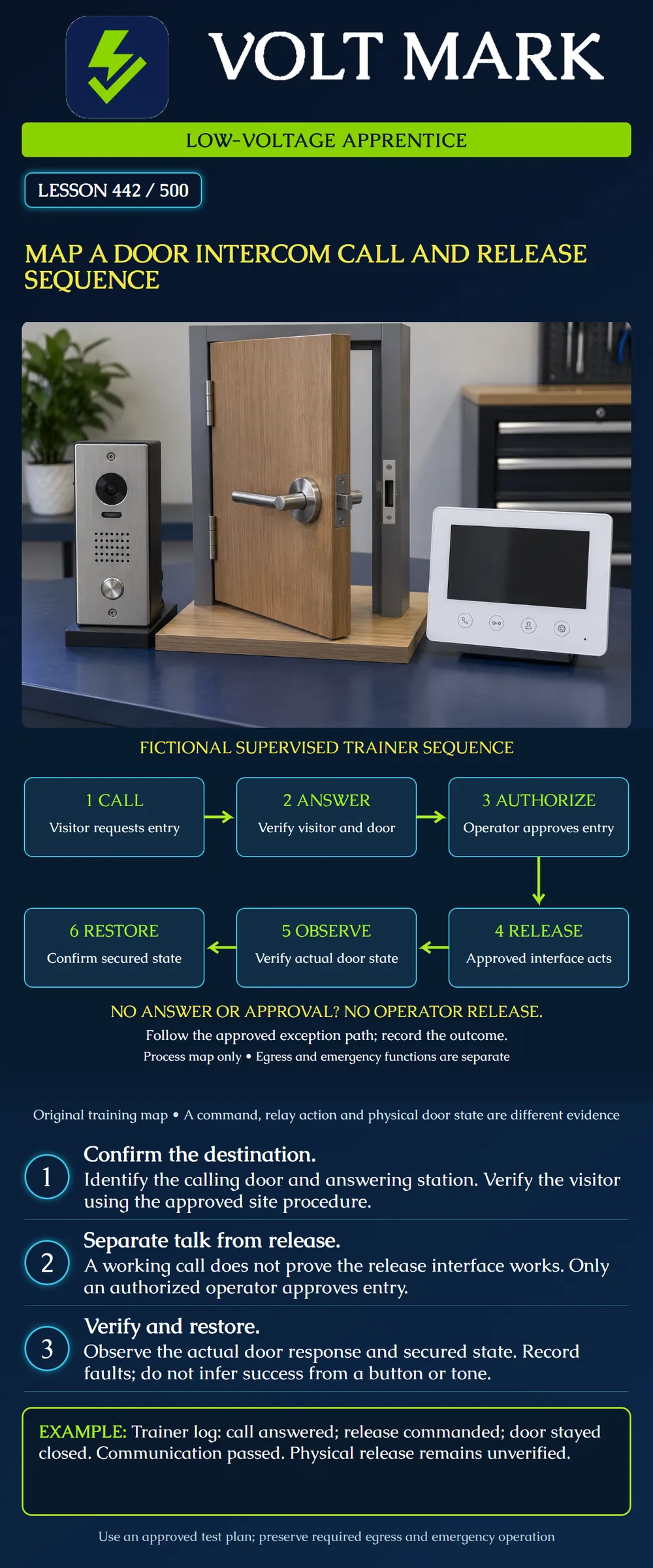
Map an intercom entry request from the calling station through the authorized entry decision, release interface, physical observation and restoration. Distinguish communication success from release-command delivery and actual door response.
This is an original paper or supervised simulator exercise, not a wiring diagram or a procedure for changing an occupied building's locks. The six-step diagram represents one fictional manually authorized entry process. Other systems support different call routes, automatic answers, transfers and approved operating modes. Obtain the actual sequence of operations and correct product instructions. Required egress and emergency functions are separate from this visitor-entry example and must not be made dependent on an operator answering an intercom.
Name the entrance, calling station, receiving station or group, authorized operator, release interface, controlled opening and observation method. Distinguish a friendly display name from an equipment identifier. Two entrances called “front door” produce an ambiguous test record. For the exercise use entrance D01, door station DS01 and reception station RS01.
Draw the call route first. Then draw the entry decision and release route. A network or two-wire audio path need not be the same circuit that operates a release interface. A connected access controller, relay module, lock power supply or other approved interface may participate. Identify those dependencies from the specific approved design, without inventing terminal assignments or assuming that a relay supplies lock power.
Step 1: A simulated visitor requests entry at DS01. Record which station or group is expected to receive that request. Step 2: The operator answers at RS01 and verifies both the caller and the intended entrance using the exercise's approved identity procedure. Confirm intelligible communication in both directions. If video is part of the exercise, verify the intended entrance image rather than assuming any displayed image is correct. Step 3: The authorized operator decides whether to admit the visitor. Answering a call alone is not an entry approval in this fictional sequence. Step 4: After approval, the operator issues the permitted release command to the specified interface. Step 5: Observe the resulting physical state using the test plan's accepted method. A command indication or tone is evidence of a command or configured indication, not conclusive evidence that the opening physically released. Step 6: Confirm the intended restored state and close the test record. “Call ended,” “release output ended,” “door closed” and “door secured” describe different events. A door-position contact typically reports position; it does not by itself establish latch or lock engagement.
The poster's no-answer/no-approval rule applies to the operator-controlled entry branch of this fictional exercise. It does not describe every system mode or override required egress and emergency arrangements. On the paper exercise, an unanswered call or refused request produces no operator release. Record the unanswered or denied outcome and follow the designated escalation route.
For a wrong destination, mismatched camera image, missing audio, stuck indication or uncertain restoration, record the observed symptom and notify the responsible instructor or authorized site contact. Do not improvise a bypass to obtain a passing result. Site personnel must manage any real unsecured opening under their approved response procedure.
Use columns for expected event, observed event, evidence source, time and result. Record a release command independently of physical movement and subsequent security. An on-screen release symbol might represent a command. A relay indication might represent an output state. A camera can show position within its view. A door contact can report its monitored state. None should be silently relabeled as a different observation. Identify what a signal actually means in the product and project documentation.
A successful conversation establishes only the tested communication behavior. It does not establish the release output rating, lock supply performance, mechanical alignment, fire interface or code compliance. Those need their own approved checks and responsible reviewers.
At 10:00:00 the fictional visitor presses CALL. At 10:00:08 reception answers. At 10:00:15 the operator approves entry and issues the release request. At 10:00:17 the observer records that the door has not released. No physical entry test passes merely because the screen showed a release icon. Time to answer was eight seconds. Time from call to command was fifteen seconds. These are observations, not universal acceptance limits or recommended settings. The exercise provides no required unlock duration. The record should say “call answered; command issued; physical release not confirmed,” then assign investigation. It should not claim a failed relay, failed lock or network fault without evidence isolating that cause.
Aiphone, IX-MV7 Operation Manual landing page: https://know.aiphone.com/station-operation-manuals/ix-mv7-operation-manual Landing page opened, including supported variants and manual link. Full linked PDF exceeded browser fetch size; no claim of complete manual review.
Aiphone, IX Series IX-SOFT Operation Manual: https://www.aiphone.com/wp-content/uploads/IX-Series-IX-SOFT-Operation-Manual.pdf Official indexed excerpt consulted for group calling and communication after answer. Product-dependent video behavior illustrates why the actual route and functions need verification.
Aiphone, IX Support Tool Manual Ver. 9.0: https://www.aiphone.com/wp-content/uploads/IX-Support-Tool-Manual-Ver.-9.0.pdf Official indexed excerpt consulted for destination-specific door-release authorization. No authentication values, default timing or configuration steps are prescribed here. Source retrieval checked 2026-10-01.
The diagram, six-step sequence, times, exercises and acceptance distinctions are original instructional synthesis. They are not quoted manufacturer procedures.
Mistake: Recording the release icon as proof that the opening released. Correction: Keep command evidence separate from the approved physical observation; mark release unconfirmed if no qualifying observation exists.
Mistake: Treating a closed door-position contact as proof of lock engagement. Correction: Identify the function actually monitored and obtain the approved secured-state check rather than relabeling position as security.
Mistake: Applying the unanswered-visitor rule to emergency egress. Correction: Limit that rule to the fictional operator-entry branch and obtain the separately approved egress and emergency sequence.
Texas journeyman, 15 questions, scored by topic against the 70% mark. No card, and no account needed to start.
Free study material for low-voltage apprentices. This is a national foundation course: requirements differ by state and by local jurisdiction, and a practice that is common in one place is not a rule everywhere. Nothing here is a licence, a certification, or authority to work unsupervised, and completing it does not count as apprenticeship hours or continuing-education credit. Check the codes adopted where you are working, the licensing authority for that work, and your employer's safety programme. VoltMark is not affiliated with, endorsed by, or sponsored by NFPA, OSHA, NICET, BICSI, FOA, or any state or local licensing authority.

Electrician licensing exam prep: practice questions, timed exam simulations, and step-by-step help finding every answer in the NEC.