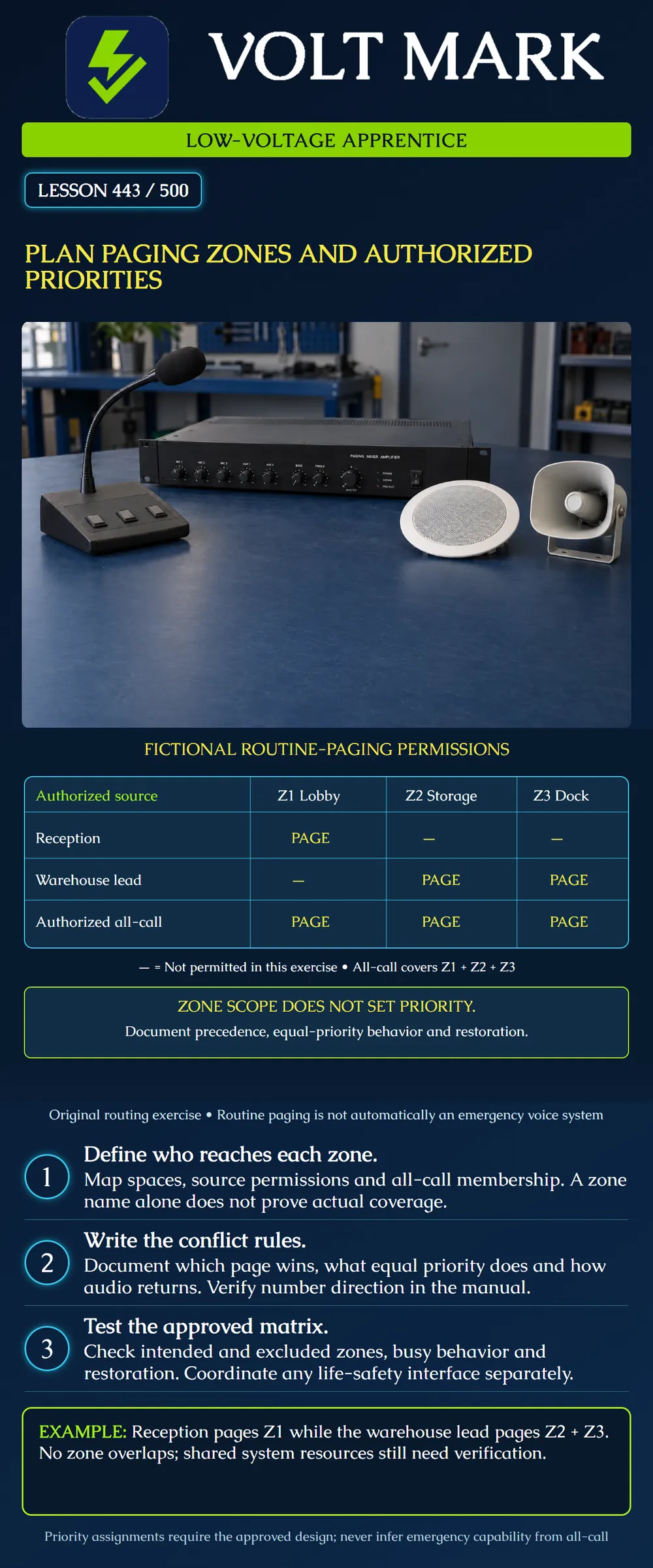
Build a zone-and-permission matrix and an explicit conflict policy for routine paging. Separate destination coverage, source authorization and event priority.
This lesson uses an original three-zone paper exercise. It is not a configuration for a live site and is not an emergency voice-system design. Systems used for evacuation, mass notification or other life-safety functions need the applicable approved design and coordinated review. A routine paging system does not acquire those capabilities simply by adding an all-call button.
A paging zone is an intended destination grouping in the design. It may contain several outputs and loudspeakers, and its logical name must be mapped to actual spaces and equipment. Record the identifier, area description, output path and relevant drawing revision. Do not assume an amplifier channel, a floor, a fire-alarm zone and a paging zone are automatically the same boundary.
For the exercise, Z1 is the lobby, Z2 is storage and Z3 is the loading dock. These are fictional design choices. Reception may page only Z1. The warehouse lead may page Z2 and Z3. A separately authorized all-call source may address all three. A dash in the poster matrix means that route is not permitted in this exercise, not that the room has no speaker.
All-call has a defined membership. It can mean all zones in a group or all zones configured for that function, rather than every physical space in a property. Write the membership explicitly and review it when zones are added.
Permission answers who may initiate which page to which destinations. Priority answers which competing event takes precedence under the defined rules. A broad destination list does not inherently confer greater priority. A source labeled “manager” or “all-call” does not by itself prove authority to override another function.
For each planned page, document its source, permitted user role, destinations, live or recorded mode, priority meaning and any schedule restrictions. Record who approves changes. Read the actual product/version documentation before translating words such as higher or lower into numeric values.
Manufacturer examples demonstrate the hazard of guessing: Biamp's Vocia Page Codes documentation uses a higher number for greater precedence, while its Qt X Page Codes documentation specifies lower numbers for higher priority. These are product-specific conventions, not contradictory national rules. Do not copy a number from one product family into another as if it carried the same meaning.
A complete policy addresses a higher-priority request, a lower-priority request and two requests of equal priority. It also states whether the system rejects, queues, records for later delivery, interrupts or otherwise handles an event, and what happens when the current event ends. Not every product supports every behavior.
For an original paper-only conflict exercise, define rule R: a currently active routine page keeps the shared zone against an equal-priority new request; the new request receives busy and is not queued. This is a chosen trainer rule, not a claim about Vocia, Qt X or a site. A separate higher-priority trainer page interrupts the lower one; require a fresh request after interruption. Again, that restoration behavior is fictional and must not be imposed on actual equipment.
Biamp Vocia's documented behavior distinguishes live, recorded and other sources and whether store-and-forward is enabled. That demonstrates why “the message comes back” is too vague. State whether playback restarts, resumes, waits or is discarded for the selected configuration. Background audio restoration also needs its own expected result.
Use the approved test schedule and personnel. Define a recognizable test phrase that cannot be mistaken for an emergency instruction. Identify an observer or authorized measurement method for each destination and excluded area. The expected matrix must be written before testing.
Record selected page, initiating source, destination membership, expected included and excluded zones, observed output, competing event, result and restoration. Check each permitted route and an approved method of verifying restrictions. A UI selection is not proof of actual routing.
Audio heard near a zone boundary might be spill from another space rather than a wrong electrical route; distinguish the observation from the cause. Conversely, a silent speaker does not by itself prove correct exclusion. A failed path could conceal a configuration error. Investigate through the approved procedure rather than increasing volume or changing priorities until something happens.
Do not initiate emergency messages, suppress protective audio or alter occupied-site life-safety interfaces as an informal exercise. Such checks belong to their separately coordinated test plan.
Biamp Vocia, Page Codes: https://vocia-help.biamp.com/Help_File/Device_Configuration/World_Properties/World_Properties_Items/Page_Codes.htm Official indexed text consulted for page-code properties and numeric precedence.
Biamp Qt X, Page Codes: https://qtx-help.biamp.com/Page_Codes_Config.htm Opened directly. Supports zone assignment, station availability and lower-number priority convention.
Biamp Vocia, Role of Priority Levels: https://vocia-help.biamp.com/Help_File/System_Components/Role_of_Priority_Levels.htm Opened directly. Supports product-specific conflict, store-and-forward and restoration distinctions. Defaults and emergency thresholds are not prescribed here. Sources checked 2026-10-01. Matrix, rule R, exercises and set examples are original teaching material.
On the paper matrix, reception requests Z1 while the warehouse lead is already paging Z2 and Z3. The destination sets share no zone, so a zone-priority conflict is not demonstrated; shared processing capacity still needs verification. Next, a second equal-priority source requests Z2. Under fictional rule R, the current warehouse page retains Z2 and the new request gets busy without replay. The record names the overlapping zone, rule R and the rejected request; it does not assume that every paging product behaves this way.
Mistake: Giving all-call automatic precedence because it reaches more zones. Correction: Record its permitted destinations and approved priority independently, then check how the selected product expresses precedence.
Mistake: Copying priority number 1 between product families. Correction: Read the exact product/version convention before translating the approved conflict policy into settings.
Mistake: Checking only where a test page is heard. Correction: Include approved observations of excluded zones and restoration; record an unobserved excluded area as unverified.
Texas journeyman, 15 questions, scored by topic against the 70% mark. No card, and no account needed to start.
Free study material for low-voltage apprentices. This is a national foundation course: requirements differ by state and by local jurisdiction, and a practice that is common in one place is not a rule everywhere. Nothing here is a licence, a certification, or authority to work unsupervised, and completing it does not count as apprenticeship hours or continuing-education credit. Check the codes adopted where you are working, the licensing authority for that work, and your employer's safety programme. VoltMark is not affiliated with, endorsed by, or sponsored by NFPA, OSHA, NICET, BICSI, FOA, or any state or local licensing authority.

Electrician licensing exam prep: practice questions, timed exam simulations, and step-by-step help finding every answer in the NEC.