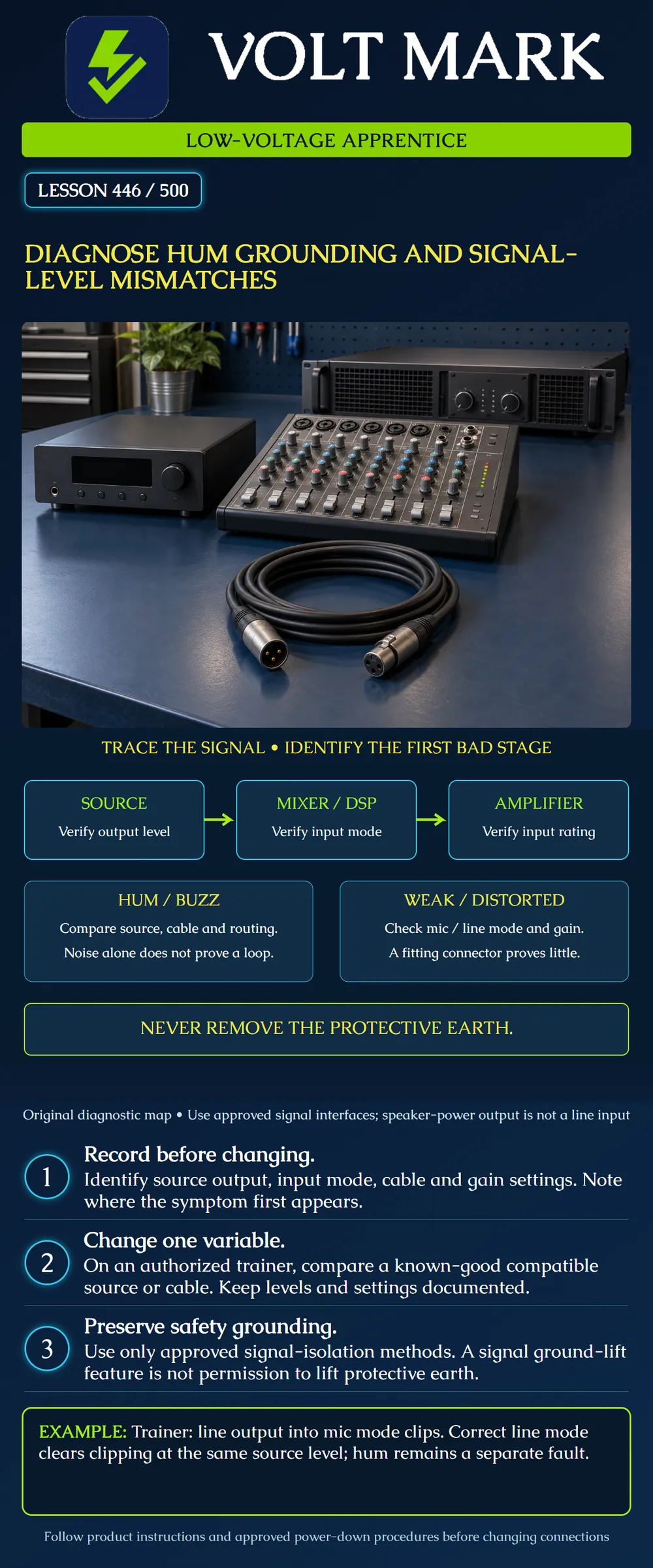
Use a documented signal path to distinguish an audio level mismatch from hum or buzz, and explain why removing protective earth is not a troubleshooting method.
This lesson uses paper records and an instructor-approved audio trainer. It does not authorize mains work, exposed live testing, arbitrary shield modifications or interruption of operational paging. Preserve protective grounding and follow equipment instructions when changing connections. Speaker-power outputs, including distributed-audio outputs, are not ordinary line-level inputs.
Shure explains that microphone outputs generally need preamplification, while line-level sources suit line inputs. A line source applied to a mic input can overload it; a mic source applied to a line input can be too weak. Connector fit does not establish level compatibility. Some equipment provides selectable modes. Read the actual source and input specifications rather than treating approximate signal levels as fixed limits.
Rane's Sound System Interconnection emphasizes leaving factory safety grounding intact. Balanced interconnections and properly selected signal-isolation interfaces can help address noise, but ground-related audio paths and protective earth have different purposes. Hum is not permission to defeat the safety conductor. Follow the specific equipment/interface wiring instructions; this lesson supplies no universal shield-disconnection rule.
For the fictional exercise, identify player S01, mixer input M01 and amplifier A01. Record S01 output type, the cable identifier, M01 input mode and the downstream routing. The poster shows this three-stage signal path. The amplifier's speaker output and its load are outside the diagram.
Add the exact models and manual revisions on an actual training worksheet. Record whether any phantom power or other supplied interface power is present and whether the connected source permits it. Do not enable a feature by assumption or connect a speaker output to a small-signal input because an adapter happens to fit.
“Bad audio” is too broad. State whether the result is low level, clipping, steady hum, intermittent buzz, loss of one channel or another reproducible symptom. Note whether the symptom is present with the test program paused, during speech or music, or only under a particular documented state.
The description should distinguish what was heard from the proposed cause. “Hum present when S01 is connected” is an observation. “Ground loop confirmed” requires more evidence. A source fault, cable defect, unwanted pickup, routing mistake or another problem may produce overlapping symptoms. Do not replace diagnosis with a label.
Use an instructor-approved test source, conservative listening level and defined observation points. Save the original settings. Power down or otherwise follow the specified connection-change procedure. Use only known-compatible substitution items.
Change one identified variable, then repeat the same stimulus and observation. A cable comparison is useful only if the substitute has the correct wiring and interface type. A source comparison is useful only when its level and operating mode are documented. If several settings and cables change together, a better result does not isolate the responsible change.
After a test, restore or retain the approved final arrangement and document it. Do not leave an improvised adapter or unexplained control setting behind.
The instructor supplies this fictional record: Run A: S01 line output, M01 mistakenly set to mic mode; input clipping and audible hum. Run B: same source and level, approved change of M01 to line mode; clipping clears, hum remains. Conclusion: the controlled mode change supports an input-level mismatch as the clipping cause in this trainer. It does not explain the hum.
Run C: after the required power-down sequence, a compatible known-good signal cable replaces the original; source, route and input mode remain as in Run B. Hum disappears. Conclusion: the change implicates the original cable or the connection conditions altered by replacement. It does not yet prove which conductor or termination failed. Run D: instructor inspection and a separate approved cable check find a documented defect. Record that independent result before naming the defect as confirmed.
These outcomes are hypothetical teaching data, not field measurements. Do not repeatedly recreate a hazardous condition just to reproduce the example.
If a trainer worksheet proposes a two-prong mains adapter, broken earth pin or removed chassis safety connection, reject that proposed test. A noise improvement obtained by defeating protective grounding is not an acceptable repair.
An approved signal transformer or other isolation interface must suit the audio application, levels and required performance. Its role is not to bypass a building protective conductor. A manufacturer's signal ground-lift control must be understood from that product's instructions; its name alone does not establish which connection it changes.
Suspected grounding defects in the supply or equipment require the appropriate qualified personnel. An audio apprentice should document the symptom and preserve the safe boundary rather than improvise electrical alterations.
Use these fields: Equipment and connection IDs. Original source level, input mode and relevant settings. Expected signal behavior and observation point. One authorized change. Observed difference under the same stimulus. Conclusion supported by the evidence. Unresolved alternatives and next approved check. Restored/final state and responsible reviewer.
Do not write “all audio passed” after checking one input. Verification scope must match the claimed result: other sources, routes and required paging functions need their own approved acceptance checks.
Shure, What's the Difference Between Line and Mic Levels? https://www.shure.com/en-US/insights/whats-the-difference-between-line-and-mic-levels Opened directly. Used for level compatibility and connector-fit limitations. Approximate levels are not turned into universal thresholds.
Rane, Sound System Interconnection, Note 110: https://www.ranecommercial.com/legacy/note110.html Opened directly. Used for preserving safety grounding and audio-interface principles. No generic custom-cable recipe copied. Sources checked 2026-10-01. Trainer records, diagnostic form and exercises are original instructional synthesis.
Mistake: Raising gain to compensate for a microphone connected to a line input. Correction: Verify source level and input mode first; use the specified compatible input or approved interface before evaluating gain.
Mistake: Declaring the hum fixed when changing mic mode to line clears clipping. Correction: Repeat the same listening observation and document clipping and hum separately, as in Runs A and B.
Mistake: Removing protective earth after a cable comparison points toward a grounding issue. Correction: Preserve the safety conductor and have the responsible person assess the documented signal path and compatible isolation options; a noise change does not authorize a safety modification.
Texas journeyman, 15 questions, scored by topic against the 70% mark. No card, and no account needed to start.
Free study material for low-voltage apprentices. This is a national foundation course: requirements differ by state and by local jurisdiction, and a practice that is common in one place is not a rule everywhere. Nothing here is a licence, a certification, or authority to work unsupervised, and completing it does not count as apprenticeship hours or continuing-education credit. Check the codes adopted where you are working, the licensing authority for that work, and your employer's safety programme. VoltMark is not affiliated with, endorsed by, or sponsored by NFPA, OSHA, NICET, BICSI, FOA, or any state or local licensing authority.

Electrician licensing exam prep: practice questions, timed exam simulations, and step-by-step help finding every answer in the NEC.