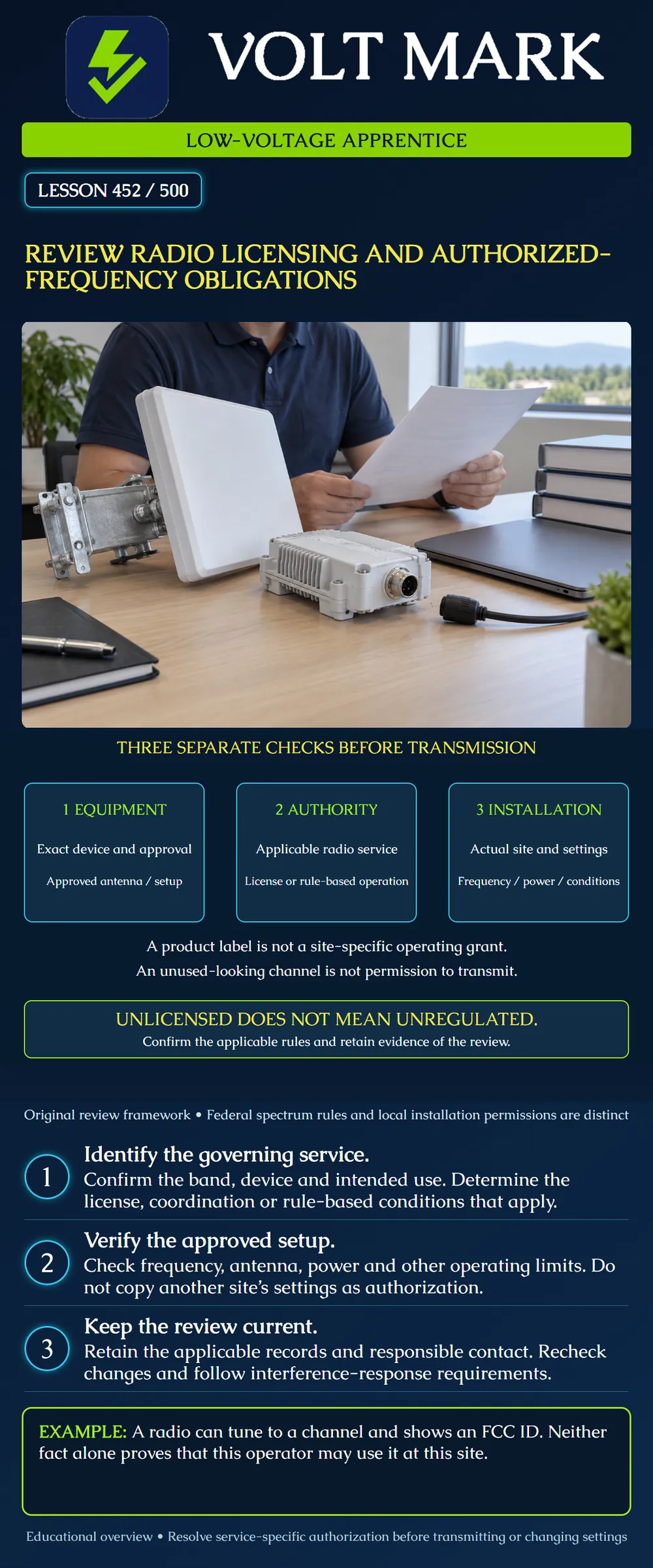
Separate equipment authorization, authority to operate and installation compliance. Identify the records that must be reviewed before a proposed radio installation transmits.
This is a U.S. federal radio-rule awareness lesson, not a frequency assignment or site-specific legal determination. Different services and equipment classes have different conditions. Determine the applicable rule part and obtain the responsible licensee, coordinator or specialist review. Local construction and installer requirements are separate matters; a building permit does not assign spectrum.
The poster has three boxes because three different questions need evidence. Equipment: Is this exact device, antenna arrangement and configuration appropriate under the applicable authorization and instructions? Authority: What rule-based operating conditions or license cover this operator and intended use? Installation: Do the actual location, frequency, power and other settings satisfy that authority and the relevant requirements?
An FCC identifier helps identify a device's equipment-authorization record. It does not, by itself, grant every purchaser permission to transmit on every tunable frequency. A product menu shows capability, not a complete determination of lawful use. Do not confuse a database equipment record with a station license or a site-specific review.
47 CFR 15.1 describes conditions under which covered devices may operate without an individual license. Administrative and technical requirements still apply. “Unlicensed” is not permission to use arbitrary frequencies, power levels or modified equipment.
Under 15.5, covered operation must not cause harmful interference and must accept interference described by that provision. Prior equipment certification does not create a permanent right to a particular frequency. When a Commission representative notifies the operator that the device is causing harmful interference, operation must cease and not resume until the cause is corrected.
This summary does not supply every band-specific condition. Confirm the actual device category and applicable provisions rather than treating Part 15 as one universal set of radio settings.
For a service requiring an individual authorization, obtain the actual grant and applicable rules, not just an application receipt, purchase order or a neighbor's configuration. Verify the responsible entity and the permitted operations. Review location or service-area conditions, frequencies and other parameters relevant to that service.
Some services require frequency coordination or other approvals. Part 101 includes coordination procedures for the microwave services within its scope. That does not mean every radio installation uses Part 101 or the same coordination process. Do not assume an application automatically permits transmission; any temporary or conditional authority must be specifically established under the applicable rules.
Maintain a responsible contact who can interpret the operating authority and manage amendments or changes. An apprentice should identify missing evidence, not invent the authorization basis.
Part 15.203 addresses antenna arrangements and includes specified exceptions. It is not a rule that every transmitter must always have a permanently attached antenna. Its installer responsibility is a reason to verify the proper antenna and applicable limits, not to treat any matching connector as acceptable.
Read the actual device's approved antenna options, installation instructions and restrictions. Document the intended frequency, channel width, transmit-power configuration and other required parameters. Where radiated-power or other limits depend on antenna gain and feeder loss, the responsible designer must account for the complete arrangement. No universal power limit is provided in this lesson.
Do not bypass regional settings, protective controls or required authorization mechanisms to make a link work. A setting available in software is not evidence that it may be used at the proposed site.
A local permit may address installation, structures or other site requirements. It does not replace the applicable federal spectrum authority. Conversely, a radio license does not automatically approve a mast, rooftop mount, building penetration or the installer’s scope of work.
List the separate reviewers and outstanding records so that one approval is not mistaken for all approvals. This course supports national fundamentals; it does not declare identical county permit or contractor rules throughout the country.
The fictional project file contains a radio model number, an FCC ID and a screenshot showing an available channel. It has no identified radio service or operating-authorization basis. Result: equipment identification has begun; operating authority is unresolved. Do not mark the project ready to transmit.
The owner then supplies a license for a different site. That is not enough to establish that this proposed operation is covered. Refer the location/service conditions to the responsible reviewer.
A later approved antenna substitution changes the installation file. Recheck whether the revised arrangement remains within the device and operating conditions. Preserve the before/after settings and approval evidence. Do not silently carry forward a previous conclusion after material changes.
Record: Exact device model and equipment-authorization reference. Applicable service and rule provisions. License/grant or documented rule-based operating basis. Responsible licensee/operator and reviewer. Site or service area and relevant operating conditions. Approved antenna, power and frequency configuration. Required coordination or related records. Review date, unresolved questions and change-control owner.
Use “verified,” “not applicable with reason,” or “unresolved.” A blank field is not a completed review. This is a learning checklist, not a substitute for the full service-specific compliance process.
Record the reported symptoms, times, equipment identity and relevant settings. Contact the responsible operator and follow the applicable response requirements. Do not retaliate, deliberately interfere with another system or assume that the absence of complaints proves compliance.
The specific mandatory cessation condition summarized above comes from Part 15.5(c). Other services and circumstances require their own applicable review. This lesson does not declare a right to continue harmful operation while a complaint is investigated.
eCFR 47 CFR 15.1, Scope: https://www.ecfr.gov/current/title-47/chapter-I/subchapter-A/part-15/subpart-A/section-15.1 eCFR 47 CFR 15.5, General conditions: https://www.ecfr.gov/current/title-47/chapter-I/subchapter-A/part-15/subpart-A/section-15.5 eCFR 47 CFR 15.203, Antenna requirement: https://www.ecfr.gov/current/title-47/chapter-I/subchapter-A/part-15/subpart-C/section-15.203 eCFR 47 CFR 101.103, Frequency coordination: https://www.ecfr.gov/current/title-47/chapter-I/subchapter-D/part-101/subpart-C/section-101.103
All four primary pages opened on 2026-10-01; displayed Title47 currency was 2026-09-29. Verify updates before publication or project use. The FCC industrial/business landing page returned403 and was not relied upon. Original examples are fictional; no actual license or equipment grant was reviewed.
A fictional job file has an FCC ID, a building permit and a pending application receipt. The proposed antenna differs from the submitted model. Sort the evidence into equipment, operating authority and installation, and write the unresolved questions.
Answer: The FCC ID begins equipment identification; the building permit addresses its local scope; the receipt proves submission, not automatically authority to transmit. Ask the responsible reviewer to establish the applicable service and operating basis and verify the changed antenna arrangement before marking transmission authorized.
Mistake: Treating an FCC ID as a license for every available channel. Correction: Identify the applicable service and separate equipment authorization from the operator's rule-based or licensed authority.
Mistake: Treating unlicensed operation as permission to ignore interference conditions. Correction: Review the applicable Part 15 conditions and route an interference report to the responsible operator, including required cessation when the specified Commission notice applies.
Mistake: Carrying an earlier approval forward after an antenna substitution. Correction: Have the complete revised antenna, gain, feeder and power arrangement checked against the applicable device and operating conditions.
Texas journeyman, 15 questions, scored by topic against the 70% mark. No card, and no account needed to start.
Free study material for low-voltage apprentices. This is a national foundation course: requirements differ by state and by local jurisdiction, and a practice that is common in one place is not a rule everywhere. Nothing here is a licence, a certification, or authority to work unsupervised, and completing it does not count as apprenticeship hours or continuing-education credit. Check the codes adopted where you are working, the licensing authority for that work, and your employer's safety programme. VoltMark is not affiliated with, endorsed by, or sponsored by NFPA, OSHA, NICET, BICSI, FOA, or any state or local licensing authority.

Electrician licensing exam prep: practice questions, timed exam simulations, and step-by-step help finding every answer in the NEC.