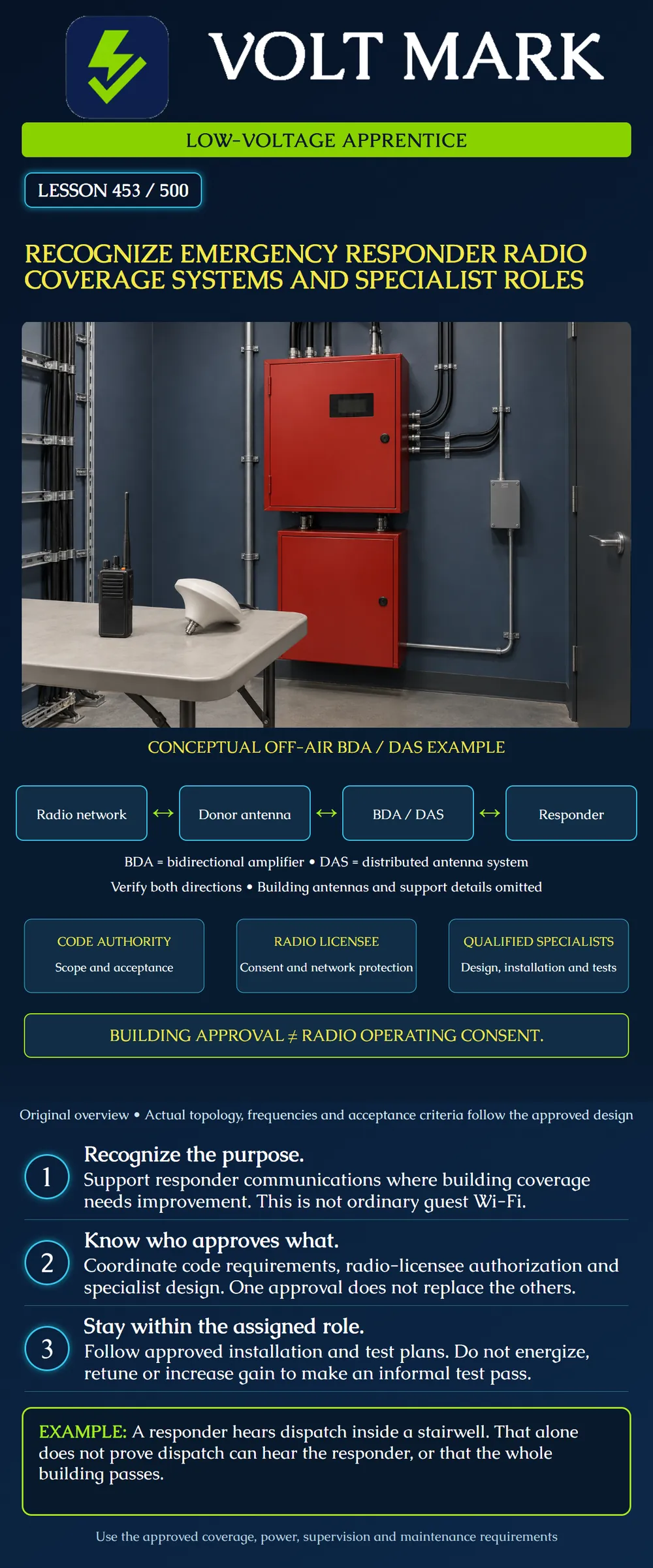
Recognize the purpose and major roles associated with emergency responder radio coverage systems, and distinguish building-code acceptance from radio operating authorization.
This is a recognition and coordination lesson, not an RF commissioning procedure. The poster illustrates one conceptual off-air bidirectional-amplifier/distributed-antenna arrangement. Other approved architectures exist. Local adoption, amendments, radio-network requirements and actual design determine applicability and acceptance. No nationwide coverage percentage, signal threshold, battery duration or technician credential is prescribed here.
Building materials and geometry can impair communications between responder radios and the serving network. A coverage enhancement system may provide an engineered path through the building. BDA means bidirectional amplifier. DAS means distributed antenna system; it is a distribution arrangement, not a synonym for every booster.
In the poster's example, the radio network communicates through a donor antenna and BDA/DAS arrangement to an indoor responder. The reverse path carries the responder's transmission toward the network. Double arrows emphasize that both directions matter. Interior antenna branches, filtering, power, supervision and detailed connections are omitted.
The drawing does not specify antenna separation, gain, frequencies, cable lengths or permitted equipment. It cannot be used to install or adjust a system.
The applicable code authority determines building requirements and acceptance within its jurisdiction. The radio licensee/system operator protects the authorized radio system and has a different role in operating consent and network coordination. Qualified design, installation and test personnel perform their assigned work under the relevant requirements.
A building permit is not evidence of all radio consent. A radio-related approval is not automatically a building-code acceptance. One person or organization may have several roles, but the project must still document each required decision.
Under 47 CFR 90.219, non-licensees operating covered PLMRS signal boosters need express consent from the licensees whose frequencies are intended to be amplified, retained in a recordable form. Class B installations covered by that rule require registration. Technical and interference obligations also apply. This is a scoped federal reference, not a complete operating checklist or a rule for every consumer cellular booster.
The responsible RF specialist evaluates the intended network, donor conditions, distribution, isolation, gain and the potential to impair other communications. Poorly designed or adjusted amplification can cause interference. “Turn it up” is not an acceptable substitute for the engineering process.
The project team must determine applicable installation qualifications, equipment acceptance and test credentials. Do not infer one universal national credential from a local specification. Confirm who may design, install, program, commission and maintain the actual system.
An apprentice may assist with assigned pathways, identification, documentation or other supervised work within their authorized scope. That assignment does not confer permission to transmit test signals, alter passbands, change gain or operate an unapproved system.
Locate the approved design and revisions, applicable authority requirements, radio-system coordination records, equipment information and defined test plan. Identify the responsible contacts before work begins.
Document pathways and components against the drawings. Record power and supervision interfaces and the responsible trade for each. An alarm contact connected to another system does not by itself prove that the intended fault will be detected, displayed and acted upon; the approved coordinated test must verify that behavior.
Requirements for standby power, fault supervision, survivability, inspection and maintenance must come from the project's applicable provisions. This lesson intentionally supplies no substitute default.
The acceptance plan should identify required areas, test methods, radio/network conditions, acceptance criteria and responsible witnesses. Keep evidence linked to test locations and directions of communication.
The poster's original scenario is deliberately incomplete: a responder hears dispatch in a stairwell. It supports a downlink observation there under those conditions. It does not prove the return path, all required areas, reserve power, alarm reporting or interference performance.
Do not average away a failed critical location or invent a passing threshold. Record the result and route it to the responsible reviewer. If a design change is authorized, retain the revision and repeat the required affected checks.
Seattle Fire Department CAM 5123 describes its local emergency responder/public-safety radio amplification process for PSERN and references Seattle Fire Code requirements. It also recognizes evaluation of coverage without amplification. This illustrates that a building's need and acceptance path must be assessed; amplification should not be presumed solely because the building exists.
That Seattle document is a local example dated March 2024. Its specific scope, network, submission requirements and criteria are not copied into a nationwide rule. A project elsewhere must obtain its own current authority and radio-system requirements.
The fictional project folder contains a building permit and a BDA equipment submittal, but no record of radio-licensee consent. Mark operating authorization unresolved. A drawing shows a donor antenna moved from the approved position. Refer the change for the proper RF/design review rather than assuming cable continuity proves equivalent performance. A test record covers the lobby but omits the required stairwell. Mark the missing area unverified. A trouble indication was acknowledged, but its cause and restoration were not recorded. Keep the fault follow-up open. The contractor has finished cabling, but the coordinated acceptance test has not occurred. Record installation progress without claiming system acceptance.
Provide the approved as-built records, test evidence, equipment identification and responsible contacts. Document ongoing inspection, maintenance and impairment processes according to the applicable requirements. Keep unauthorized settings changes out of routine troubleshooting.
If an operational problem occurs, follow the site's communication and impairment procedure. Do not disable a responder system, disturb another service or attempt an RF repair beyond the assigned role.
eCFR 47 CFR90.219, Use of signal boosters: https://www.ecfr.gov/current/title-47/chapter-I/subchapter-D/part-90/subpart-I/section-90.219 Opened directly; displayed Title47 currency2026-09-29. Consent, registration and interference duties summarized within PLMRS scope.
Seattle Fire Department CAM5123, Emergency Responder/Public Safety Radio Amplification Systems Using PSERN: https://seattle.gov/Documents/Departments/Fire/Business/CAM5123-EmerRespondRadioSys.pdf PDF opened; March2024 local example only. No universal Seattle criteria claimed. Sources checked2026-10-01. Diagram and exercises are original instructional material.
Mistake: Treating a building permit as the radio licensee's consent. Correction: Track code acceptance and radio operating consent separately, with the actual responsible entity and record for each.
Mistake: Accepting a stairwell after the responder hears dispatch once. Correction: Retain that limited downlink observation and complete the approved return-path, location and operating-condition checks.
Mistake: Increasing BDA gain to resolve a weak location without RF review. Correction: Refer the documented symptom to the responsible specialist to assess the approved design, isolation and interference implications before any adjustment.
Texas journeyman, 15 questions, scored by topic against the 70% mark. No card, and no account needed to start.
Free study material for low-voltage apprentices. This is a national foundation course: requirements differ by state and by local jurisdiction, and a practice that is common in one place is not a rule everywhere. Nothing here is a licence, a certification, or authority to work unsupervised, and completing it does not count as apprenticeship hours or continuing-education credit. Check the codes adopted where you are working, the licensing authority for that work, and your employer's safety programme. VoltMark is not affiliated with, endorsed by, or sponsored by NFPA, OSHA, NICET, BICSI, FOA, or any state or local licensing authority.
Electrician licensing exam prep: practice questions, timed exam simulations, and step-by-step help finding every answer in the NEC.