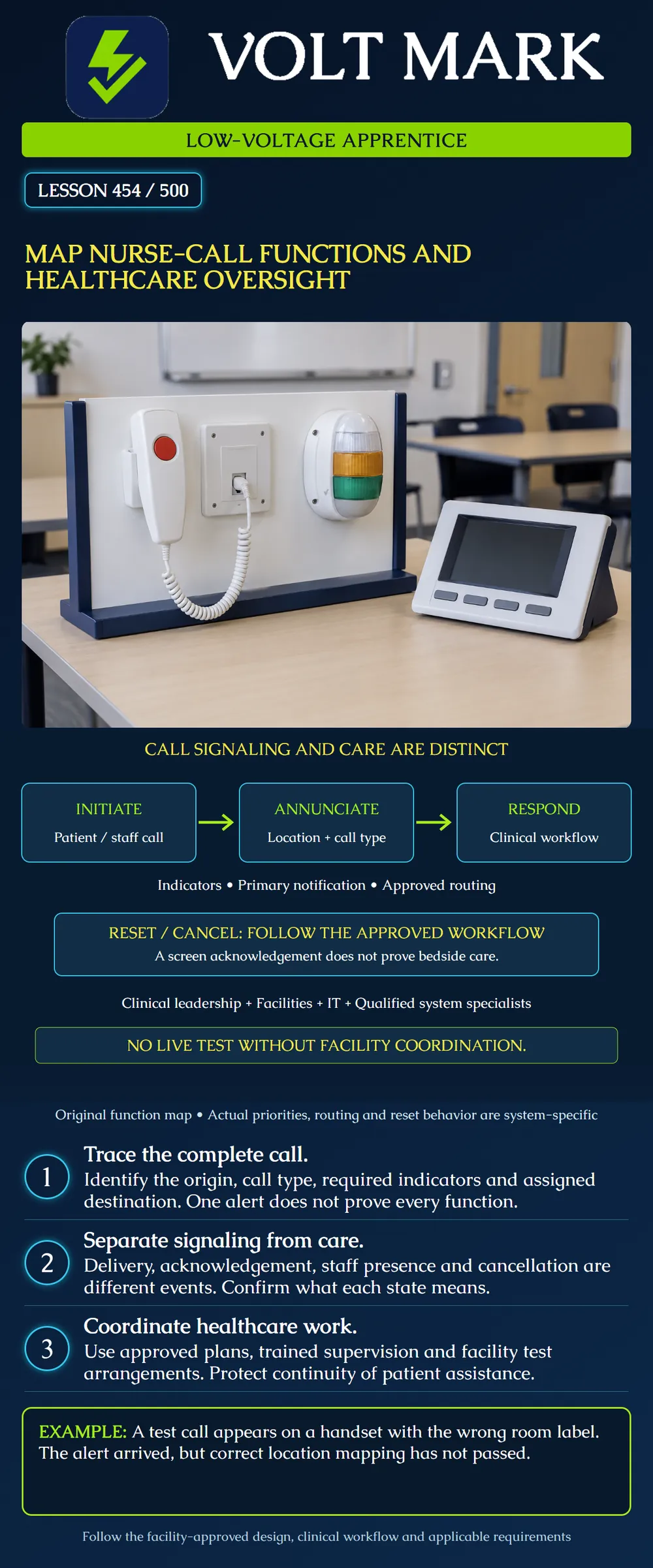
Draw a function map for a nurse-call request and identify who must approve the technical and clinical workflow. Explain why a delivered notification, a staff acknowledgement and completed patient assistance are different claims.
This is foundational low-voltage systems education. It is not a clinical protocol, an installation manual or authorization to test an occupied patient-care area. Use the approved project documents, manufacturer instructions and facility supervision. Requirements depend on the care setting, adopted codes, licensing authorities and approved system configuration.
A nurse-call system communicates a request for assistance. The public scope of UL 1069 describes call initiation, audible and visual primary notification, call-placed indication, corridor and zone annunciation, and reset/cancellation. This is a useful organizing map, not the full standard or a complete acceptance checklist. [1]
Draw the originating station first. Then show the required local indicators and notification destinations from the actual design. Label every device with its approved identity. Do not substitute a familiar office intercom for a specified nurse-call component simply because both can carry speech. UL's scope excludes office intercoms and many types of medical equipment; compatibility and system function need specific evidence. [1]
For the classroom exercise, give five events separate columns: initiated, displayed, acknowledged, attended and cancelled. These are analytical labels, not a claim that every product exposes all five as distinct states. Ask the system specialist what the installed product records and what the clinical team considers the required response.
An electronic acknowledgement may establish only that a user or device accepted a notification. A cancellation event alone does not tell an observer what care occurred. Do not instruct an apprentice to clear a call just to silence a test or tidy an event list. The responsible team defines the approved cancellation procedure and its relationship to staff presence or patient needs.
Rauland's product information illustrates how a modern platform can combine nurse-call hardware and software with clinical workflows. Its room devices and handset options also demonstrate that a device may have several functions. These are product examples, not capabilities promised for every installation. [2]
Create a project responsibility sheet. Clinical leadership should identify the intended care workflow and appropriate test conditions. Facilities coordinates the work area and building services. IT addresses approved network dependencies where present. Qualified system specialists confirm hardware, software, configuration and manufacturer requirements. The project's responsible code and healthcare authorities determine applicable compliance and acceptance requirements. These assignments are a planning example; the facility supplies the actual names and authority.
Treat scheduled work as a coordinated change. The team needs to know which rooms, stations, notification destinations and shared services could be affected. Ask for the facility's approved arrangements for maintaining patient assistance during any impairment. An apprentice does not invent a temporary substitute or decide that a unit can remain occupied without its required service.
On a disconnected training system, create a fictional room A12. The exercise sheet requires the call to display A12 at the designated station and show the specified local indication. A trainer activates the call, but the destination displays A21. Record the mismatch as a failed identity check even though an audible alert occurred.
Do not relabel the physical room to make the screen appear correct. Compare the approved device schedule, configuration and physical identity under supervision. After an authorized correction, repeat the affected checks and record the result. A successful correction at one device does not establish that every room has been tested.
Expand the paper exercise with two destinations. Suppose the primary station receives A12 but the approved supplementary destination does not. The observed result is partial delivery, not a complete pass. The actual acceptance plan determines whether that destination is required and what corrective action follows. Avoid guessing routing delays or priorities from a different brand.
Use fictional names and room assignments for training. Follow facility restrictions on photographs, recordings and access to real event logs. A construction progress picture should not expose patient information. Do not connect personal test devices or change a network configuration without the responsible team's authorization.
Keep nurse-call functions distinct from medical-device monitoring, fire alarms, location tracking and general messaging even where approved integrations exist. Identify the interface owner and its defined function. A working nurse-call indicator does not prove an integrated medical alarm or another system is functioning.
UL distinguishes hospital nurse-call equipment under UL 1069 from emergency-call systems for assisted and independent living under UL 2560. [3] Do not pick the standard from the building's marketing name alone. Ask the responsible designer to document the care setting, required functions, applicable editions and listing basis. This lesson does not claim one universal configuration for every state or facility.
On paper, map a call from fictional room B04. Include its origin, indicators, primary destination, any approved additional routing and cancellation responsibility. Mark unknowns explicitly. Add an oversight list and one proposed test condition that requires clinical approval. This exercise does not authorize live calls.
Answer: No. Delivery occurred, but correct identity was not demonstrated.
Answer: No. Establish the meaning of each recorded state and the clinical workflow.
Answer: No. Follow the approved system and clinical procedure.
Answer: No. Confirm the applicable setting and project requirements.
Answer: An unresolved requirement for the responsible team, not an assumed pass.
[1] UL Standards & Engagement, UL 1069 Edition 8, February 8, 2024, public scope: https://www.shopulstandards.com/ProductDetail.aspx?productId=UL1069_8_S_20240208 Opened October 1, 2026. Public scope reviewed; full paid standard not reviewed. Scope is not a substitute for detailed project requirements. [2] Rauland, Responder Enterprise: https://www.rauland.com/Products/Healthcare/Responder-Enterprise Opened October 1, 2026. Manufacturer product overview only; not a site-specific operating or commissioning manual. [3] UL Solutions, Nurse Call and Emergency Call Systems, January 30, 2020: https://www.ul.com/news/nurse-call-and-emergency-call-systems Opened October 1, 2026. Background on distinct standards and care settings; not proof of current local adoption.
Original fictional scenarios, function map and questions are teaching aids. No numerical design calculation is presented.
On the disconnected trainer, room A12 initiates a call. The primary station displays A12, but the supplementary destination required by the exercise receives nothing. Record correct primary identity and failed supplementary delivery separately. Do not mark the overall required routing passed or infer that a patient has been attended. The instructor has the system specialist review the approved destination mapping, then repeats the affected checks after an authorized correction. Clinical staff still own the meaning and handling of acknowledgement and cancellation.
Mistake: Accepting a beep while the displayed room identity is wrong. Correction: Compare the origin, physical identity and displayed destination against the approved schedule; record the identity mismatch as a failed check.
Mistake: Treating acknowledgement as proof that patient assistance occurred. Correction: Ask clinical leadership and the system specialist what the recorded event means, and keep attendance evidence separate.
Mistake: Selecting requirements from a facility's marketing name. Correction: Have the responsible designer identify the care setting, required functions and applicable standards and editions before choosing the system basis.
Texas journeyman, 15 questions, scored by topic against the 70% mark. No card, and no account needed to start.
Free study material for low-voltage apprentices. This is a national foundation course: requirements differ by state and by local jurisdiction, and a practice that is common in one place is not a rule everywhere. Nothing here is a licence, a certification, or authority to work unsupervised, and completing it does not count as apprenticeship hours or continuing-education credit. Check the codes adopted where you are working, the licensing authority for that work, and your employer's safety programme. VoltMark is not affiliated with, endorsed by, or sponsored by NFPA, OSHA, NICET, BICSI, FOA, or any state or local licensing authority.
Electrician licensing exam prep: practice questions, timed exam simulations, and step-by-step help finding every answer in the NEC.