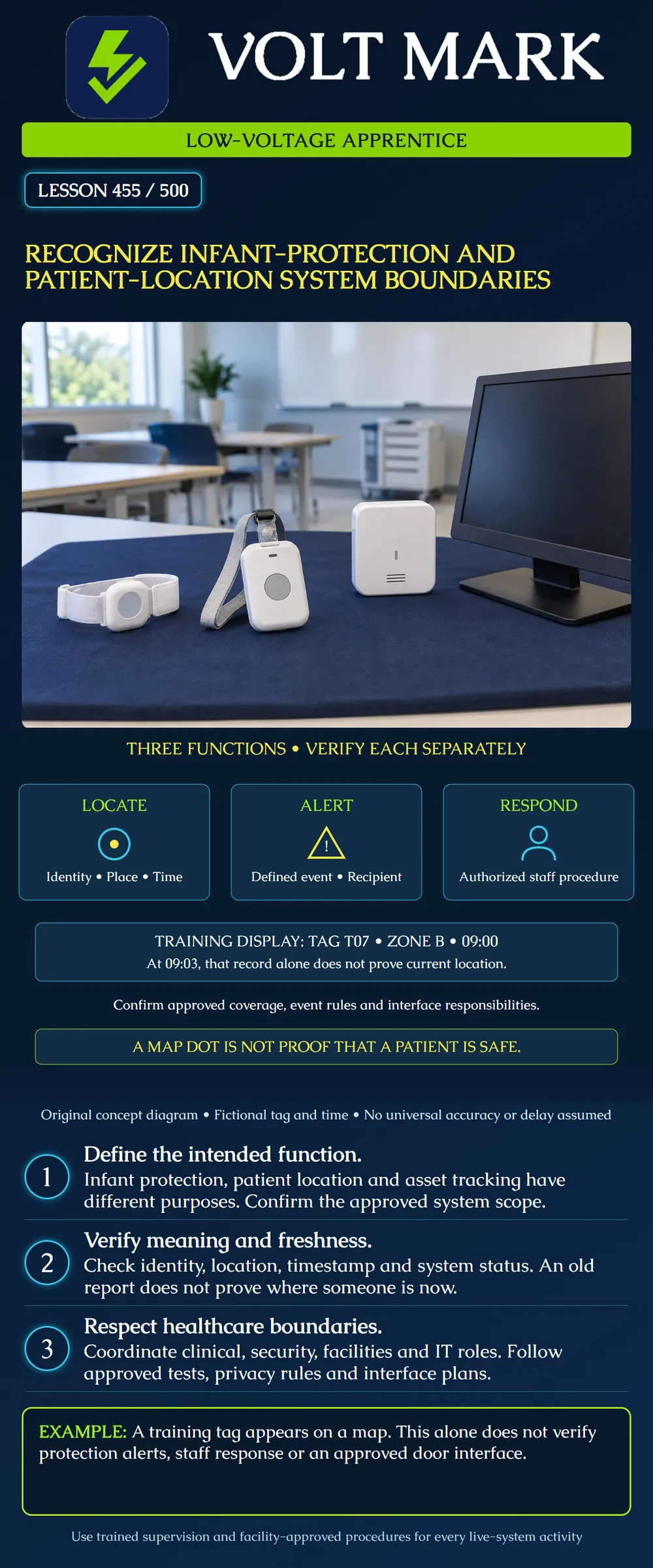
Distinguish locating a tag, generating a protection alert and carrying out a staff response. Identify the limits of a displayed location and the responsibilities surrounding healthcare-system interfaces.
This lesson is an overview for low-voltage apprentices. It does not authorize clinical decisions, attachment of patient devices, changes to security rules, live alarm tests or door-control changes. The facility and qualified system specialists supply the approved design, operating procedures and test plan. Fictional identifiers are used throughout.
An infant-protection installation supports a defined security program. A patient-location application supports a defined locating or workflow purpose. Asset tracking follows equipment. Sharing an RTLS platform does not make these functions interchangeable.
RTLS means real-time location system. That name does not establish a universal accuracy, refresh interval, coverage boundary or safety guarantee. The project must define what the chosen implementation is expected to do and how that expectation will be verified.
Securitas Healthcare describes Hugs as an infant-protection application with tags and an associated mother/infant matching component. That is a manufacturer-specific example of protection functions; it is not evidence that any generic location tag provides those functions. [1]
Ask what object the display identifies. Is it the tag, an assigned patient record, a room association or a calculated position? Then ask when the underlying event was observed and whether the interface shows data age or system status. A current-looking screen can contain an older observation.
The poster's fictional record says T07, Zone B, 09:00. At 09:03, the record is three minutes old if both timestamps share the same date, time zone and synchronized time reference. That arithmetic alone does not determine whether the installed product considers the data stale. It also does not prove the tag stayed in Zone B during the interval. The exercise teaches the difference between an observation and a present-tense claim, not an allowable update interval.
Before using timestamps for acceptance, confirm their meaning. An event time, database receipt time and display refresh time may represent different steps. Do not calculate an apparent response delay from unrelated clocks and present it as a verified system measurement.
For the classroom exercise, create three evidence columns: location, alert and staff response. A correct location display supports only the locating observation tested. An alert appearing at a destination supports that delivery observation. An acknowledgement or dispatch record is evidence of a recorded action, not automatic proof of completed patient protection.
CenTrak's workflow overview describes locating infrastructure, purpose-built wearables, maps, reports and alerts, with several technology options and integrations. These examples show why a project needs a defined use case and configuration. They do not establish that every wearable, room or integration has identical capabilities. [2]
On a training worksheet, write the expected result beside each observation. If the required alert recipient is unspecified, record an unresolved requirement. Do not mark a whole system as passed because one screen looks plausible.
The chosen solution may depend on tags, sensing infrastructure, network services, application software, power and approved interfaces. The Cisco Spaces integration documentation provides one vendor-specific example involving on-premises and cloud components. [3] Other implementations differ. A general poster should not imply that every infant-protection system requires the same cloud connection or wireless design.
Use approved drawings to identify the installed dependencies and who maintains each one. A change to a shared network service can require coordination beyond the low-voltage contractor. The responsible specialists decide which functions are affected and what verification is necessary.
Where the approved design includes an access-control or door interface, document its intended interaction and responsible parties. Locating a tag does not establish that a door command occurred; a command does not by itself prove the physical door state. Life-safety and egress requirements require their own approved treatment. This lesson does not teach bypasses, lock programming or a generic response sequence.
Clinical and security leadership define operational response. Facilities, IT and manufacturer-qualified specialists support their assigned technical responsibilities. The apprentice works under supervision, records observations accurately and escalates a discrepancy to the assigned lead. Do not change thresholds or silence events to make an informal test appear successful.
Use dedicated training identifiers on a disconnected demonstration system whenever possible. For any authorized live testing, follow the facility's agreed schedule, notifications, precautions and restoration process. Do not place a real infant or patient into a training scenario.
Keep screenshots and records within approved access controls. Avoid personal phones, public dashboards and real patient names in construction examples. Ask the responsible team which information belongs in the handover record and who may receive it. A useful technical record can identify the device, test case, expected result, observation and unresolved issue without unnecessary patient details.
Scenario A: A training tag appears in the intended zone. Claim: Every protection function has passed. Correction: Only the observed locating result is demonstrated. Evaluate the other approved functions separately.
Scenario B: The event log shows a notification was acknowledged. Claim: The assigned staff member physically reached the patient. Correction: The log establishes the recorded acknowledgement. Confirm what additional evidence and clinical process are required.
Scenario C: The map has no new entry for T07. Claim: The patient is outside the building. Correction: The display alone does not establish that conclusion. Follow the facility response process and specialist troubleshooting responsibilities.
Answer: No; purpose, approved configuration and operating requirements differ.
Answer: No. It records an earlier observation; no universal staleness limit is supplied.
Answer: No. Those are separate claims.
Answer: No. Use the approved change and testing process.
Answer: The responsible project and facility teams with qualified system specialists and applicable authorities.
[1] Securitas Healthcare, Hugs: https://www.securitashealthcare.com/hugs Opened October 1, 2026. Product overview; not a complete installation or operating manual. Marketing superlatives and coverage claims are not adopted as guarantees. [2] CenTrak, Workflow: https://centrak.com/solutions/workflow Opened October 1, 2026. Manufacturer application overview. Accuracy claims are not generalized to all sites or products. [3] Cisco Spaces Technical Adoption, Infant Protection with Securitas Healthcare and Cisco Spaces: https://runbooks.ciscospaces.io/docs/infant-protection-with-securitas-healthcare-and-cisco-spaces Opened October 1, 2026. One specific integration architecture, not a universal topology.
Original conceptual art and fictional exercises. Time subtraction assumes a common synchronized reference; it is not a performance criterion.
At 09:03, the fictional display still shows T07 in Zone B with an observation time of 09:00. With a common synchronized reference, its age is three minutes. Write "last recorded in Zone B at 09:00," not "currently in Zone B." A separate log shows alert acknowledgement but no attendance evidence. Retain that acknowledgement as its own event and refer the missing response evidence to the facility team. Neither record establishes present location or completed protection.
Mistake: Assuming a plausible map marker is a current patient position. Correction: Record tag identity, timestamp meaning and data age, and follow the facility response process when the present condition is uncertain.
Mistake: Substituting a generic asset tag for an infant-protection tag. Correction: Verify the approved purpose, device and configuration with the system specialist; shared RTLS infrastructure does not establish equivalent protection functions.
Mistake: Closing a protection test when an alert is acknowledged. Correction: Verify location, alert delivery and the required staff-response evidence separately; do not infer attendance from acknowledgement.
Texas journeyman, 15 questions, scored by topic against the 70% mark. No card, and no account needed to start.
Free study material for low-voltage apprentices. This is a national foundation course: requirements differ by state and by local jurisdiction, and a practice that is common in one place is not a rule everywhere. Nothing here is a licence, a certification, or authority to work unsupervised, and completing it does not count as apprenticeship hours or continuing-education credit. Check the codes adopted where you are working, the licensing authority for that work, and your employer's safety programme. VoltMark is not affiliated with, endorsed by, or sponsored by NFPA, OSHA, NICET, BICSI, FOA, or any state or local licensing authority.

Electrician licensing exam prep: practice questions, timed exam simulations, and step-by-step help finding every answer in the NEC.