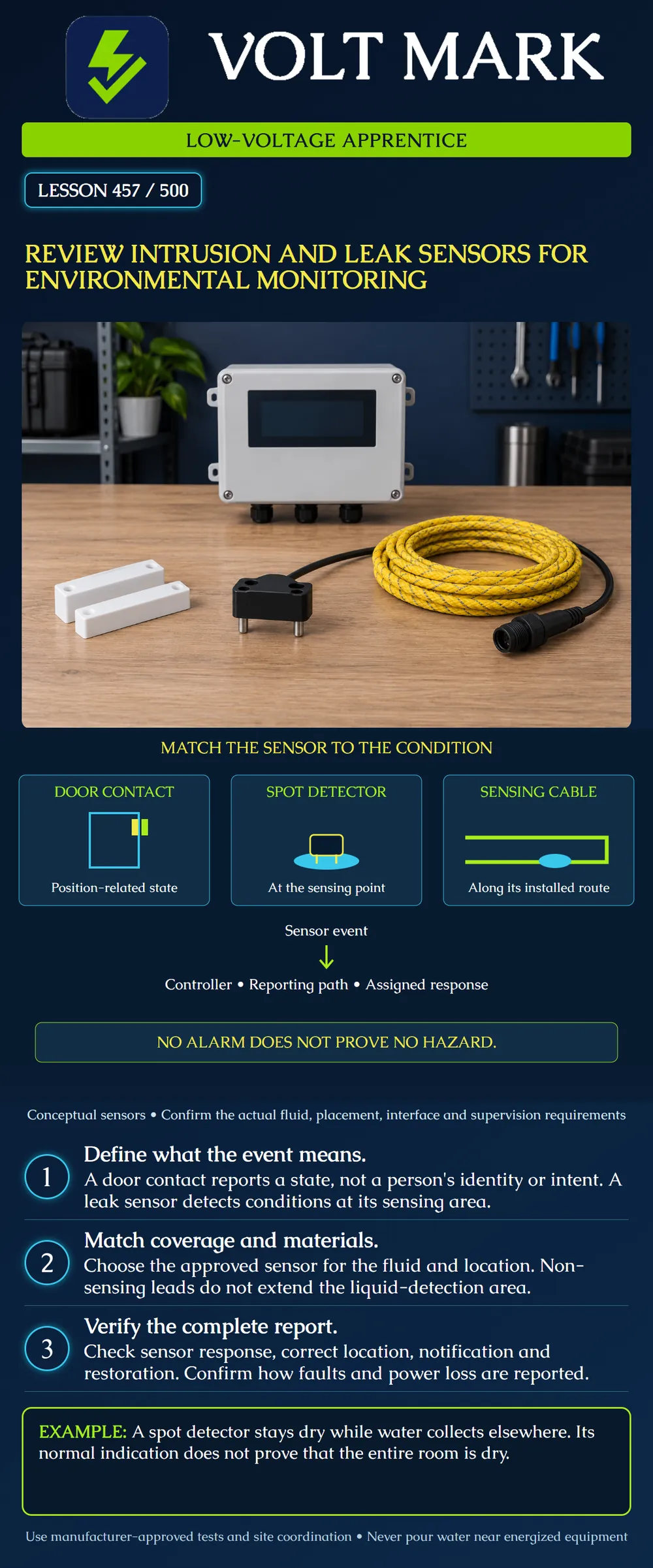
Explain what a door contact or leak detector can actually establish. Trace an event from the sensing point through a monitoring controller to an assigned response, and identify the limits of coverage and fault reporting.
This is low-voltage monitoring education. It is not permission to trigger a live security response, alter alarm programming or introduce water into an equipment room. Follow the approved system design, manufacturer instructions and supervisor's test arrangements. A general environmental monitor does not automatically replace a required security, fire or life-safety system.
A door contact responds to the installed contact arrangement and door position. It does not identify who opened the door or whether entry was authorized. The application needs context, including the approved schedule and response rules. Likewise, an apparent closed state does not by itself prove the door is mechanically secured.
For a fictional equipment-room example, the monitoring record shows Door D1 changed state at 14:20. The defensible observation is the recorded state change. Do not rewrite it as “an intruder entered” without supporting evidence and the responsible security team's assessment.
AKCP's dry-contact interface describes integration of external contact states, including door/window and environmental applications. This is an example of input monitoring, not proof that arbitrary sensors, voltages or life-safety systems can be connected interchangeably. [1]
A spot leak detector responds where its sensing elements encounter the specified condition. A sensing cable extends detection along its installed sensing length. A non-sensing connection lead transports signals but does not add liquid-detection coverage.
AKCP distinguishes the sensing rope, its non-sensing lead and the controller interface. Its product information also gives model-specific installation limitations, including a caution against conductive surfaces. These requirements belong to that product; consult the instructions for the actual selected equipment. [2]
Draw where liquid would plausibly travel in the approved layout, then compare the sensor position or cable route with that path. Do not infer whole-room coverage merely from a detector mounted somewhere in the room. Floor slope, barriers and equipment arrangements can affect whether liquid reaches the sensing area.
RLE's SC datasheet identifies detection of water and other conductive fluids. [3] That does not establish detection of every oil, solvent or chemical. The designer must match the fluid and operating environment to the selected sensor and controller. Do not use an unknown liquid to “prove” compatibility.
Protect sensing components from contamination, crushing and unsuitable placement according to their instructions. A sensor cable is not a substitute for a spill barrier or an approved containment system. It reports a condition; it does not remove the liquid or make the affected equipment safe.
On paper, trace: sensing element, interface/controller, event label, notification route, recipient and response responsibility. Label any optional automatic action separately. A received notification does not prove a valve closed or a person attended.
For an original training exercise, a dry demonstration input changes state and the local controller displays an event. The remote notification is absent. Record local event detection as observed and remote reporting as unverified or failed against the test requirement. Do not call the entire chain passed.
A second exercise delivers the message to the correct destination but labels Door D1 as Pump Area Leak. The message arrived, but the event identity is wrong. Verify configuration and documentation under supervision, then repeat the affected checks after an authorized correction.
Read the actual input and supervision design. A plain contact input does not automatically distinguish every wire fault from an ordinary state. Some products provide explicit disconnect or damage indications; others can combine conditions in a shared alarm. Establish what the selected system actually reports before interpreting a normal screen.
AKCP describes fault-related reporting for its rope sensor, but that behavior must not be generalized to every leak cable or input. [2] Record how power loss, sensor disconnection and communication failure are intended to appear, using only approved test procedures. Do not defeat a real alarm to discover its behavior informally.
Use the manufacturer's permitted test method and a suitable training arrangement. Never pour water near energized equipment. A live site test requires coordination with those receiving notifications and those responsible for the protected area. Avoid surprise dispatches, equipment shutdowns or other unintended actions.
After testing, confirm the required restoration state and documentation. An acknowledged alarm, a cleared event and a physically dry or secure area are separate facts. If a real incident is suspected, follow the site response process rather than treating it as a convenient training opportunity.
Draw a fictional room with a door contact, one spot detector and a short sensing-cable route. Mark the non-sensing lead separately. Place a fictional puddle outside both liquid-sensing areas and explain why normal indications would not establish a dry room. Then map the approved reporting and response chain.
Answer: No; it reports a monitored state, requiring context.
Answer: No.
Answer: No; confirm fluid compatibility and the actual product.
Answer: No; the reporting path is not demonstrated.
Answer: No; confirm the required physical and system conditions separately.
[1] AKCP, Dry Contact Sensor: https://www.akcp.com/dry-contact-sensors/ Opened October 1, 2026. Manufacturer interface overview; not universal wiring permission. [2] AKCP, Rope Water Sensor: https://www.akcp.com/rope-water-sensor/ Opened October 1, 2026. Product-specific sensing/non-sensing components, placement limitations and reporting characteristics. [3] RLE Technologies, SC Leak Detection Sensing Cable datasheet, v11/24: https://rletech.com/wp-content/uploads/2024/11/SeaHawk-SC-Sensing-Cable-Datasheet-v-11.24.pdf Opened October 1, 2026. Two-page manufacturer datasheet. Fluid scope is product-specific.
Original conceptual drawings and exercises; no numerical coverage or design calculation claimed.
On paper, a leak occurs beside a non-sensing connection lead while the actual sensing rope remains dry. A normal monitor indication cannot establish that the room is dry because the liquid has not reached the sensing area. Mark the coverage limitation on the layout. In a separate approved dry trainer test, the correct local event appears but the required remote message does not. Record local detection observed and remote delivery failed; have the assigned specialist investigate the reporting path without introducing liquid near equipment.
Mistake: Counting the non-sensing lead as monitored floor coverage. Correction: Mark sensing sections and connection leads differently on the route plan and compare the sensing area with plausible liquid paths.
Mistake: Labeling a door-contact transition as an intrusion. Correction: Report the observed contact state and time, then obtain the security context before describing unauthorized entry.
Mistake: Assuming a normal screen proves every sensor cable is intact. Correction: Check the documented supervision behavior and required fault tests; do not infer wire-fault detection from an ordinary input state.
Texas journeyman, 15 questions, scored by topic against the 70% mark. No card, and no account needed to start.
Free study material for low-voltage apprentices. This is a national foundation course: requirements differ by state and by local jurisdiction, and a practice that is common in one place is not a rule everywhere. Nothing here is a licence, a certification, or authority to work unsupervised, and completing it does not count as apprenticeship hours or continuing-education credit. Check the codes adopted where you are working, the licensing authority for that work, and your employer's safety programme. VoltMark is not affiliated with, endorsed by, or sponsored by NFPA, OSHA, NICET, BICSI, FOA, or any state or local licensing authority.

Electrician licensing exam prep: practice questions, timed exam simulations, and step-by-step help finding every answer in the NEC.