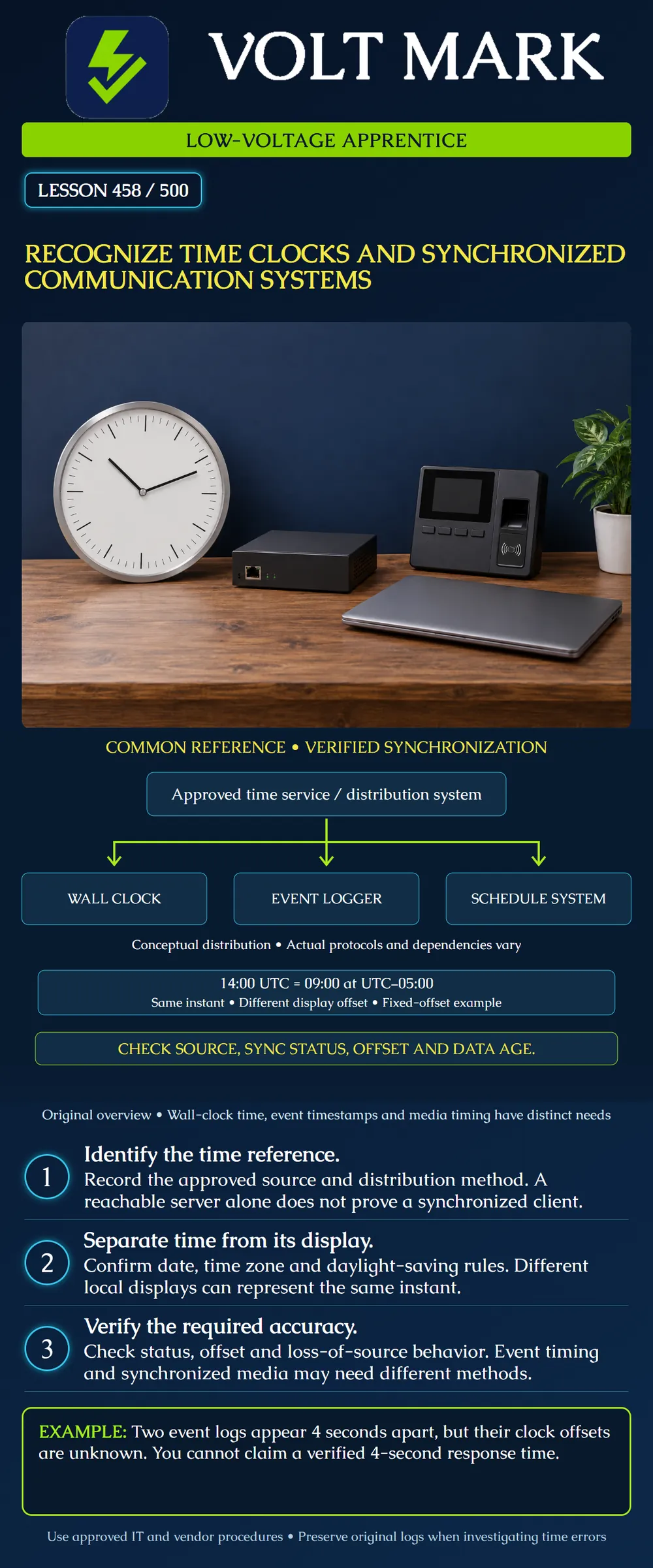
Identify a shared time reference and distinguish synchronization from time-zone display. Explain why wall clocks, event logs, schedules and synchronized communications can have different timing requirements.
This is foundational systems education. It does not authorize changes to production time servers, employee attendance records, security logs, school schedules or media clocks. Use the approved design and the responsible IT or specialty-system team. The poster shows a conceptual dependency map, not a network wiring plan.
A wall clock presents time to people. An attendance terminal records an event used by another application. A schedule controller may trigger a defined action. An event logger records observations. Each depends on a time reference, but the consequences of an error differ.
Start with the application requirement. Ask which reference is approved, how it reaches the device and what accuracy is required at the point of use. A clock face showing the expected minute does not establish subsecond timing for another application.
NIST's Internet Time Service illustrates distribution of a reference linked to UTC(NIST). Its discussion distinguishes time at the server from the accuracy received by a client, where network conditions matter. This is not a promise that a device using an Internet source meets every project's accuracy requirement. [1]
NTP means Network Time Protocol. RFC 5905 describes NTPv4 and includes clock synchronization concepts such as offset, delay, source hierarchy and synchronization state. Stratum represents position in the hierarchy; it is not a stand-alone guarantee of client accuracy. [2]
Do not treat network reachability as proof of correct time. A response can be received while the application has not accepted the source, the source has a problem or the client has not converged within its required tolerance. Read the actual product's status and approved verification method.
NIST's work on practical NTP limitations identifies unequal network delays as an important source of time-transfer error. [3] This is why an apprentice should not infer precise agreement merely because two devices share a network cable path or server name.
UTC is Coordinated Universal Time. A local display applies a time-zone interpretation to an instant. In the poster's fixed-offset example, 14:00 UTC corresponds to 09:00 at UTC−05:00 on the same date. Subtracting five hours gives the displayed result. This is not a claim that a particular U.S. region always uses that offset.
Real location-based time-zone rules may change with daylight-saving transitions and legislation. Confirm the configured zone and relevant date; do not permanently apply a hand-written one-hour adjustment. A local time during a backward transition can be ambiguous without its offset or other identifying information.
A pair of clocks can display different hours and still represent the same instant. Conversely, two clocks can display the same digits while their dates or zones differ. Always preserve the full context when comparing records.
Ask what the event timestamp means. It might mark detection at an endpoint, receipt by a controller, ingestion into a server or display in an application. Those are different moments. Time synchronization does not eliminate transmission, processing or queue delays.
For a fictional exercise, log A says 10:00:00 and log B says 10:00:04. Both show the same date and offset, but their clock errors are unknown. The displayed difference is four seconds; it is not yet a verified physical response interval. Establish timestamp meanings and clock conditions before drawing that conclusion.
If A's clock is known to be two seconds fast and B's two seconds slow, the corrected events could instead be eight seconds apart under those stated assumptions. A's 10:00:00 corresponds to 09:59:58 reference time, while B's 10:00:04 corresponds to 10:00:06. This exercise demonstrates how clock errors affect interpretation; it is not an instruction to rewrite original evidence.
Calendar schedules and wall-clock displays are not the same problem as tightly coordinated media playback or sampling. A system can use an ordinary time service for logs while relying on another approved timing mechanism for its real-time communication functions. Consult the manufacturer's design for each application instead of assuming that “NTP enabled” proves synchronized audio or video.
Similarly, a synchronized clock does not establish that a scheduled message reached every output. The command, transport, endpoint and physical output still require their own tests. Keep the time-reference test separate from the functional test.
Ask the responsible specialist what the device does if its source becomes unavailable. Does it report loss of synchronization? How is elapsed time since a valid update shown? What requirements apply during independent running and recovery? Do not supply universal holdover durations or drift rates without product evidence.
A returned source can require controlled recovery. Large time changes may affect logs or scheduled actions. Follow the system's approved change procedure and document the observed behavior; do not manually step production clocks to make a dashboard look consistent.
Draw a time dependency map for a wall clock, a fictional attendance terminal and an event logger. For each, identify the source, display zone, required accuracy, status evidence and responsible owner. Mark missing requirements rather than inventing values.
Answer: No.
Answer: 09:00 on the same date.
Answer: No; include date, zone and synchronization evidence.
Answer: Yes.
Answer: Preserve originals; document any analytical corrections separately through the approved process.
[1] NIST, Internet Time Service: https://www.nist.gov/pml/time-and-frequency-division/time-distribution/internet-time-service-its Opened October 1, 2026. Time-reference distribution and client accuracy context. No live source status or universal accuracy claimed. [2] RFC Editor, RFC 5905, Network Time Protocol Version 4: https://www.rfc-editor.org/rfc/rfc5905.html Opened October 1, 2026. Foundational protocol reference; later updates exist. This lesson is not an implementation specification or exhaustive standards review. [3] NIST, Practical Limitations of NTP Time Transfer: https://www.nist.gov/publications/practical-limitations-ntp-time-transfer Opened October 1, 2026. Publication abstract supports the effect of delay asymmetry; no universal performance threshold adopted.
Original conceptual map and numerical exercises. Fixed-offset conversion and stated clock-error example checked.
Log A displays 10:00:00 on a clock known to be two seconds fast; log B displays 10:00:04 on a clock two seconds slow. On a separate analysis sheet, correct A to 09:59:58 and B to 10:00:06. The resulting interval is eight seconds, not the four seconds between displayed values. Preserve the original logs and document the clock-error evidence. Even this corrected interval needs compatible timestamp meanings before it can describe a physical response.
Mistake: Treating a reachable NTP server as proof of endpoint synchronization. Correction: Read the endpoint's accepted-source and synchronization evidence and compare against its application requirement.
Mistake: Fixing a time-zone error by permanently adding an hour to the device clock. Correction: Verify the intended location-based zone and date rules with the responsible team instead of manually changing the underlying time reference.
Mistake: Subtracting timestamps from different clocks and calling the result response time. Correction: Identify the event meanings, dates, offsets and clock uncertainties, retaining analytical corrections separately from original evidence.
Texas journeyman, 15 questions, scored by topic against the 70% mark. No card, and no account needed to start.
Free study material for low-voltage apprentices. This is a national foundation course: requirements differ by state and by local jurisdiction, and a practice that is common in one place is not a rule everywhere. Nothing here is a licence, a certification, or authority to work unsupervised, and completing it does not count as apprenticeship hours or continuing-education credit. Check the codes adopted where you are working, the licensing authority for that work, and your employer's safety programme. VoltMark is not affiliated with, endorsed by, or sponsored by NFPA, OSHA, NICET, BICSI, FOA, or any state or local licensing authority.

Electrician licensing exam prep: practice questions, timed exam simulations, and step-by-step help finding every answer in the NEC.