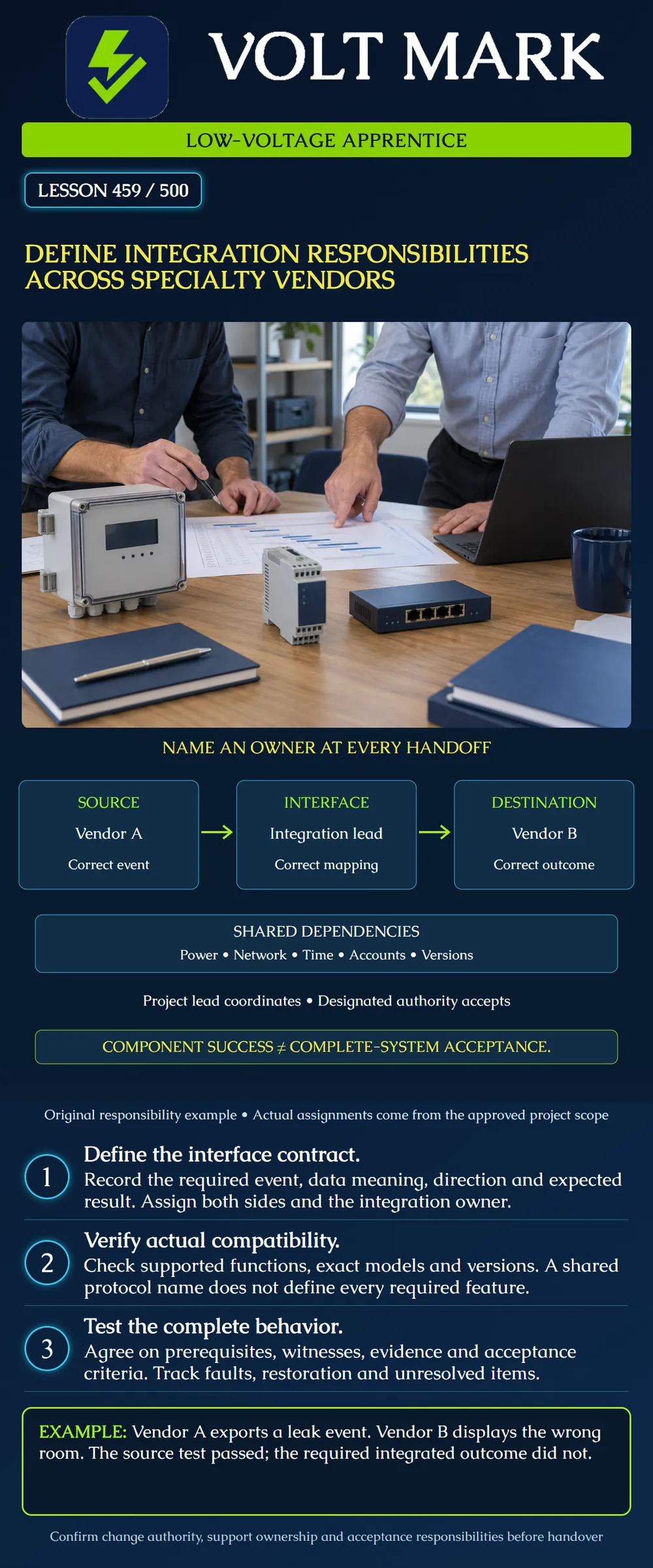
Create a responsibility map that connects a source system, an interface and a destination outcome. Explain why individual vendor tests do not replace integrated functional acceptance.
This is a project-coordination lesson for low-voltage apprentices. The example assignments are original teaching aids, not contractual or legal interpretations. The actual project scope, approved design and designated acceptance authority determine responsibilities. No live programming, credentials, control commands or safety-system modifications are authorized by this lesson.
A statement such as “integrate the systems” is too incomplete to test. Replace it with a specific, approved behavior: when a defined source condition occurs, the required destination must show the correct identity and state, with the required response and restoration behavior.
For the classroom example, a fictional leak controller reports Zone L1 to a facilities dashboard. The required display is “Room B — Leak.” The example performs monitoring only; it does not command a shutoff valve or change a life-safety system. Adding those actions would require new approved requirements, responsibilities and testing.
The source vendor demonstrates the agreed event and its documented representation. The receiving vendor demonstrates how the destination processes and displays it. An assigned integration lead coordinates translation, mapping and the complete chain. A project lead manages unresolved scope questions and the designated authority accepts the required outcome.
These roles can be held by different organizations or combined in one organization. The important point is a named accountable person or team for each task, not a mandatory organizational chart. Record the assignment before testing so a gap does not become “someone else's problem.”
An apprentice can help label interfaces, gather approved documents and record observations. The apprentice should not resolve a contractual scope dispute or assume authority to alter another vendor's configuration.
For each connection, record its source, destination, permitted direction, data identity and expected meaning. Add the actual model, software or firmware version, supported functions and approved communication method. Specify who provides connectivity, power, configuration, access credentials and ongoing support.
A binary value is not self-explanatory. In the fictional example, determine whether a value represents a present alarm, a latched event, a fault or a normal state. Include what happens when the source returns to normal or becomes unavailable. An unlabeled number on a dashboard is insufficient evidence that the intended condition is understood.
BACnet's Protocol Implementation Conformance Statement, or PICS, identifies the capabilities implemented in a particular product. The BACnet Committee explains its use in product selection and integration. Use the actual product documentation to check needed functions rather than treating the word BACnet as a complete feature list. [1]
ONVIF states that conformance is tied to a specific product firmware/software version and the claimed profiles. Its process includes mandatory and applicable conditional features. Check the appropriate registered product and documentation for the version being used. [2]
This illustrates a broader project habit: record what was actually tested. A product-family name or manufacturer's membership in an organization is not the same evidence as the specific implementation and required feature support.
Compatibility evidence and project acceptance answer different questions. Standards-related information can support selection, while the site test must still demonstrate the required mapping, configuration and end result. Do not promise every optional feature merely because the products use the same named protocol.
The interface may depend on approved network paths, addressing, time services, power, accounts, certificates, licenses or other services. Identify the responsible owners. Include those prerequisites in the test plan rather than inviting vendors to a test with missing dependencies.
Record read-only versus control permissions explicitly. A monitoring requirement is not permission to write commands. Do not expose passwords in a teaching worksheet or handover screenshot; use the organization's approved method for account management.
In the original exercise, Vendor A demonstrates the correct L1 event at its output. Vendor B's dashboard displays “Room C — Leak.” Source generation passed that observation, but integrated location mapping failed. Keep both facts in the record rather than declaring either that nothing works or that everything passed.
The integration lead coordinates diagnosis against the approved map. After an authorized correction, repeat the affected case and related checks required by the test plan. Keep the initial failure and corrective action traceable; do not replace the record with an unexplained green check.
Define acceptance criteria before the test. Include expected normal, event, fault and restoration behavior where applicable. If a response-time criterion is required, specify the measurement points and time basis. This lesson does not invent a universal delay limit.
The handover should identify the tested configuration, outstanding issues, support contacts and change responsibilities. Record who maintains mappings when a room is renamed, an endpoint is replaced or firmware changes. A system that works today can lose required behavior after an uncoordinated change.
Do not equate training attendance with technical acceptance, or a vendor's local test with acceptance by the project's designated authority. Keep those records distinct and link them to the approved requirements.
Create a one-page interface record for the fictional L1 example. Name the source owner, mapping owner, destination owner and acceptance authority. Add one shared dependency and one unresolved question. Write a test with expected and actual outcomes for the wrong-room condition.
Answer: No.
Answer: The assigned integration lead; actual project assignments may differ.
Answer: No; verify the whole required outcome.
Answer: No; permissions must match the approved scope.
Answer: Traceable correction, affected retests and the required acceptance evidence.
[1] BACnet Committee, Conformance (PICS): https://bacnet.org/conformance-pics/ Opened October 1, 2026. Supports product-specific capability documentation and integration use. [2] ONVIF, Conformance Process: https://www.onvif.org/profiles/conformance/ Opened October 1, 2026. Supports profile/version-specific conformance. No particular product was certified or validated by this lesson.
The responsibility matrix and scenarios are original teaching examples, not prescribed legal allocations. No engineering arithmetic required.
In the fictional L1 test, the source vendor demonstrates Zone L1 correctly, but the receiving dashboard displays Room C instead of required Room B. The source observation passes; the integrated identity check fails. Assign the mapping discrepancy to the named integration lead, preserve both observations and retest after the authorized correction. Do not give a monitoring interface control permissions while resolving the map.
Mistake: Accepting integration because each vendor's local test passed. Correction: Test the complete requirement from source event through destination identity, state and restoration.
Mistake: Treating a protocol logo as evidence of every required feature. Correction: Check the actual product capabilities, profile and firmware/software version against the interface record.
Correction: Name the owner responsible for mapping changes and the designated authority who accepts the integrated outcome.
Texas journeyman, 15 questions, scored by topic against the 70% mark. No card, and no account needed to start.
Free study material for low-voltage apprentices. This is a national foundation course: requirements differ by state and by local jurisdiction, and a practice that is common in one place is not a rule everywhere. Nothing here is a licence, a certification, or authority to work unsupervised, and completing it does not count as apprenticeship hours or continuing-education credit. Check the codes adopted where you are working, the licensing authority for that work, and your employer's safety programme. VoltMark is not affiliated with, endorsed by, or sponsored by NFPA, OSHA, NICET, BICSI, FOA, or any state or local licensing authority.

Electrician licensing exam prep: practice questions, timed exam simulations, and step-by-step help finding every answer in the NEC.