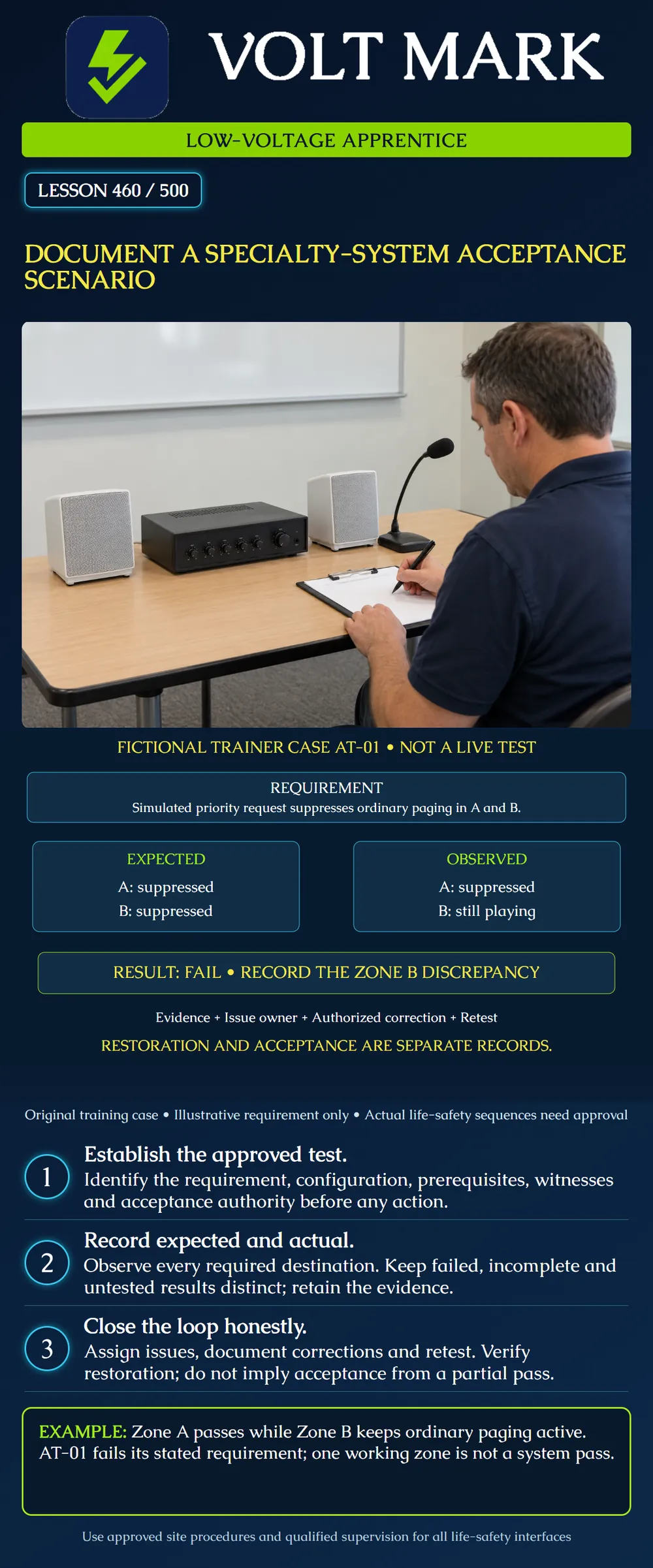
Write an acceptance scenario with a traceable requirement, prerequisites, expected results, actual observations, evidence, issue ownership and restoration. Distinguish a test observation from formal acceptance.
The worked example is a fictional disconnected classroom paging trainer. It is not a fire alarm sequence, a universal muting rule or instructions for a live building. Its priority request is simulated; no emergency message, dispatch or life-safety output is involved. Actual paging/fire interfaces require the approved design, applicable requirements, manufacturer instructions and qualified personnel.
WBDG describes commissioning documentation as a continuing record of requirements, decisions, tests and resolution. It emphasizes project-specific responsibilities, readiness checks, acceptable test results, reports and issue tracking. [1] This lesson applies that general documentation approach to an original training example. It does not reproduce a standard acceptance form or claim a completed inspection.
Case AT-01 refers to fictional trainer requirement TR-7, revision A. While the simulated priority request is active, ordinary paging must be suppressed in both trainer zones A and B. When the instructor ends the request, the trainer must return to its specified ordinary state using the documented restoration procedure.
Those are classroom assumptions. Do not transfer them to a real fire alarm installation. Actual system priorities, zones, permitted audio and restoration behavior must come from approved documents. Some systems have dedicated emergency communication functions that cannot be validated by checking an ordinary paging mute alone.
The test record identifies the two trainer zones and the exact configuration under observation. If a required document or zone identity is missing, the case is not ready. Do not invent the expected behavior after seeing what the equipment does.
For this paper exercise, assume a disconnected trainer with an instructor, an observer and a known configuration. No building systems, occupants, monitoring services or physical door controls are connected. The instructor confirms that the demonstration can be performed and restored.
For a real project, qualified leads establish the complete readiness and coordination requirements. The lesson does not list a supposedly sufficient live-test checklist. Notifications, impairment arrangements, safety precautions and required witnesses depend on the actual systems and site.
Record the test date, case identifier, configuration revision and responsible people. Distinguish a person observing a test from the person authorized to approve acceptance. Attendance alone does not convey approval authority.
Expected during the fictional request: ordinary paging suppressed in A and B. Observed in the supplied classroom case: A is suppressed; B continues ordinary paging. Result: AT-01 fails its stated requirement.
Keep the observations separate. “Zone A passed its suppression observation” is supportable. “The integrated system passed” is not. A controller indicator showing an active request would not override the observed output in B.
If nobody observed B, classify that part as untested or incomplete instead of passed. If the case could not proceed because a prerequisite failed, record it as not run with the reason. These labels prevent missing evidence from being mistaken for successful performance.
The original exercise assigns evidence record EV-01 to the instructor's observation sheet. It identifies the case, zone, stimulus state and result. A screenshot of a controller status can be supporting evidence, but it does not by itself prove the sound output at every required destination.
If an approved test includes timing or sound measurements, record the instrument, method, measurement point and required criterion. This lesson supplies no universal decibel, intelligibility or delay threshold. A statement such as “it sounded fine” is not a substitute for a specified measurement.
The apprentice's contribution is accurate observation and documentation within the assigned role. Do not fill witness names, measured values or signatures from assumptions. Do not mark a performed test in this educational file; the supplied outcomes are fictional.
Create fictional issue I-01: “Under AT-01, Zone B continued ordinary paging while the simulated priority request was active.” Assign it to the trainer integration lead for investigation. The observation does not establish the cause; possible explanations must be checked.
After an authorized correction, record its description and configuration revision. Retest the affected requirement and any related functions identified by the responsible lead. Preserve the original failure, correction and retest as connected records. A new successful observation must not erase the history of the discrepancy.
For classroom discussion, suppose a later case record shows both zones suppressed. That would support the retested observation, but formal acceptance would still require the remaining approved scope, restoration and designated review. Do not pre-complete those records.
Ending a stimulus, acknowledging an event and restoring normal operation are separate actions and observations. Record the trainer's required final state and who verified it. Leave unknowns visible.
For a live system, use the approved restoration process, including any required communication and confirmation by responsible personnel. This lesson does not authorize resetting, disabling or re-enabling fire protection equipment.
A specialty-system acceptance record must make clear what was tested, what was not, and which criteria apply. Approval of this one illustrative case would not establish compliance of an entire facility.
WBDG's guidance provides documentation context; project contracts and applicable authorities determine actual acceptance roles. Integrated fire/life-safety requirements must be checked against the applicable adopted documents by the responsible specialists. No NFPA clause or nationwide test sequence is asserted here.
Write a blank record for AT-01 with fields for requirement revision, prerequisites, expected result, actual result, evidence, status, issue owner, correction, retest, restoration and acceptance. Fill only the fictional observations provided. Mark the rest as pending or not supplied.
Answer: No; both destinations are required by TR-7.
Answer: No; it remains untested or incomplete.
Answer: No; verify each required outcome.
Answer: Preserve it with the correction and retest history.
Answer: No; use approved site-specific requirements.
[1] WBDG Commissioning Committee, Commissioning Documents: Process, Contents, and Acceptance: https://legacy.wbdg.org/building-commissioning/commissioning-documents Opened October 1, 2026. General commissioning documentation guidance, not a live-system procedure or universal regulatory requirement.
Research limitation: The NFPA 4 standard-development page was opened but exposed no substantive standard text. It is not relied upon for clause-level requirements. Full NFPA standards were not reviewed for this lesson.
All case identifiers, observations and records above are original fictional teaching material. No arithmetic or measured acceptance result is claimed.
For AT-01, TR-7 revision A requires suppression in both A and B during the simulated request. EV-01 records A suppressed and B still paging. Enter fail, open I-01 for the B observation and assign the trainer integration lead. A later successful observation must link to the correction and new configuration revision. Leave restoration and formal acceptance pending until their separate required evidence exists; a successful partial retest cannot fill those fields.
Mistake: Changing the expected result after seeing the trainer's behavior. Correction: Keep the approved requirement and revision fixed; record the discrepancy and obtain authorized review of any requirement change.
Mistake: Marking an unobserved zone as passed because the controller indicates an active request. Correction: Record that zone as untested and obtain the required output observation.
Mistake: Replacing the failed test sheet with a later passing one. Correction: Link the original failure, issue, correction, retest and restoration evidence so acceptance remains traceable.
Texas journeyman, 15 questions, scored by topic against the 70% mark. No card, and no account needed to start.
Free study material for low-voltage apprentices. This is a national foundation course: requirements differ by state and by local jurisdiction, and a practice that is common in one place is not a rule everywhere. Nothing here is a licence, a certification, or authority to work unsupervised, and completing it does not count as apprenticeship hours or continuing-education credit. Check the codes adopted where you are working, the licensing authority for that work, and your employer's safety programme. VoltMark is not affiliated with, endorsed by, or sponsored by NFPA, OSHA, NICET, BICSI, FOA, or any state or local licensing authority.

Electrician licensing exam prep: practice questions, timed exam simulations, and step-by-step help finding every answer in the NEC.