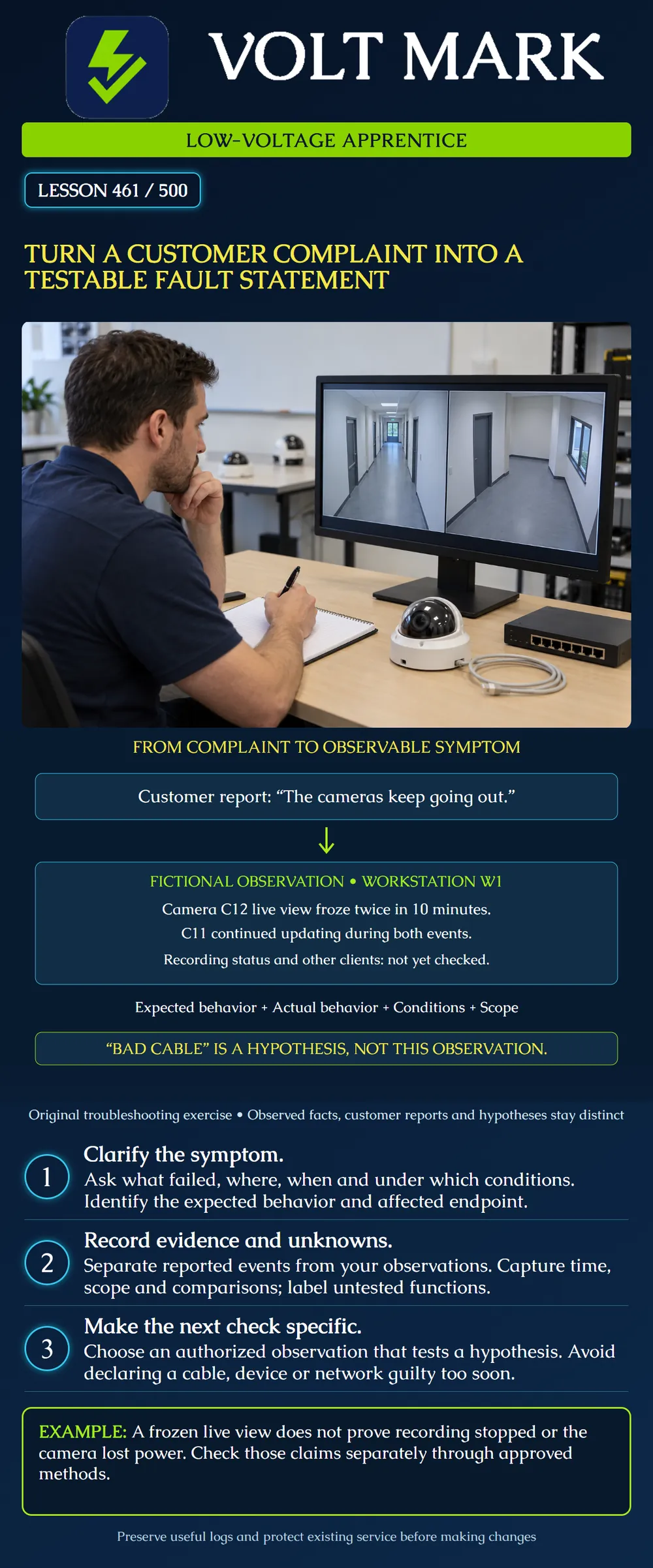
Convert a general service complaint into a precise description of expected and actual behavior, affected scope and relevant conditions. Keep reported information, observed evidence and possible causes distinct.
This is a troubleshooting communication lesson. It does not authorize surveillance access, account changes, cable replacement, service interruption or live life-safety testing. Use approved access and supervision. All camera identifiers and observations below are fictional.
Cisco's Troubleshooting Overview describes defining symptoms, gathering facts from people and technical records, considering possible causes and evaluating results through a structured plan. It stresses using the particular environment's context. [1] The exercises here are original examples applying that general approach, not product-specific diagnosis instructions.
“The cameras keep going out” communicates a real problem from the user's perspective, but it does not identify the failing function. Preserve the report, then clarify its meaning with plain questions.
Ask which camera or view was affected, where the user was viewing it, what the screen actually showed, when it happened and whether it recovered. Ask whether the issue affected live viewing, playback, exporting or another function. A black tile, frozen picture, login error and missing recording are different symptoms.
Avoid replacing the customer's words with an unsupported diagnosis. “The network is bad” might be their interpretation; record the actual behavior that led them to that conclusion. Do not dismiss an intermittent complaint simply because the system looks normal during a brief visit.
The fictional workstation W1 should display an updating live view from camera C12 under the agreed viewing conditions. That is the expectation for this exercise. If the actual requirement includes frame rate, latency or other performance limits, obtain the approved criteria rather than inventing them.
Identify the device and application version when relevant, but keep private credentials and unnecessary personal information out of the fault statement. A useful description is concise enough for the next technician to understand and specific enough to reproduce within authorized conditions.
During a fictional ten-minute observation on W1, the C12 live view froze twice. C11 continued updating during both events. Recording status and other viewing clients were not checked.
That statement establishes a bounded observation. It does not establish the freeze duration, a long-term failure rate, the cause or the condition of every camera. Two events in ten minutes should not be projected into an hourly reliability claim without supporting data.
Write the observation interval and timestamps with the available time basis. Do not invent exact times or precision after the fact. If times came from different systems, note that clock agreement has not yet been verified where relevant.
Recording may have continued while live view froze, but it has not been examined in the exercise. The camera may have remained powered, but no power evidence is supplied. Other clients might show the same problem or might not. These are questions for investigation, not facts to fill in by assumption.
C11's continued updating is a useful comparison. It narrows the observed scope on W1; it does not prove that all shared network components are fault-free. Different streams can behave differently through shared services.
A fault statement becomes stronger when it marks its limits. “C12 live view froze on W1; recording status unknown” is more useful than “C12 offline” when an offline condition was not actually verified.
Possible explanations might involve the viewing application, camera stream, network path or another dependency. “Bad cable” is one hypothesis only if evidence gives a reason to consider it. A frozen image alone does not select that cause.
For the exercise, a useful next question is whether the same time interval contains a continuous recording in the authorized recording system. Another might compare the live stream at a second approved client under controlled conditions. Choose checks based on the approved access, service impact and the specific hypothesis.
The point is not to perform every available diagnostic. It is to choose a check whose result would change the next decision. A test that cannot distinguish among the suspected conditions may consume time without improving the fault statement.
Do not start by restarting equipment simply to make the symptom disappear. A restart may interrupt service or remove useful transient evidence. The responsible lead determines whether it is appropriate after considering operational needs and available records.
If an authorized action changes the condition, record what changed and what was observed afterward. “It works now” does not establish the cause or long-term resolution. Preserve the original complaint and compare the same relevant function under the agreed verification conditions.
For an access-control complaint, distinguish reader response, access decision, lock command and physical door behavior. “The door is broken” does not specify which function failed.
For a fiber complaint, distinguish an application problem, a link indication and a measured optical result. “The fiber is bad” is not an observed loss measurement.
For an environmental alarm complaint, distinguish sensing, controller reporting and remote notification. A missing text message does not establish that the sensing element failed. Each example uses the same discipline: expected behavior, actual evidence, conditions and known limits.
Rewrite “The cameras are unreliable” using only the fictional observations above. Then list two unknowns and one authorized observation that could help distinguish a hypothesis. Do not add a cause or claim that recording failed.
Answer: No; it is a possible cause requiring evidence.
Answer: That C11 updated on W1 during the stated observations, not that every shared component is healthy.
Answer: Unknown; it was not checked.
Answer: No.
Answer: A defined, authorized observation tied to a hypothesis and decision.
[1] Cisco, Troubleshooting Overview: https://www.cisco.com/en/US/docs/internetworking/troubleshooting/guide/tr1901.html Opened October 1, 2026. Legacy methodology reference, used only for general structured fact gathering and symptom definition. No legacy product configuration or command is recommended.
Original scenarios, observation record and questions. No real customer incident or test result is claimed.
The complaint is "the cameras keep going out." The supplied observation supports: "During a ten-minute check at W1, C12 live view froze twice while C11 continued updating; C12 recording and other clients were not checked." This names function, scope and limits without diagnosing a cable fault. An authorized comparison of the same interval's recording could distinguish a viewing-only symptom from loss in the recorded path. Preserve the unknowns until that evidence is obtained.
Texas journeyman, 15 questions, scored by topic against the 70% mark. No card, and no account needed to start.
Free study material for low-voltage apprentices. This is a national foundation course: requirements differ by state and by local jurisdiction, and a practice that is common in one place is not a rule everywhere. Nothing here is a licence, a certification, or authority to work unsupervised, and completing it does not count as apprenticeship hours or continuing-education credit. Check the codes adopted where you are working, the licensing authority for that work, and your employer's safety programme. VoltMark is not affiliated with, endorsed by, or sponsored by NFPA, OSHA, NICET, BICSI, FOA, or any state or local licensing authority.

Electrician licensing exam prep: practice questions, timed exam simulations, and step-by-step help finding every answer in the NEC.