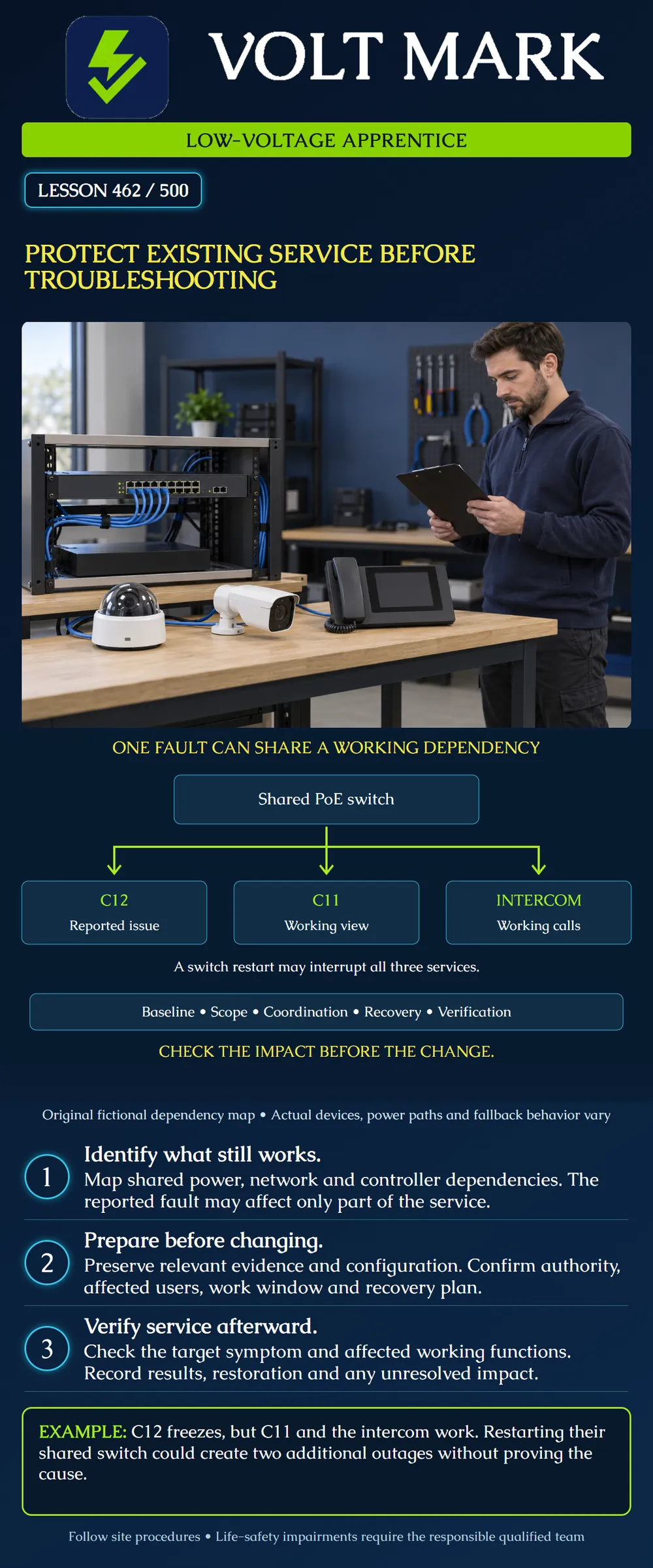
Identify working services that a proposed troubleshooting action could interrupt. Prepare evidence, coordination and recovery before making an authorized change, then verify both the target function and affected dependencies.
This is a planning lesson for low-voltage apprentices. It does not authorize production restarts, configuration changes, alarm impairments or bypasses. Follow the responsible service owner's procedures and assigned supervision. The diagram is an original fictional example, not a real network assessment.
A service complaint does not mean everything is already out of service. Identify the affected function and what still works. Record those facts before changing equipment.
In the fictional example, camera C12's live view freezes intermittently. C11's view and an IP intercom's calls are working. All three use a shared PoE switch. Restarting that switch could interrupt the working devices as well as the reported one. The diagram does not assert any particular intercom's fallback behavior; that must be checked for the real product and configuration.
Cisco's troubleshooting guidance recommends current network information, a documented baseline, maintenance coordination and records of changes to support recovery. [1] These ideas help prevent a narrow symptom from turning into a wider service problem.
For a proposed action, ask which equipment and functions depend on the component being changed. Include power as well as communications. A switch may carry traffic and supply endpoint power, while a controller or server may support several sites or subsystems.
Do not equate an endpoint's label with its whole dependency chain. A device on a different wall can still share the same supply, uplink or software service. Conversely, a nearby device may have an independent path. Use approved drawings and verified configuration records rather than assuming from physical location.
In the paper exercise, changing a local viewing setting could have a different reach from restarting the shared switch. That does not automatically make the setting change appropriate; confirm its effect and authority. The purpose is to identify impact before acting.
Collect the relevant approved observations and records while they still exist. A restart can remove transient state or make an intermittent symptom disappear temporarily. Avoid collecting unnecessary sensitive content.
Record the installed configuration and the proposed change with enough detail for the responsible team to understand and recover it. Keep backups and credentials in approved locations. A file called “backup” is not proof that it is current, complete, compatible or restorable.
NIST's updated SP 800-128 publication describes security-focused configuration management as part of managing risk while supporting business functions and services. [2] That context supports treating troubleshooting changes as controlled work, not isolated experiments. This lesson does not impose federal requirements on every private installation.
Establish who can authorize the action, who performs it, who must be informed and who verifies service afterward. Confirm the agreed work window and any restrictions. Urgency does not erase the need to understand consequences; use the site's escalation process.
For the fictional case, the service owner needs to know that a shared-switch restart could affect the intercom. Do not treat “camera maintenance approved” as evidence that every unrelated service outage was approved. Ask the responsible lead to resolve the scope before a disruptive step.
Life-safety systems, patient-care systems and other critical functions may require specific impairment arrangements and qualified personnel. This general lesson does not provide a complete impairment checklist or authorize a temporary substitute.
A recovery plan identifies the intended return state, who can restore it, required resources and the condition that triggers stopping or reversing the work. Consider whether the proposed change can actually be reversed and whether recovery depends on the same network access that could be lost.
For a classroom worksheet, leave the recovery method pending if the necessary product information is missing. Do not write “undo it” as if that guarantees restoration. Firmware, database and hardware changes can have different recovery constraints.
A configuration backup does not protect against every hardware or power fault. A second network connection does not prove an independent recovery path unless the shared dependencies have been checked. The responsible specialist determines what preparations are suitable.
Choose the next authorized check for a defined reason. Start with appropriate existing evidence and low-impact observations when they can answer the question. Even a diagnostic action can affect a constrained system, so follow product and site guidance.
Do not repeatedly reset shared equipment merely because one restart seemed to help. Temporary symptom relief is evidence about behavior, not proof of the root cause. Record exactly what changed and what happened.
If unexpected effects appear, use the agreed stop and escalation process. Do not conceal a new outage while continuing to experiment. The working baseline helps identify which functions changed during the action.
After an authorized change, check C12's relevant function under the agreed observation conditions. Also verify the working functions that the action could affect, including C11 and the intercom in this example. Restored power or a link light alone does not prove the application service works.
Document what was checked, observed results and anything still unresolved. A passing immediate check does not establish permanent resolution of an intermittent fault. The service owner sets the required follow-up and closure criteria.
For the fictional diagram, list the working services, the reach of a shared-switch restart, evidence to preserve, people to coordinate with and recovery questions. Write separate post-checks for C12, C11 and the intercom. Do not supply a live restart procedure.
Answer: No.
Answer: Transient evidence may be lost or the symptom temporarily hidden.
Answer: No.
Answer: The target symptom and all affected required functions.
Answer: Follow the agreed stop, recovery and escalation process.
[1] Cisco, Troubleshooting Overview: https://www.cisco.com/en/US/docs/internetworking/troubleshooting/guide/tr1901.html Opened October 1, 2026. Legacy general methodology; no legacy device commands recommended. [2] NIST, SP 800-128, updated publication record and abstract: https://csrc.nist.gov/pubs/sp/800/128/upd1/final Opened October 1, 2026. Includes updates as of October 10, 2019. Publication summary reviewed for configuration-management context; full document not reviewed for this lesson.
Original scenario and planning exercises; no real outage, backup validation or recovery test claimed.
The paper job authorizes investigation of C12 freezing, but the proposed switch restart also interrupts working C11 and intercom service. The scope of approval therefore needs resolution before that action. Record those working functions, preserve transient evidence and have the owner establish the work window and recovery arrangement. After an authorized shared change, the verification record must cover C12's symptom, C11 live view and intercom calls, not only switch power.
Mistake: Reading camera-maintenance approval as approval to interrupt the shared intercom. Correction: Map power and communication dependencies and resolve the proposed outage scope with the responsible service owner.
Mistake: Assuming a file named backup guarantees rollback. Correction: Verify its date, completeness, compatibility, access and the approved restoration method before relying on it.
Mistake: Closing the task when the problem camera returns after a switch restart. Correction: Check the formerly working dependent services and use the agreed follow-up conditions for the intermittent symptom.
Texas journeyman, 15 questions, scored by topic against the 70% mark. No card, and no account needed to start.
Free study material for low-voltage apprentices. This is a national foundation course: requirements differ by state and by local jurisdiction, and a practice that is common in one place is not a rule everywhere. Nothing here is a licence, a certification, or authority to work unsupervised, and completing it does not count as apprenticeship hours or continuing-education credit. Check the codes adopted where you are working, the licensing authority for that work, and your employer's safety programme. VoltMark is not affiliated with, endorsed by, or sponsored by NFPA, OSHA, NICET, BICSI, FOA, or any state or local licensing authority.

Electrician licensing exam prep: practice questions, timed exam simulations, and step-by-step help finding every answer in the NEC.