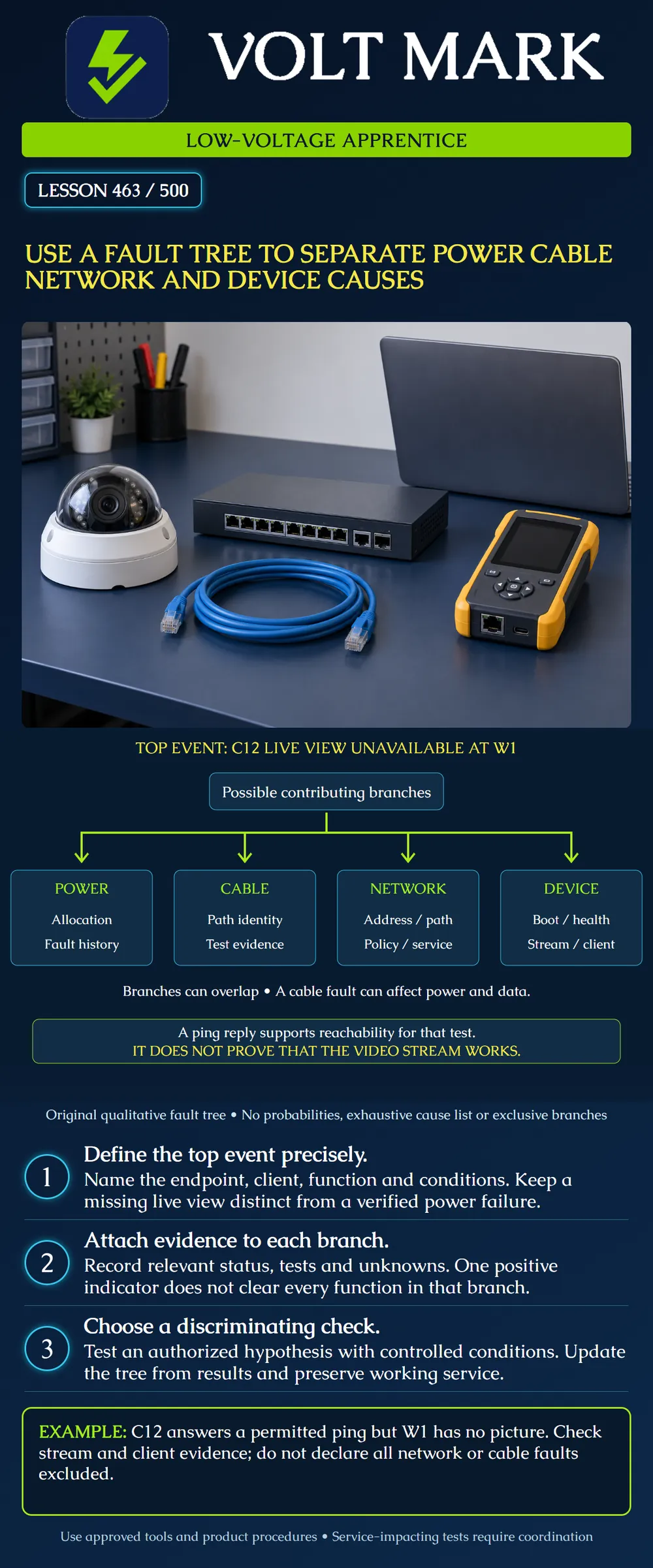
Organize possible causes of a low-voltage service fault into evidence-based branches. Distinguish what a test demonstrates from what remains unknown.
The poster is a qualitative troubleshooting tree, not a formal probabilistic reliability analysis. Its categories overlap and are not exhaustive. The fictional top event is “Camera C12 live view unavailable at workstation W1.” No live test, intrusive diagnostic or equipment substitution is authorized by this lesson.
The top event names the observed function. It does not say C12 lost power, the cable failed or the camera is defective. Those are potential explanations requiring evidence.
Confirm the time, conditions and affected client from the service record. A symptom reported by a user and a symptom personally observed by a technician are different evidence sources; label them. Identify what should occur under the approved operating requirements.
Power: What supplies the endpoint, and what evidence shows its state during the event? Relevant approved records might include allocation status, power faults and device restart history. Cable: Which physical path is actually involved? What inspection or suitable test evidence is available for that path? Network: What addressing, permitted communication path and application services are required? Which observations confirm or challenge those requirements? Device: What do endpoint health, boot state, stream settings and client behavior show? Include the viewing application rather than assuming only the camera can fail.
Cisco's Catalyst 9000 PoE troubleshooting guide distinguishes power and data symptoms and asks about scope, timing, device compatibility, available power and logs. [1] Those categories inform this exercise. Its platform-specific commands and intrusive recovery procedures are not general apprentice instructions.
A cable problem can affect both delivered power and data. A device configuration can interact with network policies. A shared switch can be involved in several branches. Do not force every cause into a single exclusive box.
The tree is a way to organize questions. It does not assign equal probabilities or establish which cause is most likely without evidence. If the situation suggests an omitted dependency, add it. A recording server, authentication service or software license might matter to a particular system even though the poster uses only four broad categories.
A permitted ping reply supports reachability for the tested exchange at that time. It does not demonstrate a working video stream, sufficient sustained performance or correct viewing permissions. A failed ping does not by itself prove a cable is open; the target or path may not permit that traffic.
A link indication does not demonstrate every cable performance requirement. A power allocation entry does not automatically establish endpoint operation through every transient. Read the manufacturer's meanings and the actual test boundaries rather than converting an indicator into a blanket pass.
Record “supported,” “contradicted” or “unknown” beside a specific hypothesis with its evidence. Avoid a broad statement such as “network good” when the only evidence is one response.
Suppose a supervised trainer works after a patch lead and port are changed together. That result does not isolate which change mattered. The changed setup also may have altered power negotiation, configuration or timing.
A controlled comparison should identify exactly what changed, what remained the same and the observation conditions. Even when a substitution points toward a component or connection, verify the interpretation before claiming root cause. An intermittent symptom might disappear during either test for unrelated reasons.
Protect the working services identified in lesson 462. A test intended to separate hypotheses should not create an unplanned outage elsewhere. Stop and escalate if the approved scope or recovery plan is inadequate.
Update the top-event record after an authorized correction and verify the intended service under the agreed conditions. Retain unresolved branches and limitations. An immediate recovery is not proof of long-term resolution.
Write a conclusion proportional to the evidence: “The live view returned after the approved mapping correction, and the specified verification passed” is more defensible than asserting a universal failure cause for every future outage.
Copy the four-branch tree. Add the fictional ping reply to the network evidence and mark video-stream function as still unverified. Write one next observation and explain which hypothesis it would help evaluate. Do not cross out the entire network or cable branch.
Answer: No; causes can overlap.
Answer: No.
Answer: No.
Answer: No.
Answer: Its result can distinguish a stated hypothesis and guide the next decision.
[1] Cisco, Troubleshoot Power over Ethernet on Catalyst 9000 Switches, document 215636: https://www.cisco.com/c/en/us/support/docs/switches/catalyst-9200-series-switches/215636-troubleshooting-power-over-ethernet-poe.html Opened October 1, 2026; page displays September 5, 2024 update. Used for scoped symptom and evidence categories. No platform-specific power table, recovery command or procedure is generalized to all systems.
Original tree and fictional exercises. No cause probabilities or real diagnostic results claimed.
A permitted ping to C12 replies while W1 shows no picture. Add the reply to the tree as evidence of that exchange, leaving video delivery unknown. Do not eliminate the network branch: stream transport, permissions or client behavior can differ from ping. The responsible technician chooses an authorized comparison of stream status or a second client because that result can distinguish a narrower hypothesis; repeated identical ping checks cannot establish video operation.
Mistake: Crossing out the network branch after one ping reply. Correction: Record exactly what replied and when, then keep untested stream and application requirements open.
Mistake: Forcing a power-and-data symptom into only one branch. Correction: Allow a cable, switch or configuration dependency to appear in multiple branches and link the shared evidence.
Mistake: Naming the patch lead as the cause after changing both lead and port. Correction: Document both changes and obtain a controlled compatible comparison before isolating one component.
Texas journeyman, 15 questions, scored by topic against the 70% mark. No card, and no account needed to start.
Free study material for low-voltage apprentices. This is a national foundation course: requirements differ by state and by local jurisdiction, and a practice that is common in one place is not a rule everywhere. Nothing here is a licence, a certification, or authority to work unsupervised, and completing it does not count as apprenticeship hours or continuing-education credit. Check the codes adopted where you are working, the licensing authority for that work, and your employer's safety programme. VoltMark is not affiliated with, endorsed by, or sponsored by NFPA, OSHA, NICET, BICSI, FOA, or any state or local licensing authority.
Electrician licensing exam prep: practice questions, timed exam simulations, and step-by-step help finding every answer in the NEC.