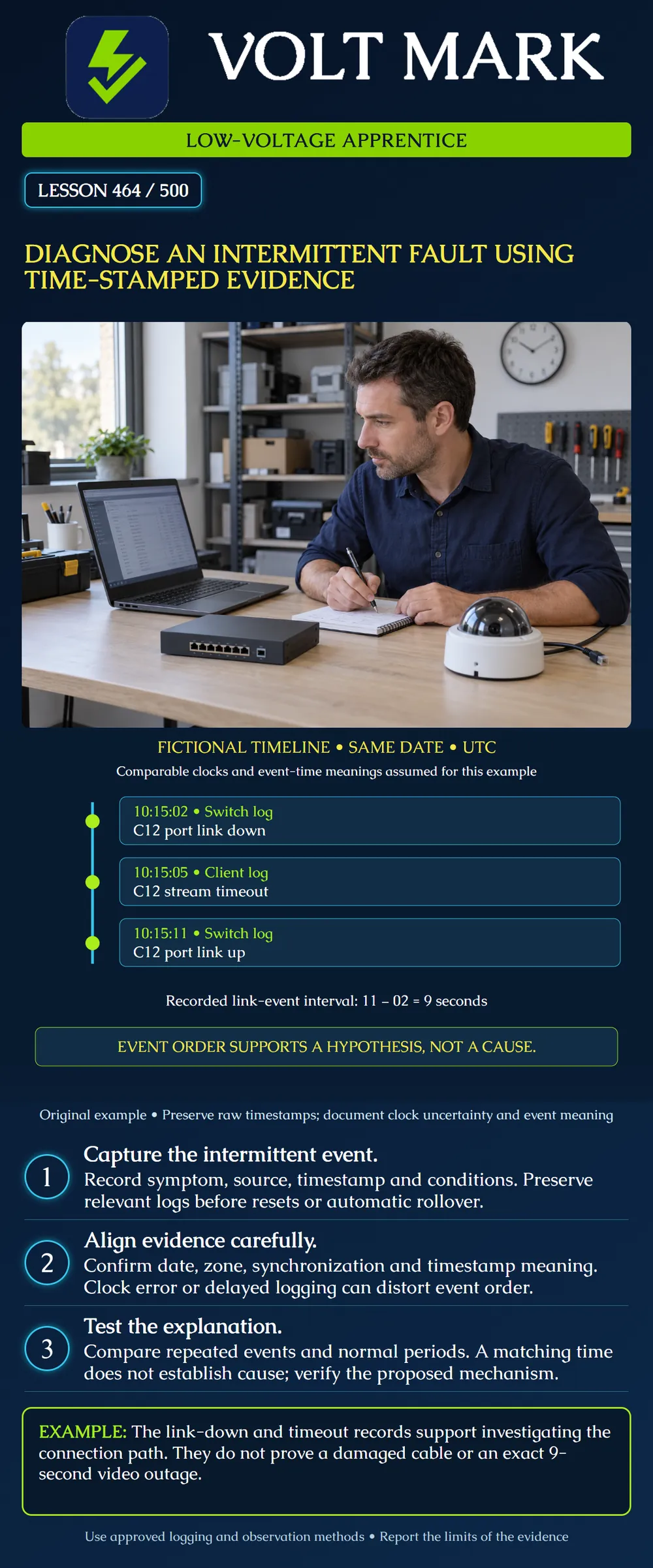
Build a defensible event timeline for an intermittent low-voltage fault. Distinguish a recorded sequence from a verified cause and state the limits of timing evidence.
All timestamps and device events in this lesson are fictional. This is an evidence-interpretation exercise, not authorization to collect private video, enable intrusive diagnostics or reset equipment. Follow the site's logging, access and service-protection procedures.
An intermittent symptom can disappear before a technician arrives. Record its function, affected endpoint, observed time and operating conditions. Preserve relevant existing logs before they roll over or a reset changes the available evidence.
NIST's SP 800-92 publication overview describes organized log-management practices and infrastructure. [1] The lesson uses that general context, not a claim that a particular logging product guarantees complete evidence. Identify what each available log actually records and whether there are known collection gaps.
For the fictional C12 camera complaint, useful questions include whether the loss occurs at the same time of day, whether other endpoints show symptoms and whether configuration or environmental conditions changed. Treat the answers as reports or observations according to their source.
A timestamp needs a date, time zone or UTC offset, and a clear meaning. Determine whether it represents event detection, message transmission, server receipt or display. Equal-looking times from different systems are not automatically comparable.
Check available synchronization evidence and uncertainty. NIST's research on NTP time transfer identifies unequal network delays and endpoint-related effects as timing limitations. [2] Do not assume every synchronized device meets a universal accuracy value.
Preserve original records. If analysis converts local times to UTC or applies a documented clock correction, keep those derived values in separate columns with the method and assumptions. Do not rewrite raw logs to make a sequence fit a preferred explanation.
For this exercise only, assume the same date, UTC, comparable clocks and event-time meanings suitable for the displayed sequence: 10:15:02 — Switch log: C12 port link down. 10:15:05 — Client log: C12 stream timeout. 10:15:11 — Switch log: C12 port link up.
The difference between the two switch records is nine seconds. The client timeout record appears three seconds after the recorded link-down event. These are differences between the supplied timestamps, not measured physical propagation delays.
The records support investigating the connection path and its dependencies. They do not identify a damaged cable. Port configuration, endpoint behavior, power events or other conditions could be relevant. Additional evidence is needed to distinguish them.
A stream timeout may be logged after the display first stopped updating. A link-up record does not prove the application immediately resumed. Therefore, the nine-second recorded link interval is not an exact video-outage measurement.
Use the appropriate evidence for the service claim. If the requirement concerns live-view availability, observe or measure that function with an approved method. If it concerns recording continuity, examine the permitted recording evidence separately. Keep latency, log resolution and clock limitations visible.
In a variant exercise, suppose the two systems' clock offsets are unknown. The apparent three-second order between link-down and timeout can no longer be treated as established across systems. The two switch entries may still support a same-clock interval, but clock steps, timestamp precision and logging behavior must be considered.
A useful pattern repeats under comparable conditions, but repeated coincidence still needs a mechanism. Look for whether the proposed contributing event occurs without the symptom, and whether the symptom occurs without that event.
For example, a scheduled task appears near one freeze. That makes it a candidate for investigation, not the cause. Determine whether the task shares a relevant resource and whether other runs show the same relationship. Do not disable a production schedule simply to test a guess.
Record observation coverage. If monitoring ran only during a short visit, do not claim that no failures occurred for the entire day. If logs rolled over, say the period is unavailable rather than interpreting missing entries as normal operation.
Logging and capture settings can consume storage, bandwidth or processing resources and may expose sensitive data. Use approved methods and limits. The apprentice's task is to gather the assigned evidence accurately, not turn on every diagnostic.
Capture the necessary device identity, software version, event text and relevant conditions. Avoid unnecessary credentials or private footage in a service report. Keep the retained evidence in authorized storage and follow the site's retention requirements.
After an authorized change, define an observation period and conditions relevant to the original symptom. Report the actual scope: “No recurrence observed during the agreed test” is different from “The fault can never recur.”
If several items changed, disclose that limitation when discussing cause. Maintain the original symptom history, correction record and follow-up evidence. An intermittent-fault investigation may narrow a hypothesis before it establishes root cause; report that progress honestly.
Copy the three fictional records into a table with columns for source, raw timestamp, time basis, event meaning and interpretation. Calculate the switch-record interval, then list two reasons it is not automatically the exact video-outage duration.
Answer: Nine seconds under the stated timestamp assumptions.
Answer: No.
Answer: Yes.
Answer: No; collection and retention limits may matter.
Answer: State what was tested, for how long, under which conditions and with what observed result.
[1] NIST, SP 800-92, Guide to Computer Security Log Management: https://csrc.nist.gov/pubs/sp/800/92/final Opened October 1, 2026. Publication overview/abstract reviewed for logging context; full document not reviewed for this lesson. [2] NIST, Practical Limitations of NTP Time Transfer: https://www.nist.gov/publications/practical-limitations-ntp-time-transfer Opened October 1, 2026. Research abstract reviewed; no universal timing guarantee adopted.
Original timeline and exercises. 11−02=9 seconds and 05−02=3 seconds checked within the same displayed minute and stated assumptions. No real outage or diagnosis claimed.
Mistake: Calling the nine-second link-record interval the exact video outage. Correction: Identify the logged boundary and obtain application recovery evidence before stating video-outage duration.
Mistake: Treating the three-second cross-system order as proven when clock offsets are unknown. Correction: Preserve raw timestamps and qualify ordering until clock basis, event meaning and uncertainty are established.
Mistake: Declaring permanent resolution after a short quiet observation. Correction: State the actual monitoring period, conditions and recurrence result, and retain the required follow-up.
Texas journeyman, 15 questions, scored by topic against the 70% mark. No card, and no account needed to start.
Free study material for low-voltage apprentices. This is a national foundation course: requirements differ by state and by local jurisdiction, and a practice that is common in one place is not a rule everywhere. Nothing here is a licence, a certification, or authority to work unsupervised, and completing it does not count as apprenticeship hours or continuing-education credit. Check the codes adopted where you are working, the licensing authority for that work, and your employer's safety programme. VoltMark is not affiliated with, endorsed by, or sponsored by NFPA, OSHA, NICET, BICSI, FOA, or any state or local licensing authority.

Electrician licensing exam prep: practice questions, timed exam simulations, and step-by-step help finding every answer in the NEC.