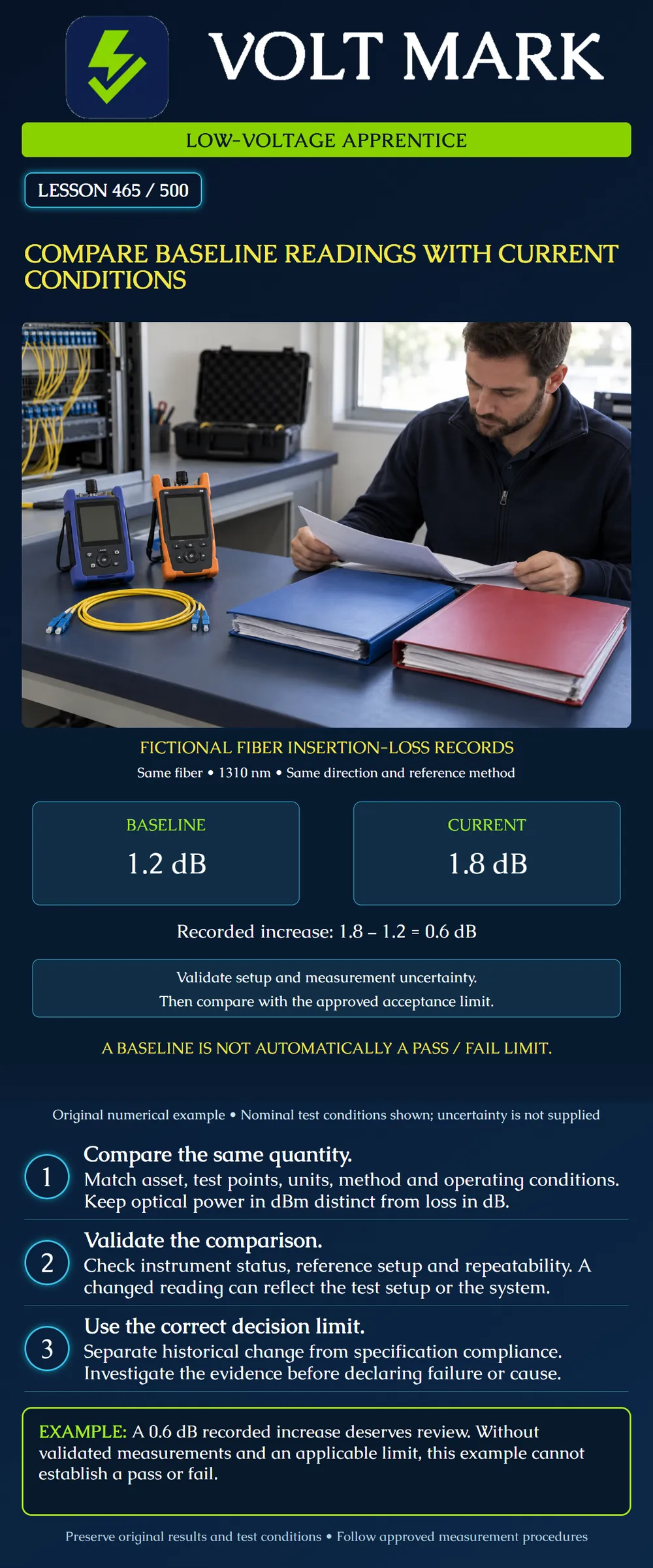
Compare historical and current readings only when the measured quantity and test conditions are sufficiently comparable. Separate a recorded change from a verified physical change, a cause and an acceptance decision.
This lesson uses fictional fiber insertion-loss results as a low-voltage measurement example. It is not a fiber test procedure or authorization to disconnect an active circuit. Apply approved test methods, instrument instructions and supervision.
A baseline is a documented reference condition. It might come from commissioning, an approved maintenance test or another known operating state. Establish which asset, path and function it represents before using it.
An old result is not automatically a valid baseline. Confirm its identity, date, configuration and test method. A mislabeled fiber or a result from before a route change can produce a misleading comparison even when the numbers look precise.
The baseline also is not automatically an acceptance threshold. A system can change while remaining within a specification, or remain close to an old reading that never met the specification. Keep the historical comparison and the compliance question separate.
For the poster, both records nominally describe insertion loss on the same fiber at 1310 nm, in the same direction, using the same reference method. Those are necessary context, not proof that every source of uncertainty is controlled.
FOA's measurement tutorial explains that reference methods, reference connections, wavelength and test conditions can affect measured fiber loss. [1] This makes the method part of the result. Do not compare an OTDR event estimate directly with an end-to-end insertion-loss result as though they measured identical boundaries.
Optical power expressed in dBm and insertion loss expressed in dB are different quantities. A negative received-power reading cannot simply be subtracted from a positive loss baseline without a defined measurement relationship. Record the unit beside every value.
The fictional baseline is 1.2 dB. The current reading is 1.8 dB. Current minus baseline is 0.6 dB, so the recorded loss is higher by 0.6 dB.
That arithmetic is valid for the supplied numbers. It does not establish that the cable itself physically degraded by exactly 0.6 dB. It also does not locate a connector, bend or splice fault.
Do not call this “50 percent less optical power” by dividing the two dB values. Decibels express a logarithmic ratio; ratios of dB readings are not direct ratios of transmitted power. The lesson intentionally reports the change in dB without introducing an unsupported percentage.
The project must supply the relevant limit and decision rule. For fiber, that requires the correct path, wavelength and test boundary. A generic value from another installation is not a substitute.
The poster gives no allowable loss limit, so it deliberately makes no pass/fail decision. Even if a nominal reading lies below a stated limit, the applicable procedure may require consideration of uncertainty, margin or other conditions. Ask the responsible specialist to resolve missing criteria.
A troubleshooting conclusion can still be useful: “The recorded loss increased from 1.2 to 1.8 dB under the stated nominal method; comparability and acceptance criteria need confirmation.” That reports progress without inventing failure or cause.
For other low-voltage measurements, the same discipline applies. A supply-voltage reading under load is not directly equivalent to an unloaded historical reading. A wireless reading from a different client position may reflect changed geometry rather than device failure. Network counters collected over different intervals need a defined comparison basis.
These examples do not prescribe tests. They show why load, location, interval and configuration belong beside the number. If conditions changed, describe the change and its possible effect before interpreting the result.
Retain the original baseline and current record. Add a separate comparison noting the method, units, assumptions and limitations. Do not overwrite the baseline with the new reading simply because it is newer.
If an authorized correction is made, record the post-change result and conditions as another entry. The responsible team determines whether it becomes a new approved baseline. Keeping the sequence supports future diagnosis and prevents loss of the installation's history.
Create a comparison sheet for the fictional values. Include asset identity, wavelength, direction, reference method, baseline, current value, difference, uncertainty information and acceptance criterion. Mark the last two as not supplied. State what can and cannot be concluded.
Answer: An increase of 0.6 dB.
Answer: No.
Answer: No.
Answer: No.
Answer: Record the limitation and seek evidence; do not assume equivalence.
[1] Fiber Optic Association, Accurately Testing Fiber Optic Cables: https://www.thefoa.org/tech/ref/testing/accuracy/accuracy.html Opened October 1, 2026. Used for reference-method and measurement-condition concepts. Legacy standards discussion and broad procedural claims are not adopted as current universal requirements. [2] NIST, Measurement Uncertainty: https://www.nist.gov/itl/sed/topic-areas/measurement-uncertainty Opened October 1, 2026. General uncertainty context; no numerical uncertainty assigned to the fictional results.
Original numerical example and exercises. 1.8−1.2=0.6 dB checked. No actual instrument, cable condition or acceptance result verified.
The paper results are 1.2 dB at baseline and 1.8 dB now, nominally for the same fiber, wavelength, direction and reference method. Subtracting gives a recorded increase of 0.6 dB. No uncertainty budget or allowable limit is supplied, so enter both as unresolved. The next decision is to verify comparison conditions and the applicable criterion, not to name a damaged connector or declare a failed link from the difference alone.
Mistake: Using the old baseline as the allowable loss limit. Correction: Retrieve the actual path-specific criterion and decision rule, keeping historical change separate from acceptance.
Mistake: Dividing 1.8 by 1.2 and calling the result an optical-power percentage. Correction: Report the 0.6 dB difference; a ratio of dB values is not a transmitted-power ratio.
Mistake: Comparing an OTDR event estimate with end-to-end insertion loss as if the boundaries matched. Correction: Identify each method, reference plane, wavelength and direction, and document non-comparable results explicitly.
Texas journeyman, 15 questions, scored by topic against the 70% mark. No card, and no account needed to start.
Free study material for low-voltage apprentices. This is a national foundation course: requirements differ by state and by local jurisdiction, and a practice that is common in one place is not a rule everywhere. Nothing here is a licence, a certification, or authority to work unsupervised, and completing it does not count as apprenticeship hours or continuing-education credit. Check the codes adopted where you are working, the licensing authority for that work, and your employer's safety programme. VoltMark is not affiliated with, endorsed by, or sponsored by NFPA, OSHA, NICET, BICSI, FOA, or any state or local licensing authority.

Electrician licensing exam prep: practice questions, timed exam simulations, and step-by-step help finding every answer in the NEC.