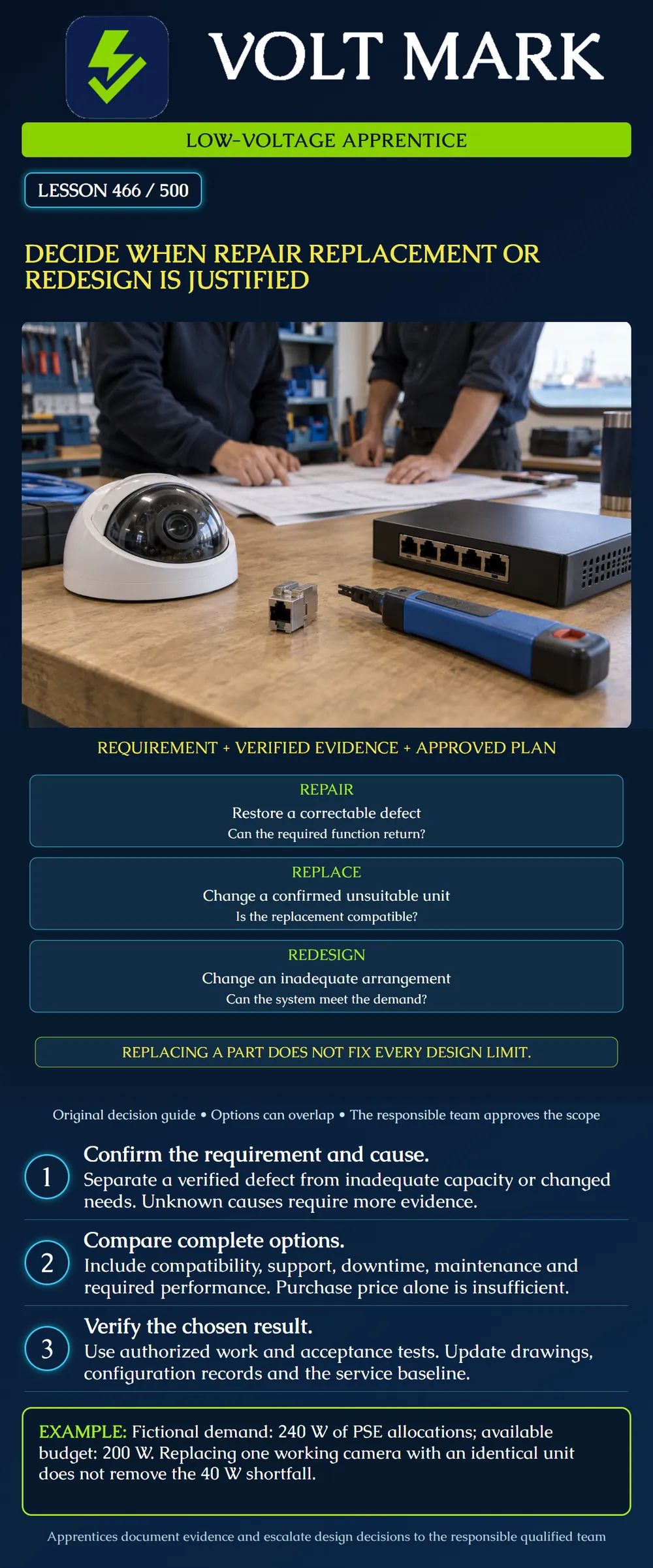
Distinguish a correctable defect, an unsuitable component and an inadequate system arrangement. Explain what evidence supports repair, replacement or redesign and how the approved outcome is verified.
This is a low-voltage decision-making lesson, not a purchase recommendation or authorization to repair equipment internally. Manufacturer instructions, project requirements and qualified design/service personnel determine permitted work. The examples are fictional and the options can overlap.
Start with the required function and current evidence. A system that once met a smaller demand may be functioning as designed but no longer meet today's requirements. A system with a localized defect may be capable of the required performance after correction.
WBDG's existing-building commissioning guidance starts from current facility requirements and compares actual performance with those needs. Its scope can range from adjustments to substantial replacement and improvement. [1] This gives useful context: the decision concerns the required outcome, not simply whether a component can be made to turn on.
Do not choose the remedy from a vague complaint alone. Record the affected function, verified findings and unresolved questions. If root cause is unknown, identify the next evidence needed rather than presenting a guess as a confirmed repair.
Repair may be appropriate when a verified, correctable defect prevents an otherwise suitable arrangement from working. The work must be permitted, practical and capable of restoring the required condition.
In an original classroom example, a documented termination defect is isolated on a training link. The responsible lead confirms an approved correction method and subsequent testing. That is a repair candidate. The observation does not justify improvised repairs to sealed electronics or changes that invalidate required equipment suitability.
Define what will be tested afterward. Correcting visible workmanship is not the same as proving the complete service. Retain the original result, the authorized correction and the verification record.
Replacement may be appropriate when a component's verified condition, support status or capability makes continued use unsuitable for the required service. Confirm the exact replacement's electrical, mechanical, environmental, software and interface compatibility.
An identical model can simplify some compatibility questions but does not automatically address a recurring external cause. If a supply or environmental condition damaged the original unit, installing another without resolving that condition may repeat the problem.
Do not infer end-of-support dates or replacement compatibility from memory. Check current manufacturer records for the specific product and version. This lesson supplies no real product recommendation or universal replacement age.
Redesign is appropriate for evaluation when the existing arrangement cannot meet the required function, capacity, coverage or other constraints even with healthy components. It can involve changed architecture, distribution or equipment selection under the responsible designer.
For the fictional PoE example, eight required PSE-side allocations of 30 W total 240 W. The available PSE budget is 200 W, leaving a 40 W shortfall. Replacing one working camera with an identical unit does not change the stated allocations or available budget.
A qualified review might consider an approved increase in available capacity, redistribution or another arrangement. This lesson does not select one. Individual port support, power sources, cabling, shared dependencies and required service still need evaluation.
Cisco's PoE troubleshooting guidance includes checking device requirements, compatible source capability and available power. [2] Those checks help distinguish a capacity limitation from an assumed defective endpoint. Its platform-specific commands are not reproduced as a generic procedure.
Prepare a plain-language comparison of the viable options. Include the expected result, evidence supporting it, compatibility, outage implications, future support, maintenance and verification. Identify what each option leaves unresolved.
The lowest purchase price need not produce the lowest total burden. Repeated visits, disruption and incomplete performance can matter. Conversely, a major redesign is not justified merely because new technology exists. Tie the scope to verified needs and evidence.
A mixed solution may be appropriate: repair one defect while redesigning an undersized shared service, or replace equipment as part of an approved redesign. The three poster rows are decision categories, not mutually exclusive rules.
An apprentice can document observations, collect approved product information and help prepare the comparison. The responsible owner, designer and qualified service team authorize the final scope within their roles. Applicable authorities may also be involved depending on the system and work.
Do not silently reduce a required function to make an existing arrangement appear sufficient. If the owner proposes a changed requirement, it needs the appropriate review and documentation. Life-safety, accessibility and other applicable obligations cannot be dismissed by an informal convenience decision.
After authorized work, test the required function and affected dependencies. Keep configuration, drawings, labels, support information and test records aligned with the installed result.
A powered-up device is not complete acceptance. Confirm the relevant application behavior and any project-specific performance criteria. For intermittent faults, report the agreed verification conditions and duration rather than promising permanent resolution from a short observation.
Classify three fictional cases: a verified correctable termination defect; a confirmed failed unit in an otherwise suitable arrangement; and healthy equipment with an inadequate shared power budget. State what additional evidence and approval each option needs. Allow overlap where justified.
Answer: No; gather evidence or clearly label the uncertainty.
Answer: 240 W.
Answer: 40 W.
Answer: Not under the stated unchanged allocations and capacity.
Answer: Yes, when different verified conditions justify them.
[1] WBDG Commissioning Committee, Existing Building Commissioning: https://legacy.wbdg.org/building-commissioning/existing-building-commissioning Opened October 1, 2026. General requirements/performance and improvement framework; not a universal contractual allocation. [2] Cisco, Troubleshoot Power over Ethernet on Catalyst 9000 Switches: https://www.cisco.com/c/en/us/support/docs/switches/catalyst-9200-series-switches/215636-troubleshooting-power-over-ethernet-poe.html Opened October 1, 2026. Supports checking power capacity and device compatibility; platform-specific recovery procedures not generalized.
Original scenarios and comparison framework. 8×30=240 W and240−200=40 W at the explicitly stated PSE allocation boundary.
Eight required PSE allocations of 30 W total 240 W against a 200 W budget. The 40 W shortfall exists even if all endpoints are healthy. Replacing one endpoint with an identical unit leaves both totals unchanged, so it does not resolve the stated deficit. Refer capacity or distribution changes for qualified design review. If a separate termination defect is also confirmed, an approved repair may be needed alongside the capacity work; verify both conditions afterward.
Mistake: Replacing healthy endpoints to solve a verified shared power-budget deficit. Correction: Recalculate the source-side allocations and refer the capacity arrangement to the designer; an identical replacement leaves the deficit unchanged.
Mistake: Calling a visible workmanship correction full service acceptance. Correction: Repeat the required performance checks and affected dependency checks after the permitted repair.
Mistake: Selecting redesign because newer technology exists. Correction: Tie the proposed scope to current required outcomes, verified limitations, support evidence and the consequences of each option.
Texas journeyman, 15 questions, scored by topic against the 70% mark. No card, and no account needed to start.
Free study material for low-voltage apprentices. This is a national foundation course: requirements differ by state and by local jurisdiction, and a practice that is common in one place is not a rule everywhere. Nothing here is a licence, a certification, or authority to work unsupervised, and completing it does not count as apprenticeship hours or continuing-education credit. Check the codes adopted where you are working, the licensing authority for that work, and your employer's safety programme. VoltMark is not affiliated with, endorsed by, or sponsored by NFPA, OSHA, NICET, BICSI, FOA, or any state or local licensing authority.

Electrician licensing exam prep: practice questions, timed exam simulations, and step-by-step help finding every answer in the NEC.