Count low-voltage components and calculate routed cable quantities from a documented drawing. Separate measured quantities, stated extras, unresolved items and purchasing decisions.
The poster is fictional sheet LV-1, revision A, not to scale. It is a quantity exercise, not an approved installation design or complete order. Use actual project drawings, specifications, schedules and authorized clarifications for real work.
Record the sheet identifiers, revisions and dates used. Read the symbol legend and relevant specifications before counting. Coordinate plans with risers, details, device schedules and notes so the same item is not omitted or counted twice.
WBDG's cost-estimating guidance emphasizes reliable quantity identification, clear documentation and methods that can be independently checked. It also distinguishes quantities from the labor and cost information applied later. [1] A takeoff supports an estimate; it is not by itself a complete price or purchase authorization.
If documents conflict, record the conflict and seek the project's approved clarification. Do not quietly choose the smaller quantity or a cheaper component to make the worksheet look complete.
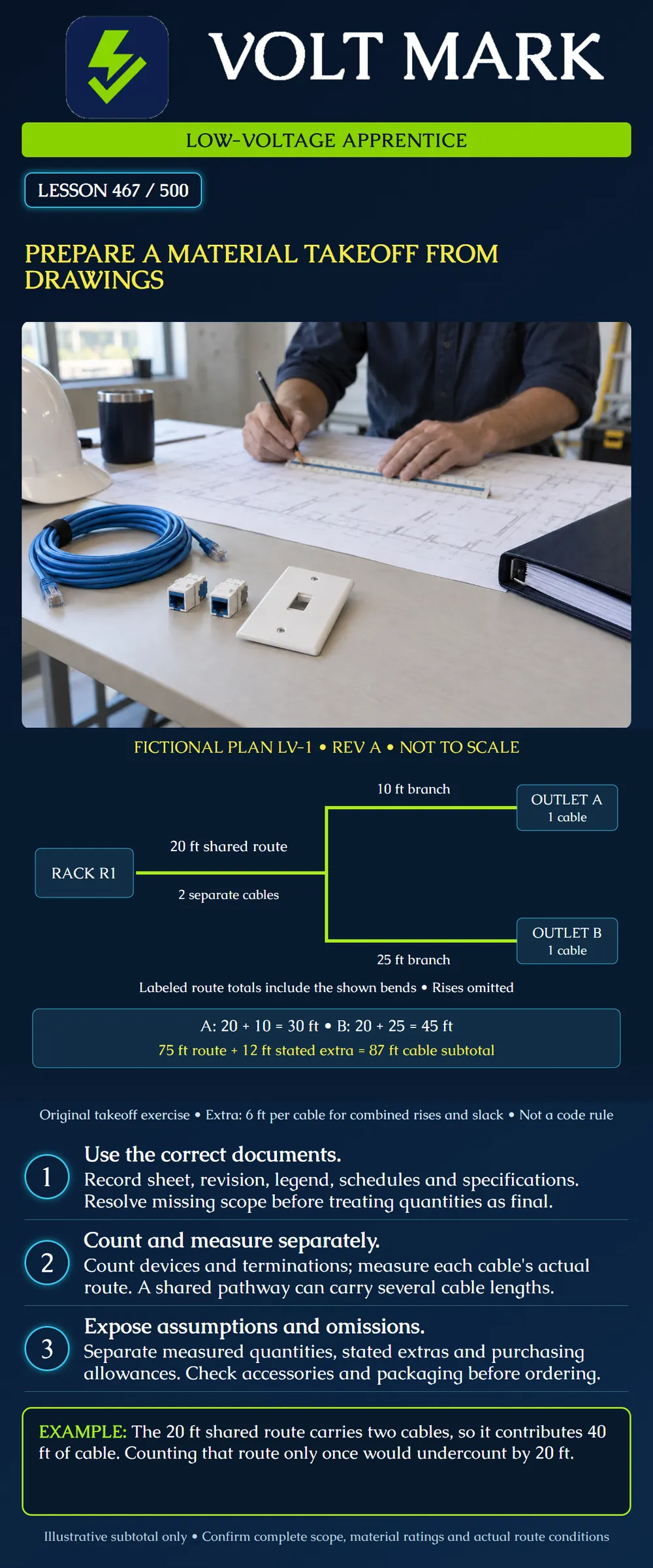
Rack R1 serves Outlet A and Outlet B with two separate home-run cables. The routes share a 20 ft section. After that, A's labeled branch is 10 ft and B's is 25 ft.
The labeled branch lengths include the bends shown on the schematic. The picture is not to scale, so do not measure its pixels or infer a shorter diagonal distance. Vertical rises are omitted from the picture and addressed only by the stated exercise allowance below.
A shared pathway length and the total cable length are different quantities. Two cables in a 20 ft route contribute 40 ft of cable even though that pathway segment is only 20 ft long. The branching drawing does not show an electrical splice or an Ethernet splitter.
Run A: 20 + 10 = 30 ft of shown route. Run B: 20 + 25 = 45 ft of shown route. Routed cable subtotal: 30 + 45 = 75 ft.
For this exercise only, add 6 ft per run for the combined omitted rises and service slack. It is not 6 ft at each end and is not a code requirement. A with stated extra: 30 + 6 = 36 ft. B with stated extra: 45 + 6 = 51 ft. Cable subtotal including that extra: 36 + 51 = 87 ft.
No cutting waste, spare stock or packaging allowance is included. In a real takeoff, use the documented route and specified slack rather than copying the classroom six-foot value.
For a supplemental fictional schedule, assume one jack at each outlet and one rack-side jack for each cable in a compatible unloaded panel. That gives two outlet jacks and two rack-side jacks: four jacks total. There are two single-port outlet faceplates and two occupied panel positions.
These counts depend on the stated arrangement. An integrated panel, modular plug-terminated link or another approved design would change the termination materials. Do not automatically multiply every endpoint by the same connector count across all low-voltage systems.
The exercise does not establish the required panel chassis, boxes, mounting hardware, supports, patch cords, labels or firestop materials. List them as items requiring scope review, not zero quantities. Confirm whether equipment is new, existing or supplied by another party.
Two equal lengths of cable may have different specifications. Record the required category or fiber type, environmental rating, conductor or fiber count, jacket requirements and approved product details as applicable. Do not merge unlike materials merely because they share a pathway.
A quantity calculation does not prove channel performance, PoE suitability, fill, support or code compliance. Those questions require the approved design and applicable requirements. Keep the takeoff faithful to those documents rather than redesigning the installation while counting.
Use separate worksheet columns for measured or dimensioned route, specified rises/slack, waste or purchasing allowance, and total. Explain the basis for each addition. Hidden blanket percentages make later review difficult.
The 87 ft classroom total is an aggregate cable subtotal, not proof that any collection of remnants can supply both required runs. Each run needs the required continuous length for the approved arrangement. Check reel or box planning and usable pieces before ordering.
Do not round down because material is sold in convenient packages. At the same time, do not describe a full purchased package as installed cable length. Purchased, installed and spare quantities are different records.
Mark each counted item or route on a working copy so a reviewer can trace the worksheet. Reconcile totals against the schedule. When a revision changes a route or adds an outlet, show the addition or deduction and the supporting reference.
Retain unresolved items and exclusions with the takeoff. “Not quantified in this exercise” means more work is required; it is not permission to omit required materials from a real job. Keep the original revision basis so changes remain understandable.
Recreate the two-run worksheet. Show A=36 ft and B=51 ft after the stated extra. Add the four-jack count from the supplemental schedule. List at least four material categories that remain unresolved before this could become a complete order.
Answer: 40 ft across the two cables.
Answer: 75 ft.
Answer: 87 ft.
Answer: No; it is an explicit classroom assumption.
Answer: No; accessories, specifications, packaging and other scope remain to be resolved.
[1] WBDG, Cost Estimating: https://legacy.wbdg.org/design-disciplines/cost-estimating Opened October 1, 2026. Used for quantity documentation and verification principles. Historical workforce statistics, pricing and estimate-level percentages are not adopted as current requirements.
Original drawing, dimensions and supplemental schedule. Arithmetic checked: 2×20+10+25=75; 2×6=12; 75+12=87 ft. Two outlet plus two rack-side jacks equals four.
Mistake: Counting the shared 20 ft pathway only once in cable quantity. Correction: Count the shared segment once for each home run: two cables use 40 ft there before their separate branches.
Mistake: Applying the fictional 6 ft extra at both ends. Correction: Use 6 ft once per run in this exercise, and replace that classroom assumption with documented rises and slack for actual work.
Mistake: Calling 87 ft a complete material order. Correction: Keep the continuous run lengths, termination arrangement, accessories, specifications and purchasing allowances visible before preparing an order.
Texas journeyman, 15 questions, scored by topic against the 70% mark. No card, and no account needed to start.
Free study material for low-voltage apprentices. This is a national foundation course: requirements differ by state and by local jurisdiction, and a practice that is common in one place is not a rule everywhere. Nothing here is a licence, a certification, or authority to work unsupervised, and completing it does not count as apprenticeship hours or continuing-education credit. Check the codes adopted where you are working, the licensing authority for that work, and your employer's safety programme. VoltMark is not affiliated with, endorsed by, or sponsored by NFPA, OSHA, NICET, BICSI, FOA, or any state or local licensing authority.

Electrician licensing exam prep: practice questions, timed exam simulations, and step-by-step help finding every answer in the NEC.