Build an auditable labor estimate for a defined low-voltage task. Distinguish worker-hours, crew elapsed time and labor cost, and explain which site assumptions could change the result.
This lesson uses an invented jack-termination worksheet. Its productivity values are classroom inputs, not measured trade averages, wage guidance or national standards. The subtotal excludes much of a real installation and must not be presented as a complete job estimate.
A worker-hour is one person's hour of labor. Two people working for one hour contribute two worker-hours. A crew-hour needs a stated crew composition: an hour for a two-person crew is not the same labor quantity as an hour for a four-person crew.
A unit rate such as worker-hours per jack must say what a completed jack includes. Does it include unpacking, dressing conductors, termination, labeling, inspection, performance testing and records? An undefined unit invites omissions or duplicate allowances.
WBDG describes labor estimates using crew analysis or labor hours applied to quantities and stresses that production varies with project complexity. It also calls for clear estimate documentation and a stated scope with assumptions. [1] Those principles support an auditable worksheet; the source does not establish the fictional rate below.
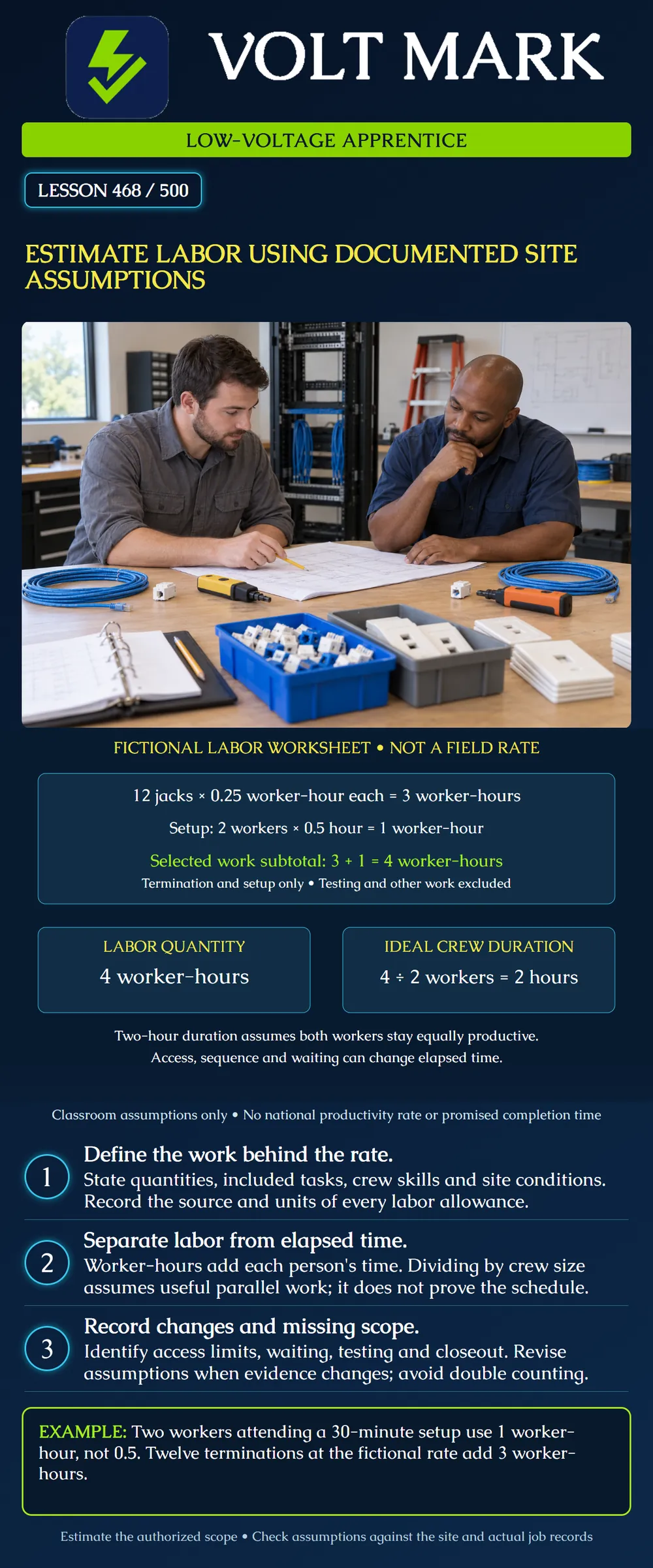
Assume twelve jacks, each requiring 0.25 worker-hour for the narrowly defined termination activity. In this exercise that activity includes preparing the cable end and seating the conductors in the specified compatible jack. It excludes cable pulling, pathway work, labeling, inspection, testing, rework and closeout.
12 jacks × 0.25 worker-hour/jack = 3 worker-hours. The jack unit cancels, leaving worker-hours.
Also assume a joint setup lasting 0.5 hour with two workers present: 2 workers × 0.5 hour = 1 worker-hour.
Selected work subtotal: 3 + 1 = 4 worker-hours.
The joint setup allowance is additional to the termination rate, not already inside it. If a real historical rate includes setup, adding this allowance again would double count that effort. Keep the original rate definition with the estimate.
Suppose both workers complete six jacks independently at the same fictional rate. Each spends 1.5 hours terminating after the shared 0.5-hour setup. The resulting ideal elapsed time is 2 hours. Each contributes 2 worker-hours, for a total of 4.
Dividing 4 worker-hours by 2 workers gives 2 hours only under suitable work allocation and availability assumptions. It is not a guarantee. A single accessible work position, a required sequence, scarce tools or a supervision requirement could prevent equally productive parallel work.
For contrast, suppose both attend the half-hour setup but only one may perform the termination activity. The second is reassigned after setup. The selected labor remains 4 worker-hours, while the example's elapsed duration becomes 0.5 + 3 = 3.5 hours. If the second instead waits on site for all three termination hours, that waiting adds three worker-hours to the labor record, making seven for the two-person attendance. State which situation the plan assumes.
Do not increase crew size in a worksheet and automatically promise proportional schedule savings. Confirm the work can actually be divided.
For this classroom worksheet, assume materials are correct and staged, compatible tools are available, the work area is released and reachable, and the people have the required training for their assigned tasks. These assumptions are part of the example, not evidence about a real site.
On an actual project, record the known access window, work height and access equipment, occupied-space restrictions, escort arrangements, material handling distance, coordination needs and expected work sequence. Identify unresolved items and who will confirm them. Never plan to bypass safety controls or required supervision to achieve a productivity target.
Describe the basis and date of any historical data. A rate recorded for a repetitive new installation in an open area may not represent troubleshooting above an occupied healthcare space. Do not conceal those differences inside a precise-looking decimal.
The poster is a selected-work subtotal. It does not estimate cable installation, supports, labels, testing, documentation, cleanup, travel, project management or other job requirements. These require a separate scope decision and appropriate labor entries.
An exclusion in a learning worksheet does not eliminate required work from a real project. Resolve who performs each activity before treating the estimate as complete. Identify allowance uncertainty rather than labeling an unknown quantity as zero.
Do not add a blanket productivity penalty on top of separately itemized delays without checking for overlap. A disruption represented in the base rate should not also be charged again as a new allowance unless the estimate explicitly justifies that treatment.
Worker-hours are a quantity, not a price. Pricing additionally requires the applicable cost basis for the assigned labor and project. This lesson supplies no wage, burden, markup or overtime rates. If different crew roles have different costs, retain their respective hours instead of obscuring them inside one unexplained average.
A schedule may also contain calendar gaps with no crew present. Those gaps can extend completion dates without adding an equal number of direct labor hours. Conversely, waiting with people assigned can consume labor even when installed quantities do not change.
Record actual quantities and time using definitions that match the estimate. Separate documented scope changes from performance differences. Note unusual conditions so the next estimator can judge comparability. Review departures with the responsible supervisor instead of altering records to make the estimate look correct.
Rebuild the four-worker-hour subtotal. Then explain the difference between the two-hour parallel case and the 3.5-hour restricted-work case. Identify four excluded activities requiring a scope decision before this becomes a full low-voltage estimate.
Answer: One worker-hour.
Answer: Three worker-hours under the fictional assumptions.
Answer: No. That depends on allocation, access, sequence and other conditions.
Answer: No; it is invented for the arithmetic exercise.
Answer: No.
[1] WBDG, Cost Estimating: https://legacy.wbdg.org/design-disciplines/cost-estimating Opened October 1, 2026. Used for labor-hour estimating, documentation and project-complexity principles. Legacy wage, workforce and estimate-level figures are not adopted as current requirements. All numerical examples are original classroom assumptions.
Arithmetic checked: 12×0.25=3; 2×0.5=1; total4 worker-hours; ideal4÷2=2 elapsed hours; restricted case0.5+3=3.5 hours; two people present throughout that restricted case contribute7 worker-hours.
Mistake: Treating four worker-hours as four elapsed hours for any crew. Correction: State crew composition and task allocation; the two-hour case depends on both workers terminating in parallel after setup.
Mistake: Adding setup again when the historical rate already includes it. Correction: Read and retain the rate's task definition and add only effort excluded from that basis.
Mistake: Assuming the restricted-work case uses only four worker-hours while the second worker waits throughout. Correction: Account for that worker's three waiting hours; full two-person attendance is seven worker-hours in the stated 3.5-hour case.
Texas journeyman, 15 questions, scored by topic against the 70% mark. No card, and no account needed to start.
Free study material for low-voltage apprentices. This is a national foundation course: requirements differ by state and by local jurisdiction, and a practice that is common in one place is not a rule everywhere. Nothing here is a licence, a certification, or authority to work unsupervised, and completing it does not count as apprenticeship hours or continuing-education credit. Check the codes adopted where you are working, the licensing authority for that work, and your employer's safety programme. VoltMark is not affiliated with, endorsed by, or sponsored by NFPA, OSHA, NICET, BICSI, FOA, or any state or local licensing authority.

Electrician licensing exam prep: practice questions, timed exam simulations, and step-by-step help finding every answer in the NEC.