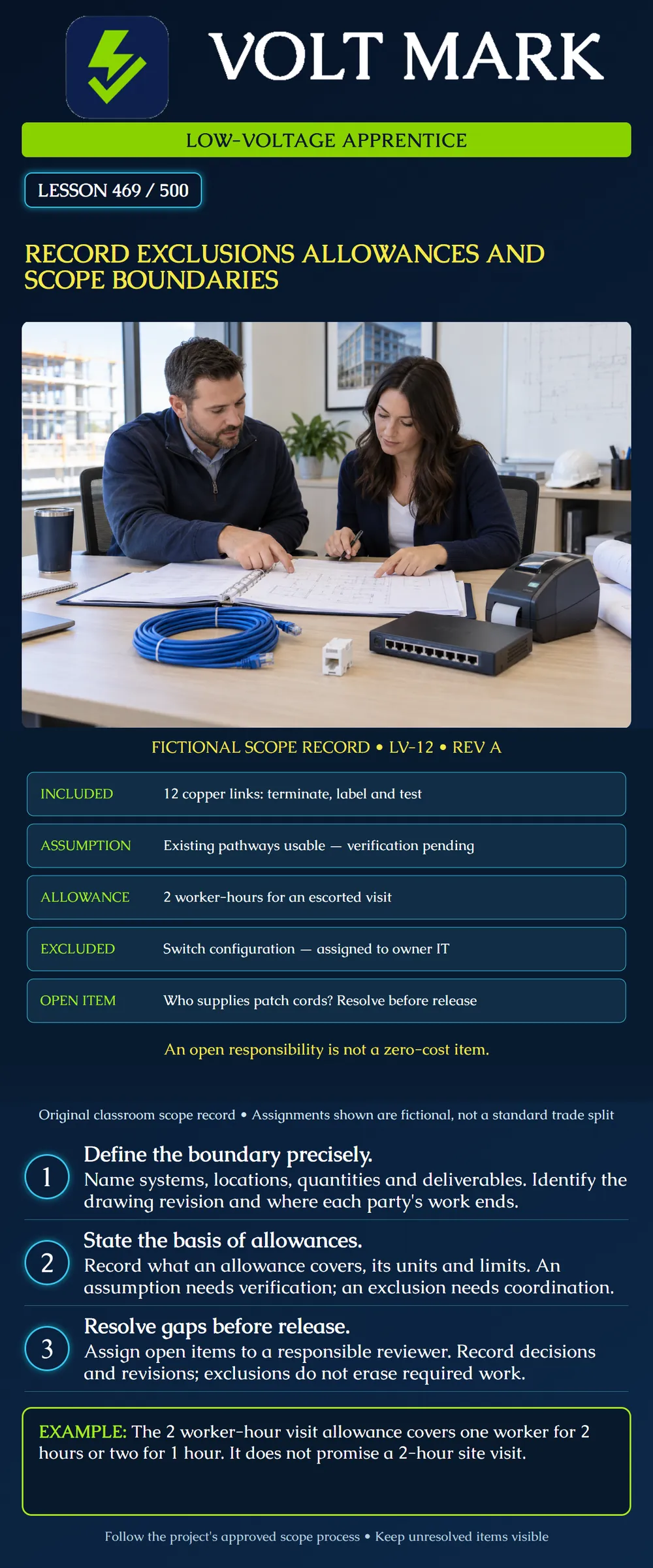
Write a clear scope record that separates included work, assumptions, allowances, exclusions and unresolved responsibilities. Explain why a missing assignment is not proof that an activity costs nothing or is unnecessary.
The poster shows fictional record LV-12, revision A, for a small copper-link project. The assignments and allowance are invented teaching examples, not standard trade boundaries. Real scope comes from the project's governing documents and authorized decisions. This is documentation training, not a contract interpretation.
Name the project area, system, document set and revision. State the quantity and deliverable rather than a broad promise such as “all low voltage.” A record should let another person identify what was counted and which version of the design was used.
WBDG calls for clear documentation of estimates and a scope statement identifying assumptions, allowances and the documents used. It also distinguishes quantities from costs applied to them. [1] The following categories turn those principles into an original classroom exercise. The project's own terminology and approval process govern actual records.
For LV-12, the included activity is terminating, labeling and testing twelve copper links. The record alone does not define cable type, route, test configuration, acceptance limits or report format. Those need referenced specifications or explicit approved clarification before the statement can function as a complete work package.
Included work is an identified activity or deliverable carried in the stated scope. For this exercise, termination, labeling and testing are included. Do not quietly remove testing to meet an allowance.
An assumption is a condition used as the planning basis. Here, existing pathways are assumed usable, but verification remains pending. That is not evidence that they have adequate capacity, support, access or suitability. Record who will verify the condition and what happens if it is false.
An allowance is an explicitly identified provisional quantity or amount for a defined purpose. Here it is two worker-hours for an escorted visit. It is not an unlimited promise to provide all escort-related effort.
An exclusion identifies work outside this particular package. In the fictional exercise, switch configuration is excluded from the cable installer's package and assigned to owner IT. This does not imply that switch configuration is unnecessary or universally an owner's responsibility.
An open item identifies a question without an accepted answer. Patch-cord supply remains open. Do not write “by others” as if that phrase names a real party or confirms an accepted commitment.
Two worker-hours could describe one worker present for two hours or two workers present for one hour. Those are different elapsed-time situations with the same labor quantity. The allowance does not establish an appointment duration without knowing attendance.
For the exercise, suppose two workers must attend an escort orientation lasting 1.5 hours each. That is three worker-hours, exceeding the two-worker-hour allowance by one worker-hour. The difference requires review under the project's process. The arithmetic alone does not authorize additional work, establish payment or determine which party bears the cost.
State whether an allowance is in labor hours, material quantity or money. State included tasks, assumptions and reconciliation method. Do not add a labor allowance to a dollar subtotal or assume a quantity allowance includes every associated accessory and activity.
For switch configuration in LV-12, a useful record identifies the owner IT role, needed configuration inputs, timing relative to testing, and the evidence of readiness. The phrase “owner IT” on the poster is a fictional assignment, not proof of an agreement on a real job.
Distinguish physical link acceptance from operational service testing. A cable test report does not by itself prove that the owner's switch, addressing or application is correctly configured. Likewise, an application working briefly does not replace the specified cable acceptance records.
For patch cords, record the required endpoints and approved specification, then seek the supply and installation assignment. Do not infer that the installer supplies them just because the installer is nearby, or that the owner supplies them because equipment is owner-furnished.
A scope exclusion is a record of package boundaries, not permission to leave a necessary activity undone. Where design, inspection, testing, life-safety or other required work affects the installation, coordinate its responsible party and completion evidence through the authorized project process.
Do not make a nationwide legal claim about what an exclusion can transfer. Requirements and agreements differ. An apprentice should flag a missing responsibility to the supervisor, not decide which party has waived a duty or who must pay.
For example, if a route requires a reviewed penetration detail, an unresolved assignment for that work is a coordination gap. Do not improvise the detail or declare the activity unnecessary because it was absent from the estimate.
Add an owner, due date, reference and current status for each open item. An owner in this context means the person responsible for obtaining resolution; it need not be the person who ultimately performs or pays for the work.
When the pathway assumption is checked, retain the original statement and the new evidence. If the route must change, update the affected scope, quantity, labor and schedule records together. Do not erase the old basis and lose the reason for the change.
A request, a proposed answer and an authorized decision are different states. Record which state applies. Carry the approved revision to the people preparing materials, labor plans and acceptance records so they use the same boundary.
Copy the five rows from LV-12 into a worksheet. Add a responsible reviewer and evidence needed for the pathway assumption and patch-cord open item. Write a more precise switch-configuration boundary including a handoff deliverable, while marking any invented detail as an exercise assumption.
Answer: No.
Answer: Not by itself.
Answer: Three worker-hours.
Answer: One worker-hour.
Answer: No; responsibility and completion must be resolved through the project's authorized process.
[1] WBDG, Cost Estimating: https://legacy.wbdg.org/design-disciplines/cost-estimating Opened October 1, 2026. Used for estimate documentation and scope-statement principles only. Historical prices, workforce figures and estimate-level percentages are not adopted.
Original fictional scope record and allowance exercise. Arithmetic checked: 2×1.5=3 worker-hours; 3−2=1 worker-hour beyond the stated allowance.
LV-12 allows two worker-hours for an escorted visit. The updated exercise requires two workers at a 1.5-hour orientation, giving 2 x 1.5 = 3 worker-hours. The difference is one worker-hour above the allowance. Record the changed attendance assumption and submit it for the project's reconciliation process; the arithmetic does not establish who pays or authorize more work. Separately, leave patch-cord supply open until a named assignment is accepted.
Mistake: Treating an assumed usable pathway as inspected and approved. Correction: Assign verification and record the actual evidence before relying on pathway suitability.
Mistake: Writing 'by others' as if it closes patch-cord responsibility. Correction: Obtain a named party, deliverable and accepted handoff; keep the item open until then.
Mistake: Interpreting a two-worker-hour allowance as a two-hour appointment for two workers. Correction: Multiply attendance by elapsed time, state the unit and refer any allowance difference through the agreed process.
Texas journeyman, 15 questions, scored by topic against the 70% mark. No card, and no account needed to start.
Free study material for low-voltage apprentices. This is a national foundation course: requirements differ by state and by local jurisdiction, and a practice that is common in one place is not a rule everywhere. Nothing here is a licence, a certification, or authority to work unsupervised, and completing it does not count as apprenticeship hours or continuing-education credit. Check the codes adopted where you are working, the licensing authority for that work, and your employer's safety programme. VoltMark is not affiliated with, endorsed by, or sponsored by NFPA, OSHA, NICET, BICSI, FOA, or any state or local licensing authority.

Electrician licensing exam prep: practice questions, timed exam simulations, and step-by-step help finding every answer in the NEC.