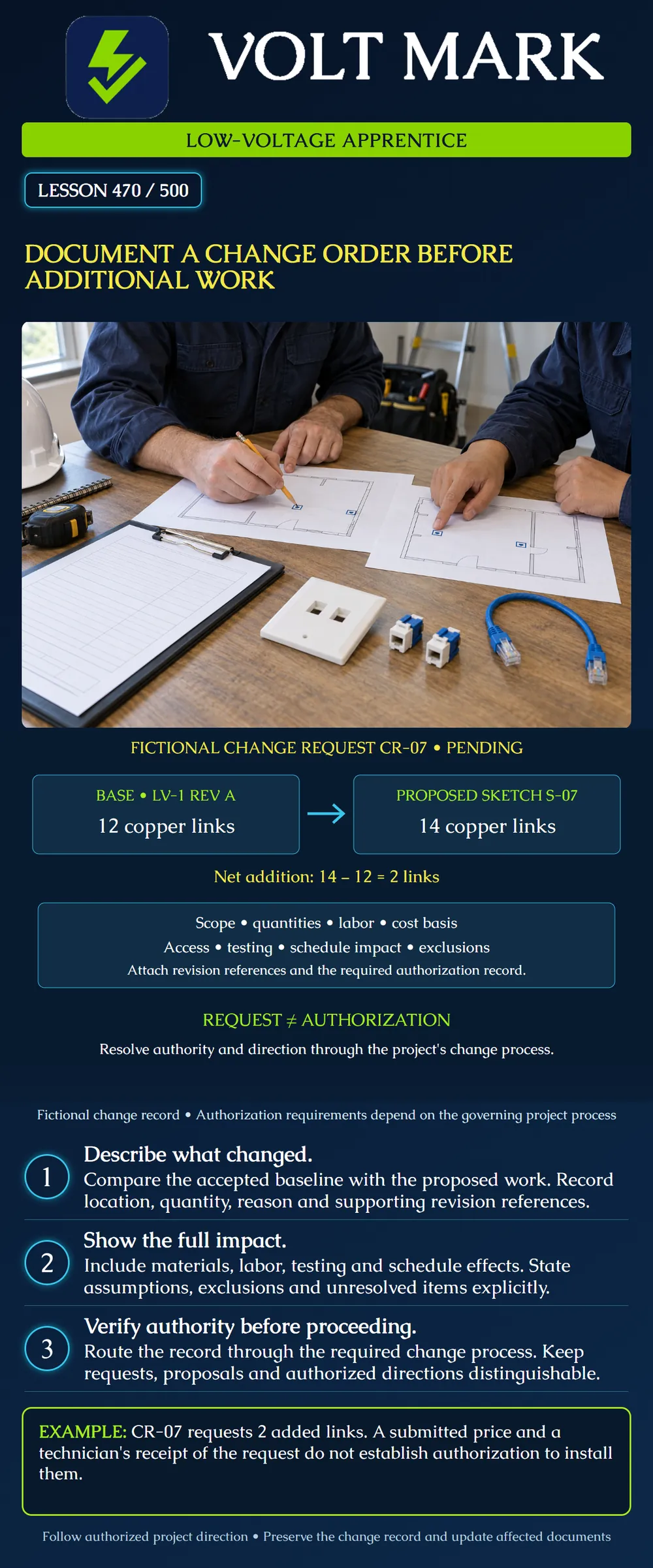
Prepare a traceable record of proposed additional low-voltage work, identify its consequences and route it through the project's authorized change process before treating it as released work.
This lesson is documentation training using a fictional copper-link request. It does not interpret a contract, determine payment entitlement or prescribe one approval form for every U.S. project. Follow the governing project procedures and your supervisor's authorized direction. A request, proposal, directive and completed change order can have different meanings under different agreements.
Suppose a project baseline, sheet LV-1 revision A, includes twelve copper links. A customer representative asks for two additional links in Room B and provides proposed sketch S-07. Create change request CR-07 and preserve the date, requester, location and supplied sketch. The new proposed quantity is fourteen links.
Write what was requested, not what you guess the requester intended. “Add two copper links at the positions shown on S-07” is more useful than “extra network work.” Identify missing endpoint, route, cable specification, termination and acceptance details for clarification.
Do not silently mark S-07 as an approved design. A sketch may describe a request without resolving routing, capacity, compatibility, required reviews or installation requirements.
Record the accepted baseline reference alongside the proposed change. The net count increase is 14 minus 12, or two links. That number alone is not a complete takeoff.
The added links may involve cable, connectors, faceplates, panel capacity, labels, supports, patch cords, testing and records, depending on the approved arrangement. Identify actual routes and specifications before assigning quantities. Preserve any deductions as well as additions if existing work is removed or relocated.
Check whether the two links are truly additional or already included elsewhere. Duplicating an existing scope line in a change proposal can overstate the work. Conversely, a relocation may involve removal and rework even if the final link count is unchanged.
WBDG's estimating guidance calls for itemized change-order proposals that identify material, labor, equipment and subcontract work, with applicable cost components made explicit. [1] Use that principle to produce an auditable proposal rather than a single unsupported total.
Separate quantity from unit cost and labor from elapsed time. Record where rates and productivity assumptions came from. Do not treat the fictional two-link count as evidence of a universal installation price.
Include testing, labeling and documentation impacts. Record access constraints, lead times, coordination and proposed work windows. A small material quantity can still require a separate visit or an outage. State whether schedule impact has been evaluated; “not yet evaluated” is different from “no impact.”
Keep any contingency or allowance identifiable and avoid charging the same activity twice. If a required input remains unknown, flag it for resolution rather than entering zero to complete the form.
A technician receiving a request does not establish that the requester can authorize a change. Similarly, preparing a price, answering a question or acknowledging an email does not by itself prove that the proposed installation has been released.
As one limited example, FAR 43.102 reserves federal Government contract modifications to contracting officers acting within their authority. [2] That is a federal contracting rule, not a universal private-project approval chart. Its relevant lesson here is to identify the actual authority that applies to the specific project.
Have the responsible supervisor or project manager confirm the required authorization route and record. Do not assume that a title such as building manager, engineer or customer contact automatically grants every type of approval.
An apprentice should not promise price, completion time or contractual acceptance beyond their assigned authority. Report the request accurately and preserve the evidence needed by the authorized decision-maker.
For the poster, CR-07 remains pending. Its sketch and proposed quantity have been recorded; installation is not represented as approved. The classroom record contains no signed order, approved directive, agreed price or established schedule adjustment.
A real change log should distinguish requested, under review, proposed, authorized, in progress and closed states using the project's terminology. Record who made each decision, when it occurred, which revision it covers and where the supporting record is stored.
Some projects provide a process for authorized directions before final pricing is settled. Do not replace that process with a blanket claim that every job must wait for a fully priced bilateral document. Escalate uncertainty through the supervisor and follow the applicable documented direction and recordkeeping requirements.
Emergency conditions require the site's established response procedure. This lesson is not an instruction to delay protective action while seeking a commercial signature.
Commercial approval of additional work does not by itself prove the technical design is suitable. Resolve required design, code, manufacturer, testing and operational reviews through the responsible project roles.
For example, adding two links may require confirming panel positions and pathway suitability. A price acceptance does not create physical capacity. If the approved solution changes the route or termination arrangement, update the quantities and affected documents so the crew receives the correct version.
Coordinate any service interruption separately through the site's operational process. Do not treat a change-order number as permission to disconnect working equipment whenever convenient.
Once properly directed work is performed, retain actual quantities, labor records, test evidence and updated drawings according to the project process. Link them to the authorized change reference.
Record deviations and unresolved items honestly. Do not label a change complete solely because the two links were physically installed if required acceptance evidence is missing. Keep the original request, approved revision and final record distinguishable.
Draft CR-07 for the two proposed Room B links. Include baseline LV-1 revision A, sketch S-07, the 12-to-14 quantity comparison, a list of missing technical details, cost and schedule items to evaluate, and the current status “pending authorization.” Leave unavailable approval information blank and marked unresolved rather than inventing it.
Answer: Two.
Answer: Not by itself.
Answer: No; it applies in its federal contracting context.
Answer: No.
Answer: No.
[1] WBDG, Cost Estimating: https://legacy.wbdg.org/design-disciplines/cost-estimating Used for itemized change-proposal documentation principles, not historical prices or universal contractual rules. [2] Acquisition.gov, FAR 43.102, Policy: https://www.acquisition.gov/far/43.102 Used only as a federal contracting example of defined modification authority. No private-project legal interpretation is made. Both opened October 1, 2026.
Original fictional scenario. Arithmetic checked: 14−12=2 added links.
CR-07 proposes two Room B links beyond the twelve-link baseline. Record a proposed fourteen-link total and a net addition of two. Sketch S-07 does not establish route suitability, available panel positions, final price or installation authority. Keep those decisions unresolved, itemize their quantity and schedule effects and route the proposal to the actual authorized role. Carry the eventual approved revision into work and test records; do not label the request itself as released work.
Mistake: Treating the customer's request or an acknowledged price email as installation authority. Correction: Confirm the project's authorized decision-maker and obtain the required direction record before treating additional work as released.
Mistake: Entering zero for an unevaluated schedule impact. Correction: Mark it unresolved and assess access, lead time, coordination and outage needs explicitly.
Mistake: Assuming a change-order number proves pathway and panel capacity. Correction: Obtain the technical checks and approved design details independently of the commercial record.
Texas journeyman, 15 questions, scored by topic against the 70% mark. No card, and no account needed to start.
Free study material for low-voltage apprentices. This is a national foundation course: requirements differ by state and by local jurisdiction, and a practice that is common in one place is not a rule everywhere. Nothing here is a licence, a certification, or authority to work unsupervised, and completing it does not count as apprenticeship hours or continuing-education credit. Check the codes adopted where you are working, the licensing authority for that work, and your employer's safety programme. VoltMark is not affiliated with, endorsed by, or sponsored by NFPA, OSHA, NICET, BICSI, FOA, or any state or local licensing authority.

Electrician licensing exam prep: practice questions, timed exam simulations, and step-by-step help finding every answer in the NEC.