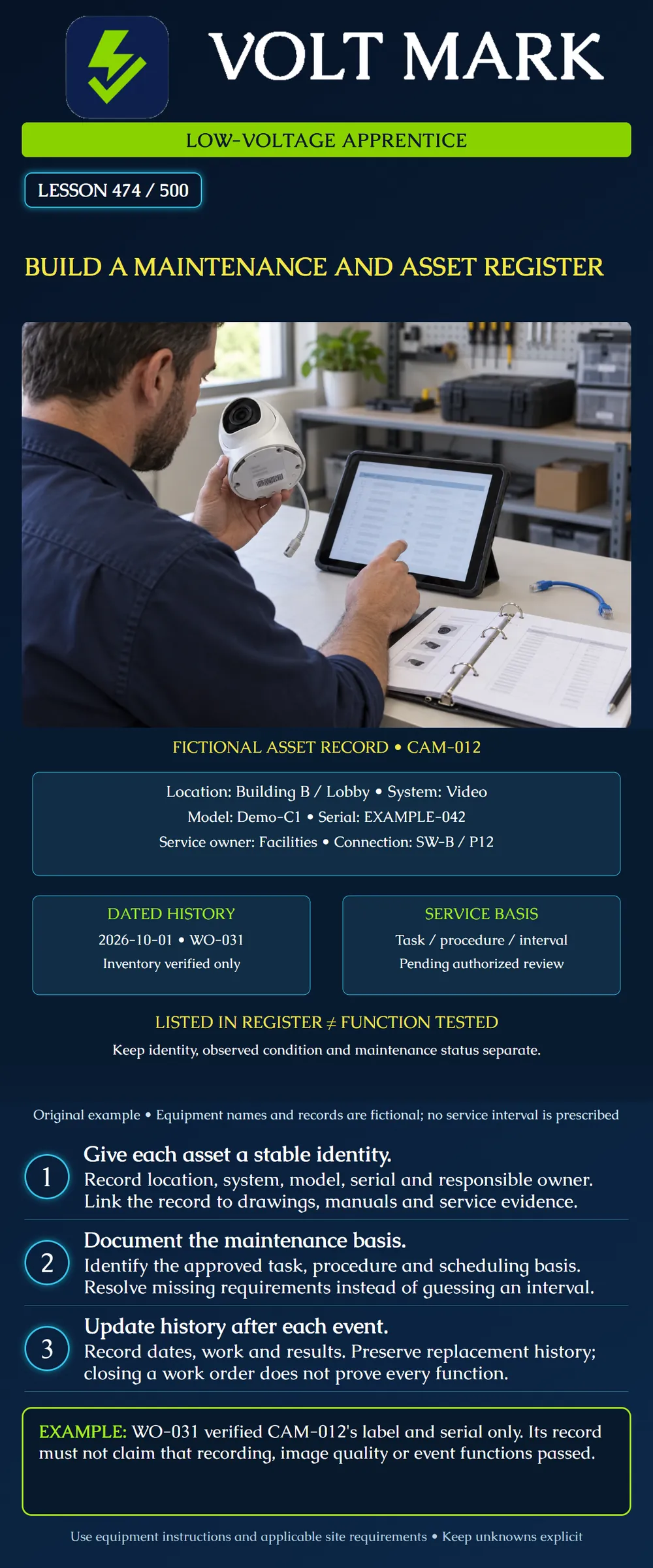
Create a traceable low-voltage asset record that connects equipment identity, location, responsibility, maintenance requirements and dated service evidence.
The poster is a fictional camera record. CAM-012, Demo-C1, EXAMPLE-042, SW-B/P12 and WO-031 are invented identifiers. The exercise verifies inventory information only; it does not establish camera performance or a maintenance schedule. The approach can support copper, fiber, security, controls and other low-voltage assets, with system-specific fields and requirements.
An asset register identifies equipment or infrastructure that the organization needs to manage. Its scope may include individual devices, assemblies, cable systems or maintainable components. Define that scope so people do not inconsistently count a rack as one asset in one building and every component as separate assets in another.
DOE's Operations & Maintenance Best Practices Guide describes maintenance-management functions that connect equipment to work orders, service history, procedures and technical documentation. [1] Those general recordkeeping concepts support this exercise. Its historical productivity figures and software examples are not current guarantees or prescribed maintenance intervals.
A register can support planning, but its presence does not prove the equipment is healthy. Keep the inventory record, observed condition and maintenance completion evidence distinguishable.
CAM-012 is the fictional asset ID. The model is Demo-C1 and the serial number is EXAMPLE-042. These fields serve different purposes. Multiple units may share a model while their serial numbers differ.
Record an ID according to the site's naming scheme. Avoid using a changeable network address as the only identity. A location can change, and a device can be replaced while a functional position retains its name.
Define whether the ID represents a physical unit or a functional position. If the site keeps CAM-012 for a camera position after replacement, preserve separate serial-number and installation histories so the old and new units are not confused. If it assigns a new asset ID, retain the relationship between the replacement and retired unit.
The example places CAM-012 in Building B's lobby and links it to switch SW-B port P12. Confirm these references against the approved site records and available evidence rather than copying an outdated label.
Useful fields depend on the asset. A fiber enclosure might require building, room, rack, panel and port references, associated cable IDs and links to strand schedules. A campus cable record may link to route sections and structures. A building-controls sensor might need its controller and point reference.
An asset register is not a replacement for detailed drawings, splice schedules or excavation-clearance procedures. Link to those records and maintain their revision references. Do not treat a short location field as a complete route survey.
The fictional service owner is Facilities. That identifies an exercise role responsible for coordinating service; it does not establish legal ownership, technical authority or a universal division of work.
On a real site, record the responsible organization or role and the approved way to request service. Separate equipment ownership, maintenance responsibility, system administration and acceptance authority when they differ.
Do not put passwords, access codes or recovery secrets in a broadly accessible asset table. Link to the approved controlled resource where appropriate. Apply the site's handling rules to network and security-system details.
Identify each applicable task, its governing procedure and revision, required qualifications, scheduling basis and acceptance evidence. The basis may involve manufacturer instructions, project requirements, applicable adopted rules and the site's authorized program.
Do not copy one interval across all cameras, alarm devices, fiber enclosures or control components. Equipment type, environment, use and applicable requirements can differ. Condition-based observations do not automatically replace required periodic work.
In the poster, the task, procedure and interval remain pending authorized review. That is an incomplete maintenance setup requiring action, not permission to omit maintenance. Assign a responsible reviewer and track resolution.
A future due date should have a traceable basis. A calendar reminder created without a valid task or interval may look organized while providing no defensible maintenance plan.
WO-031 records an inventory verification on 2026-10-01. The fictional observer checked the label and serial number only. Therefore the record cannot claim that image quality, live display, recording or event functions passed.
For each service event, record the asset, date, reported issue or planned task, authorized work, observations, parts used, results, responsible personnel and supporting evidence as appropriate. Preserve unresolved defects and follow-up references.
Distinguish the date a task was due, the date it was performed and the date its paperwork was closed. Administrative closure is not evidence that every listed function was tested. If a task was deferred or incomplete, state that status rather than entering an unsupported completion result.
If a unit is moved, replaced or retired, update its state and relationships while preserving history. Record the effective date and source of the change. Avoid overwriting the old serial number with no indication that a replacement occurred.
Keep the maintenance history attached to the correct physical unit or functional position according to the site's scheme. A failure history from the old unit should not be silently attributed to the replacement.
For passive infrastructure, preserve route, enclosure and cable relationships when work changes the network. A register update should agree with the revised drawing and test package rather than creating a separate conflicting record.
Recreate CAM-012's record and add separate fields for inventory-verification status, functional-test status, maintenance basis and next action. Enter “not tested in WO-031” for the functional result. Assign the missing maintenance-basis review without inventing an interval.
Answer: No; one identifies the product type and the other follows the site's asset scheme.
Answer: No; it verified inventory information only.
Answer: No; resolve their authorized basis.
Answer: No.
Answer: No; in the exercise only seventeen identities were verified.
[1] DOE FEMP, Operations & Maintenance Best Practices Guide, Release 3.0, Chapter 4, Computerized Maintenance Management System: https://www1.eere.energy.gov/femp/pdfs/om_4.pdf Opened October 1, 2026. Used for general equipment-linked work-order, history and documentation concepts. Historical savings figures, technology examples and maintenance intervals are not adopted as current requirements. Earlier WBDG and DOE document URLs could not be fetched; the standalone DOE chapter was successfully opened.
Original fictional asset record. Supplemental count checked: 17 verified identities + 3 unverified = 20 entries; functional-test coverage remains unspecified.
WO-031 verifies CAM-012's label and serial number. Enter identity verified, but functional test not performed in this work order; recording and image quality remain unverified. The maintenance task and interval also lack an approved basis, so assign that review before entering a due date. In the twenty-entry exercise, seventeen verified identities plus three unverified ones still says nothing about functional-test coverage.
Mistake: Treating inventory verification as camera performance acceptance. Correction: Record exactly what WO-031 checked and maintain separate fields for functional evidence and outstanding tests.
Mistake: Overwriting the old serial number when a replacement retains CAM-012. Correction: Preserve dated physical-unit history and the relationship to the functional position before adding the replacement.
Mistake: Copying one maintenance interval to every asset in the register. Correction: Link each task and schedule to the applicable product, site program and requirements, leaving an unsupported interval unresolved.
Texas journeyman, 15 questions, scored by topic against the 70% mark. No card, and no account needed to start.
Free study material for low-voltage apprentices. This is a national foundation course: requirements differ by state and by local jurisdiction, and a practice that is common in one place is not a rule everywhere. Nothing here is a licence, a certification, or authority to work unsupervised, and completing it does not count as apprenticeship hours or continuing-education credit. Check the codes adopted where you are working, the licensing authority for that work, and your employer's safety programme. VoltMark is not affiliated with, endorsed by, or sponsored by NFPA, OSHA, NICET, BICSI, FOA, or any state or local licensing authority.

Electrician licensing exam prep: practice questions, timed exam simulations, and step-by-step help finding every answer in the NEC.