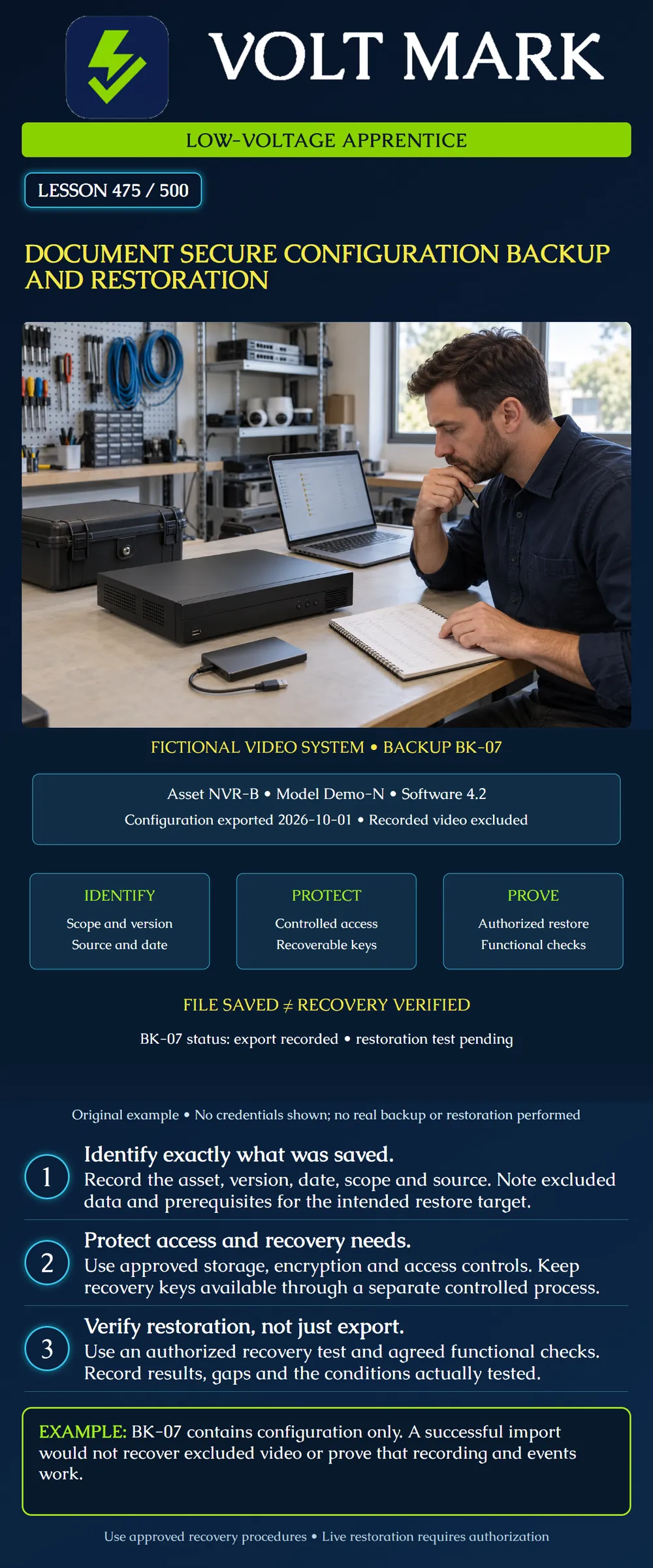
Describe a configuration backup so an authorized technician can identify its scope, protect its contents and verify restoration under defined conditions.
The poster uses fictional video system NVR-B, model Demo-N, software version 4.2 and backup BK-07. It supplies no product commands or real credentials. Its export is configuration only; recorded video is excluded. Restoration testing is pending. This is documentation training, not authorization to change a live low-voltage system.
A file can exist without being complete, readable, compatible or sufficient to recover a service. Record the export status separately from the restoration-test status.
For BK-07, the classroom record says an export was made on 2026-10-01. It does not say the file has been restored or the service has been validated. Labeling that record “recovery verified” would overstate the evidence.
A joint CISA/FBI/HHS advisory recommends protected offline encrypted backups and regular backup testing. It also notes potential compatibility problems when rebuilding onto different hardware. [1] These general recovery principles support the lesson; the advisory's 2020 healthcare threat details are not presented as current threats or low-voltage product procedures.
Identify the source asset, model, hardware revision where relevant, application or firmware version, export time with time zone, operator and backup identifier. Link the record to the authorized change or maintenance activity.
State what the export contains and excludes. A video system may separate configuration, recordings, licenses and other information. An access-control system may separate controller settings, application data and other dependencies. Verify the actual product behavior rather than assuming a button labeled “backup” captures everything.
In BK-07, recorded video is explicitly excluded. No inference is made about licenses, certificates, passwords or external databases; those items require review of the real system's documentation. Mark unresolved dependencies rather than claiming they are included.
A configuration export may contain sensitive network information, account details or secrets. Store and transfer it only through approved mechanisms with appropriate access controls and encryption. Follow the organization's retention, isolation and recovery policies.
Do not place secret values in a broadly shared inventory sheet, lesson image, email or filename. The backup record can identify the controlled recovery resource without exposing the key or password itself.
Encryption does not help recovery if authorized personnel cannot obtain the required key when the original system is unavailable. Document the approved key-recovery responsibility and process, and verify availability through an authorized exercise. Do not make the failed device the only place where recovery instructions or keys exist.
A synchronized folder should not automatically be called an isolated backup. Confirm the actual protection and retention design with the responsible administrator; synchronization may propagate unwanted changes.
Record evidence that the expected export completed and can be located. Use the product's supported validation or integrity mechanisms where available. An approved cryptographic hash can help compare a file with a trusted reference, but a hash match alone does not establish that the original configuration was correct or uncompromised.
Identify compatibility prerequisites for the intended target. A similar-looking replacement may require a different software version, license or restoration procedure. Do not import an old configuration into a live device merely to see whether it works.
Keep the original backup and its metadata traceable. Do not overwrite the only known prior version with each new export. Follow the approved retention scheme and distinguish current, superseded and unverified copies.
Document the test environment, target identity, product procedure, required access, dependencies and acceptance checks. Prefer a suitable isolated or controlled environment when the approved plan allows it. Isolation must account for network identities and outputs so a test device does not interfere with production.
A spare low-voltage controller or recorder can still create conflicts if connected with duplicated addresses or active control behavior. Use the system-specific plan and qualified supervision. Life-safety and security systems require their applicable specialist and site processes.
If live-system work is necessary, follow its authorization, outage, recovery and notification arrangements. This lesson does not grant permission to disable doors, alarms, recording or controls.
A successful file import is one observation. Confirm the intended configuration and agreed functions under the approved test conditions. Record which checks were performed and their results.
For a fictional video-system recovery exercise, the approved checklist might address device associations, intended views, recording behavior and relevant events. The exact checks depend on scope. Because BK-07 excludes prior recordings, its restoration cannot be represented as recovering that excluded history.
Record restoration time and prerequisites if measured, but do not turn one successful laboratory test into a guaranteed field recovery time. Different hardware, missing network services or unavailable personnel may change the result.
If import fails, settings are missing or functions do not work, retain the evidence and mark restoration unverified or incomplete. Identify the observed issue and the responsible follow-up.
Do not alter the record to show success because the file opened. Do not conceal a failed test by deleting it after a later attempt passes. Link corrective actions and retests to the backup and target versions.
If compromise is suspected, coordinate with the incident-response team before restoring. An older configuration is not automatically trustworthy, and restoring it can reintroduce unwanted settings. This lesson provides no malware-removal or incident-recovery procedure.
After an authorized change, determine whether the recovery package needs a new export, updated dependency information or another restoration test. Record the basis for the new version and retain earlier evidence according to policy.
Assign ownership of the backup process and its review. An unowned reminder or a file saved years ago does not establish an operational recovery capability. Keep backup availability, integrity checks and functional recovery results as separate, dated evidence.
Create BK-07's record with asset, version, date, scope, exclusions, controlled storage reference, recovery prerequisites and restoration status. Enter “pending” for the test. List the evidence needed before changing that status to verified, without inventing a real password or recovery command.
Answer: No.
Answer: No; it is explicitly excluded.
Answer: No; agreed functional checks are still needed.
Answer: No.
Answer: No; use the approved independent recovery-access process.
[1] CISA/FBI/HHS Joint Cybersecurity Advisory AA20-302A, October 2020, general backup mitigations on printed page 18: https://www.ic3.gov/CSA/2020/201102.pdf Opened October 1, 2026. Used only for protected backup, testing and hardware-compatibility principles. Historical threat indicators and other operational guidance are outside this lesson. The newer CISA guide appeared in search, but its webpage and PDF returned403; no claim is made that their full contents were reviewed.
Original fictional backup record. No numerical calculation required.
BK-07 contains NVR-B configuration only and has not undergone a restoration test. A matching stored-file hash supports file identity against the trusted reference, but does not show that Demo-N version 4.2 can recover the intended functions. Record export present, integrity comparison as performed, and restoration pending. Before a controlled test, resolve target compatibility and access to recovery prerequisites. Even a successful configuration recovery cannot be recorded as recovery of excluded historical video.
Mistake: Marking recovery verified because an export completed. Correction: Keep export, file validation, import and functional restoration as separate evidence states.
Mistake: Treating a matching hash as proof of a correct and safe configuration. Correction: Use it for file comparison and obtain the separate compatibility, trust and functional checks.
Mistake: Keeping the only key or restoration guide on the device to be recovered. Correction: Use the approved independent recovery-access arrangement and verify authorized access before depending on it.
Texas journeyman, 15 questions, scored by topic against the 70% mark. No card, and no account needed to start.
Free study material for low-voltage apprentices. This is a national foundation course: requirements differ by state and by local jurisdiction, and a practice that is common in one place is not a rule everywhere. Nothing here is a licence, a certification, or authority to work unsupervised, and completing it does not count as apprenticeship hours or continuing-education credit. Check the codes adopted where you are working, the licensing authority for that work, and your employer's safety programme. VoltMark is not affiliated with, endorsed by, or sponsored by NFPA, OSHA, NICET, BICSI, FOA, or any state or local licensing authority.

Electrician licensing exam prep: practice questions, timed exam simulations, and step-by-step help finding every answer in the NEC.