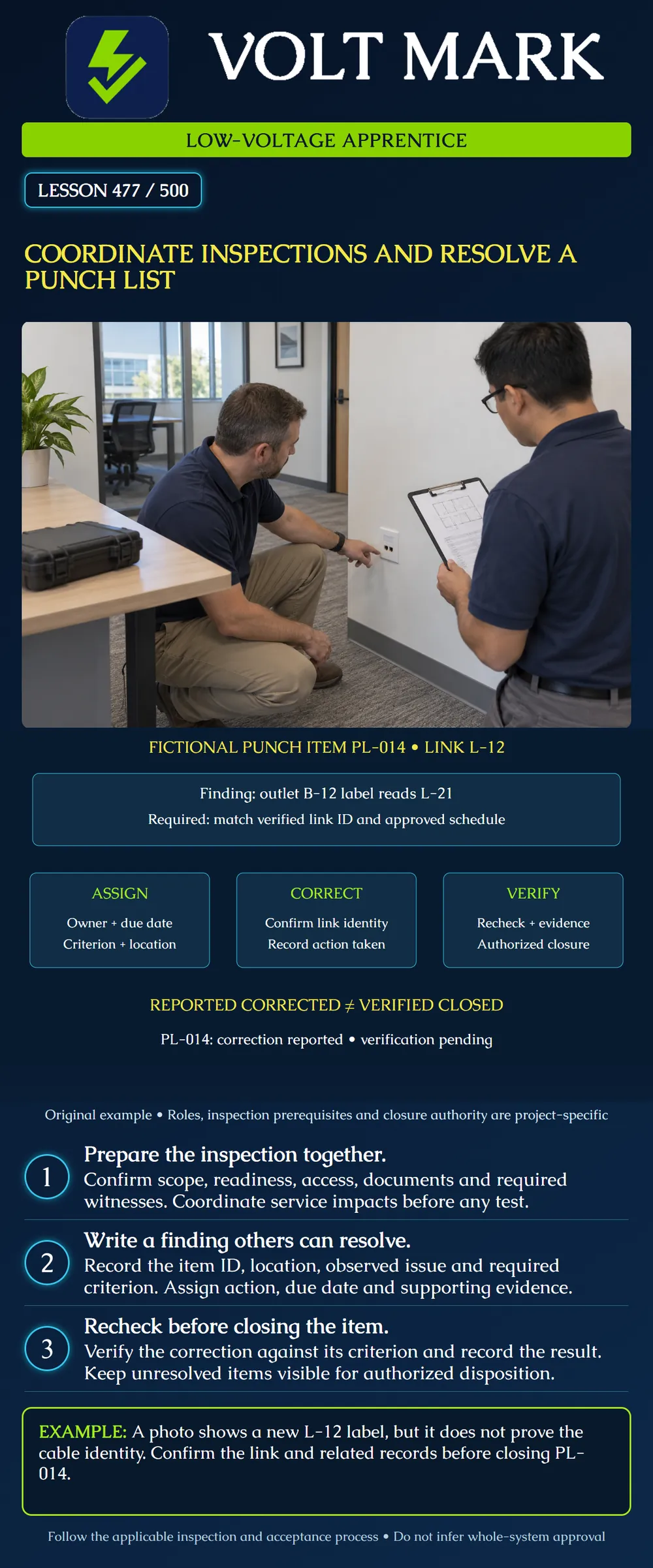
Prepare for a low-voltage inspection and track a finding from identification through corrective action, verification and authorized closure.
The poster shows fictional punch item PL-014 for link L-12. Outlet B-12 displays label L-21 while the approved schedule expects L-12. The example demonstrates a documentation workflow, not a field test or inspection approval. The link identity must be established before deciding which physical label or record needs correction.
Determine whether the event is a contractor readiness check, a commissioning test, an owner walkthrough, an authority inspection or another required review. These activities may overlap, but their scope and authority are not interchangeable.
Record the applicable inspection criteria and responsible participants. Do not assume that an owner's walkthrough replaces a required authority inspection, or that a passed authority inspection proves every contractual deliverable is complete.
WBDG's commissioning guidance explains that documentation responsibilities, review and acceptance should be planned for the project. It describes field observations and test reports feeding a controlled record of issues and their resolution. [1] Those principles support the original workflow here; they do not impose one nationwide inspection procedure or standard role assignment.
Before arranging the event, confirm the required work is ready for the stated scope. Assemble current drawings, relevant product information, test evidence, prior findings and approved procedures as required.
Coordinate access, site contacts, qualified personnel, test equipment and any required witnesses. If the inspection involves service interruption, alarms or interfaces, obtain the required operational coordination before testing.
An appointment is not proof of readiness. If necessary information or access is unavailable, report the gap through the responsible coordinator. Do not conceal missing work merely to preserve a scheduled date.
PL-014 identifies the location, observed mismatch and expected criterion. A useful finding says what is wrong and what reference supports the expected condition. “Fix labels” is too vague to reliably resolve.
For this fictional example: Item: PL-014. Location: Building B, outlet B-12. Associated link: L-12 in the approved schedule. Observation: outlet label reads L-21. Criterion: physical identifiers and related records must agree with verified link identity under the project's labeling requirements.
The record should also contain a responsible action owner, due date, date raised and supporting evidence. These fields are intentionally not populated with real people or commitments in the classroom example.
The apparent mismatch could involve a wrong label, wrong schedule, incorrect endpoint association or more than one error. Confirm the actual identity using the approved method and qualified personnel before changing information.
Replacing L-21 with L-12 solely because the punch-list text says so can hide the real problem. The task is to resolve the discrepancy, not to make a photograph resemble the schedule.
Record the proposed action and any required clarification. If correction affects a test-result mapping, drawing or schedule, identify those related records so the package remains consistent.
A technician's report that the item is corrected is evidence of a reported action. It does not automatically establish that the required criterion has been met.
For PL-014, a photograph of a new L-12 label shows the displayed text at that location. It does not by itself establish cable continuity, endpoint identity or correspondence to the test record. Verification should address the actual finding and its related evidence.
Record who verified the correction, when, by what method and with what result. Use the project's authorized closure process. If verification fails, retain the earlier action and add the new finding rather than erasing the history.
Keep one controlled source of current status or a defined reconciliation process when multiple teams maintain records. Link duplicate findings rather than counting the same issue twice or losing it between lists.
In an original counting example, ten items were raised. Six are verified closed, two are correction-reported but awaiting verification, and two remain open. That is ten total items, with four not yet verified closed.
Saying “eight complete” would merge correction reports with verified closure. Instead, report the categories and outstanding actions. This helps the coordinator plan the remaining rechecks.
Retain the final issue history, relevant inspection records, corrective-action evidence and updated documentation under the project process. Confirm which approval or acceptance the record actually represents.
Closure of PL-014 does not certify the entire cabling system, authorize occupancy or prove every commissioning test passed. It resolves one defined item under the recorded verification.
Before final handover, reconcile unresolved items with the responsible reviewer. Keep their location, action owner and disposition visible so they are not lost when the installation team leaves.
Draft PL-014 with a precise observation, criterion, action owner field, status and evidence references. Explain why changing the sticker is insufficient without confirming identity. Then report the ten-item example using separate verified, pending-verification and open counts.
Answer: No.
Answer: No.
Answer: No; confirm their respective scopes.
Answer: Four.
Answer: No.
[1] WBDG Commissioning Committee, Commissioning Documents: Process, Contents, and Acceptance: https://legacy.wbdg.org/building-commissioning/commissioning-documents Opened October 1, 2026. Used for project-specific documentation, review and issue-resolution principles. Its illustrative role matrix and referenced standards are not adopted as universal local inspection rules.
Original fictional punch item and status-count example. Arithmetic checked: 6 verified + 2 verification-pending + 2 open = 10; 2+2=4 not verified closed.
PL-014 reports L-21 on outlet B-12 where the schedule expects L-12. A new label photograph demonstrates changed text, not the underlying cable identity. Keep verification pending until the approved identity check and associated record reconciliation establish the criterion. In the ten-item list, six verified closed plus two correction-reported plus two open means four still need verified closure; report those states separately.
Mistake: Changing a label to match the schedule before establishing link identity. Correction: Resolve which endpoint, label or record is wrong through the approved identification method, then update related records.
Mistake: Counting correction-reported items as verified closed. Correction: Maintain separate action and verification states with evidence and an authorized closure decision.
Mistake: Treating the owner walkthrough as every required inspection. Correction: Identify the scope and authority of each readiness check, commissioning test and regulatory inspection.
Texas journeyman, 15 questions, scored by topic against the 70% mark. No card, and no account needed to start.
Free study material for low-voltage apprentices. This is a national foundation course: requirements differ by state and by local jurisdiction, and a practice that is common in one place is not a rule everywhere. Nothing here is a licence, a certification, or authority to work unsupervised, and completing it does not count as apprenticeship hours or continuing-education credit. Check the codes adopted where you are working, the licensing authority for that work, and your employer's safety programme. VoltMark is not affiliated with, endorsed by, or sponsored by NFPA, OSHA, NICET, BICSI, FOA, or any state or local licensing authority.
Electrician licensing exam prep: practice questions, timed exam simulations, and step-by-step help finding every answer in the NEC.