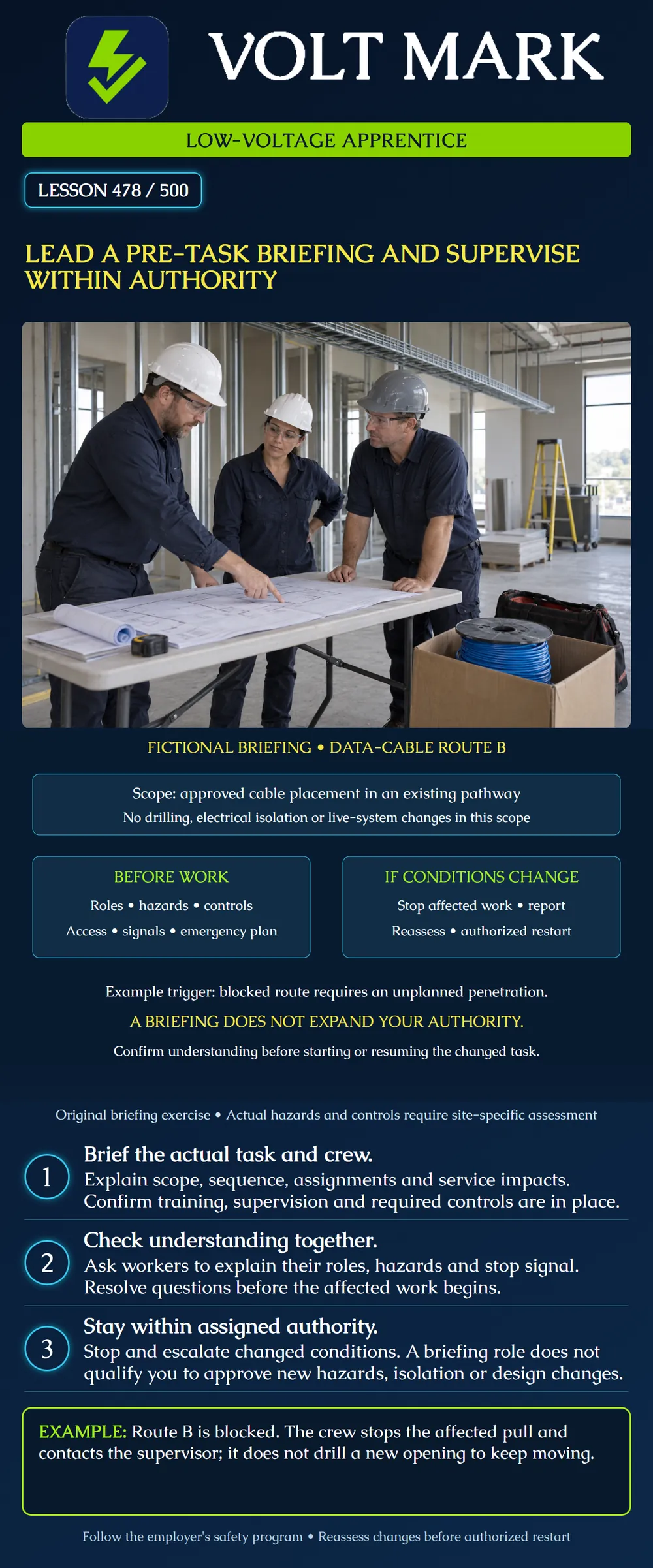
Explain the scope, responsibilities and hazard controls for a low-voltage task, check the crew's understanding and recognize when changed conditions require escalation.
The example is a fictional briefing for placing data cable in an existing approved pathway. It is not a complete job hazard analysis, cable-pulling procedure or authorization to work. The assigned scope excludes drilling, electrical isolation and live-system changes. Actual work requires the employer's applicable safety program, site procedures and competent supervision.
A pre-task briefing communicates the plan and checks shared understanding. Reading a briefing card does not grant a person authority to supervise work beyond their assigned role, approve a design change or perform work requiring qualifications they do not hold.
An apprentice may contribute observations or present assigned parts of a briefing under supervision. That does not make the apprentice the designated person for electrical isolation, structural decisions or other specialist responsibilities.
OSHA's Job Hazard Analysis guidance describes examining the worker, task, tools and environment, involving workers and identifying hazards before work. It also emphasizes addressing uncontrolled hazards and reviewing task steps with employees. [1] The exercise below applies those general principles; it does not claim that this card satisfies every applicable rule or required safety document.
For Route B, the authorized task is cable placement in a specified existing pathway. Identify the actual route, start and end points, equipment and work sequence from the approved plan.
Confirm what is outside scope. In this exercise, the crew is not authorized to create a penetration or change live equipment. If completion seems to require either, the plan needs review through the responsible supervisor.
Avoid a vague instruction such as “finish the cable run.” That can conceal assumptions about access, tools, route suitability and what to do when conditions differ.
Name the assigned lead, workers and any required support roles using the actual site's arrangement. Confirm who communicates with other trades and who can authorize changes or restart affected work.
For coordinated cable placement, establish how workers communicate and stop movement. Everyone involved should recognize the agreed stop signal. A communication method is only useful if it works in the actual environment and each person understands it.
Do not assume that being the most experienced person present gives someone every approval authority. If the responsible supervisor or required specialist is unavailable, escalate the limitation rather than redistributing authority informally.
Review the actual task assessment. Possible concerns may include access equipment, overhead work, falling objects, manual handling, pinch points, occupied walkways and nearby electrical or operating equipment. This list is not exhaustive and does not establish the controls needed at a particular site.
Identify the specific control for each applicable exposure and confirm it is in place. “Be careful” does not describe a usable control. Required training, tools, barriers, access arrangements and protective equipment must match the actual work.
Low-voltage cable does not make every surrounding hazard low risk. The workplace may contain other energy sources or activities outside the cable task. Do not open electrical enclosures or approach an uncertain condition to complete a briefing checklist.
If an immediate danger is identified, follow the site's protective and emergency procedures. Do not continue exposure while waiting to finish paperwork.
Ask each worker to explain their assigned role and what will make them stop. Invite questions and information about site conditions the planner may have missed.
For example, one worker may know that a corridor is scheduled to reopen during the planned work window. That information can change the access-control plan. Address it before the affected activity begins.
A signed attendance line records participation, not proof that hazards are controlled or the plan is understood. If language, hearing, visibility or communication barriers interfere, arrange an effective briefing method before relying on the instructions.
During the fictional task, Route B is found blocked. The crew believes drilling a new opening would allow progress. That action is outside the stated scope and introduces conditions not covered by the plan.
Stop the affected work, leave the work area in an appropriate safe condition under the site's procedure and contact the responsible supervisor. Do not drill based on a guess about concealed services or assume a nearby opening is an acceptable substitute.
The responsible roles must resolve the route, required reviews and controls before the changed task proceeds. The crew then receives the revised instructions and confirms understanding. A new verbal description alone is not evidence that all required design or safety decisions have occurred.
Changes in crew, tools, access, weather, adjacent work or service conditions can affect the plan. Use the employer's process to determine when the assessment and briefing need updating.
A worker replacing someone mid-task needs the relevant scope and control information. Do not rely on “they can copy what we are doing.” Similarly, a tool substitution may alter the task even when the desired result remains the same.
Keep supervision within the assigned authority. An individual who can coordinate material handling may not be authorized to decide electrical safety boundaries or permit a system outage. Escalate the specific decision to the responsible role.
Document the task reference, date, participants, key controls, questions and changes as required by the site. Record unresolved conditions and the action needed before work can resume.
Do not mark a control verified merely because it appears on the form. If the barrier, access equipment or required authorization is missing, the record should reflect that fact.
After the task, capture useful observations through the employer's reporting process. A near miss or unexpected condition can reveal that the plan needs improvement for the next crew. Preserve factual information without assigning unsupported blame.
Prepare a Route B briefing with scope, roles, communication, applicable hazards, control-verification fields and a stop trigger. Then introduce the blocked-route condition. State which activity stops, who receives the issue and what must be resolved before an authorized restart.
Answer: No.
Answer: No.
Answer: Stop the affected work and escalate for reassessment and authorized direction.
Answer: No.
Answer: No; controls must address the actual exposure.
[1] OSHA 3071, Job Hazard Analysis, 2002 revised edition: https://www.osha.gov/sites/default/files/publications/osha3071.pdf Opened October 1, 2026. Used for general task analysis, worker involvement and hazard-control principles. Historical directories and program details are not adopted as current requirements. Applicable current rules and site requirements must be determined for real work.
Original fictional low-voltage briefing exercise. No numerical calculation required.
The Route B crew finds the approved existing pathway blocked. Drilling would add work expressly excluded from the assignment and introduce concealed-service and route questions. Stop the affected placement work, follow the site's safe-state procedure and report the specific blockage to the responsible supervisor. Resume only after the responsible roles resolve the changed scope and controls and the crew understands the revised instructions. A briefing signature cannot supply those missing decisions.
Mistake: Treating 'finish the run' as authority to drill around a blockage. Correction: Compare the proposed step with the assigned scope and escalate the route change before the affected work proceeds.
Mistake: Assuming the person presenting the briefing can authorize isolation or structural work. Correction: Name the actual decision roles and keep specialist decisions with qualified authorized personnel.
Mistake: Using attendance signatures as proof that controls are in place. Correction: Check the actual control conditions and have workers explain roles and stop triggers before relying on the plan.
Texas journeyman, 15 questions, scored by topic against the 70% mark. No card, and no account needed to start.
Free study material for low-voltage apprentices. This is a national foundation course: requirements differ by state and by local jurisdiction, and a practice that is common in one place is not a rule everywhere. Nothing here is a licence, a certification, or authority to work unsupervised, and completing it does not count as apprenticeship hours or continuing-education credit. Check the codes adopted where you are working, the licensing authority for that work, and your employer's safety programme. VoltMark is not affiliated with, endorsed by, or sponsored by NFPA, OSHA, NICET, BICSI, FOA, or any state or local licensing authority.

Electrician licensing exam prep: practice questions, timed exam simulations, and step-by-step help finding every answer in the NEC.