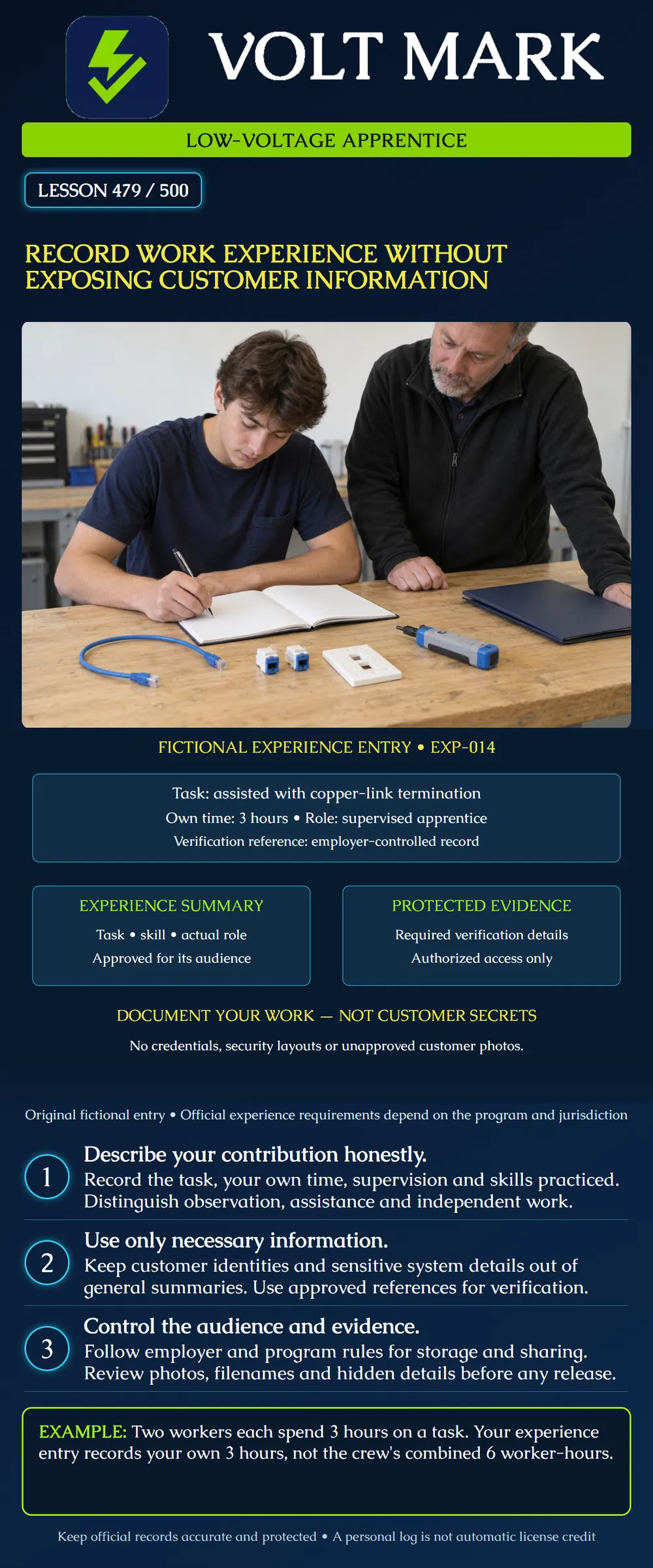
Write an accurate experience entry that documents personal work and supervision while protecting customer and system information.
EXP-014 is an invented example for a supervised apprentice who assisted with copper-link termination for three hours. It is not an actual employment record, license application or approved apprenticeship form. Required experience categories, supporting evidence and approval rules vary by program and jurisdiction.
Describe the task and your own contribution. “Assisted with copper-link termination under assigned supervision” communicates a different role from “designed and certified the network.”
Distinguish watching, assisting, performing a task under supervision and carrying out an authorized task independently. Do not claim a test, inspection or approval simply because you were present when another person performed it.
Record useful learning details without exaggeration. For EXP-014, an entry might identify conductor preparation, following the specified termination arrangement and learning how identifiers connect to test records. Include only activities actually performed in a real log.
The fictional apprentice worked three hours. A second worker also spent three hours. The crew contributed six worker-hours, but the apprentice's personal participation was three hours.
Do not multiply personal experience by crew size or count overlapping tasks as separate additional time. If two activities share the same hour, describe the work accurately under the applicable reporting method rather than turning one hour into two.
Different programs may treat work categories, classroom learning, observation, breaks or supervision differently. Keep source time records and follow the specific program's instructions. This lesson does not determine which hours qualify for a credential.
A general experience summary usually does not need the customer's name, exact address, security layout or device credentials. The example uses an employer-controlled verification reference rather than copying sensitive work-order contents into a personal portfolio.
Official verification may require details that a public summary should omit. Provide required information through the authorized employer, program or licensing process. Do not remove mandatory fields from an official submission without resolving the requirement, and do not publish that submission merely because it is legitimate to provide it privately.
The FTC's guidance recommends collecting only needed personal information, limiting access and protecting retained records. [1] This lesson applies those general principles to an original experience-log workflow; it does not declare that every customer system detail is legally classified as personal information.
Access-control layouts, alarm-zone descriptions, camera views, network addresses, configuration exports, badges and passwords can expose security or operational information. A technician's ability to view them for work does not establish permission to copy or publish them.
Names, faces, contact information and exact locations can also identify customers or occupants. A short story about a “nameless” site may still reveal it through unique equipment, signage or location clues.
Use task-level descriptions that demonstrate the skill without exposing the installation. If a public portfolio is permitted, an approved training-board example can often show a technique without using customer material. Label it as training work rather than implying it was a customer installation.
Follow the employer's rules before taking or retaining site photos. Do not assume that blurring a logo makes a photograph acceptable to share. Screens, reflected text, labels, badges, adjacent paperwork and distinctive room features may reveal information.
Files can contain identifying names, comments, metadata or location information beyond the visible picture. Use the organization's approved review and release process for any permitted sharing. Do not upload customer files to an outside service to “clean them up” without authorization.
A drawing or test report supplied for project work is not automatically available for a personal portfolio. Record a controlled reference where permitted rather than copying the entire document.
For the example, the detailed entry can include date, task category, own time, role, supervision reference and the employer-held verification record. The public or general summary may use less detail after the required review.
Have the appropriate person verify information using the program's process. Never invent a supervisor signature, backdate an approval or describe a pending verification as complete.
Correct mistakes transparently. Preserve the basis for a correction when required, especially if a time or task entry was already submitted. Do not alter the employer's underlying records to make them match a personal claim.
Use approved storage and access controls. Personal email, public links or an unmanaged device may not be suitable for employer or customer records. Follow applicable retention and disposal policies; do not delete required evidence simply because you no longer want it in a portfolio.
Limit a recipient's access to the information needed for that purpose. A training coordinator verifying experience and a public audience reading a résumé have different needs.
If sensitive information is accidentally included or shared, report it through the employer's incident process. Do not conceal the event or make unsupported assurances that deleting a local copy removed every other copy.
A fictional internal learning summary could read: “EXP-014: Assisted with copper-link termination under assigned supervision for three hours. Practiced preparation and identification steps. Verification remains with the employer's approved record system.”
That wording describes the exercise without claiming independent design, certification or licensing credit. A real entry should use the required task descriptions and actual evidence.
For a public résumé, even this summary requires the relevant employer and confidentiality review. Approval for one audience or use should not be assumed to authorize every future disclosure.
Write EXP-014 with the apprentice's own time and supervised role. Then identify which details belong in a controlled verification record and which can be omitted from a general skills summary. Review a fictional photo checklist without using real customer images.
Answer: Three hours.
Answer: No.
Answer: No; other details may still identify the site or person.
Answer: No.
Answer: No; the applicable program or jurisdiction determines its requirements.
[1] Federal Trade Commission, Protecting Personal Information: A Guide for Business: https://www.ftc.gov/system/files/documents/plain-language/pdf-0136_proteting-personal-information.pdf Opened October 1, 2026. Used for data minimization, access control and protected retention principles only. The web article timed out; the official PDF was successfully opened. No jurisdiction-specific privacy or licensing interpretation is made.
Original fictional experience entry. Arithmetic checked: two workers×3 hours=6 crew worker-hours, while the individual records3 hours of participation.
For EXP-014, the apprentice and another worker each participate for three hours. The crew total is six worker-hours, but the apprentice records three hours of supervised participation. A general skills summary states the termination task and role without the customer's address, device credentials or security layout. Required verification details stay in the employer-approved record and are supplied only through the appropriate program process; reducing public detail does not justify omitting mandatory private-submission fields.
Mistake: Claiming the crew's six worker-hours as six personal experience hours. Correction: Record the apprentice's own three hours and retain the role and supervision basis required by the program.
Mistake: Assuming a photo is safe to publish after the customer's name is blurred. Correction: Check labels, screens, reflections, metadata and location clues through the employer's approved release process.
Mistake: Calling attendance at a test personal certification of the installation. Correction: Describe whether you observed, assisted or performed the task and claim only the authority and evidence actually held.
Texas journeyman, 15 questions, scored by topic against the 70% mark. No card, and no account needed to start.
Free study material for low-voltage apprentices. This is a national foundation course: requirements differ by state and by local jurisdiction, and a practice that is common in one place is not a rule everywhere. Nothing here is a licence, a certification, or authority to work unsupervised, and completing it does not count as apprenticeship hours or continuing-education credit. Check the codes adopted where you are working, the licensing authority for that work, and your employer's safety programme. VoltMark is not affiliated with, endorsed by, or sponsored by NFPA, OSHA, NICET, BICSI, FOA, or any state or local licensing authority.

Electrician licensing exam prep: practice questions, timed exam simulations, and step-by-step help finding every answer in the NEC.