Assemble and check a low-voltage closeout package against its actual required deliverables, then distinguish delivery, review and accepted completion.
Package C-01 is a fictional six-row teaching example. It is not an exhaustive national checklist or an actual accepted project. The governing contract documents, approved changes, applicable requirements and assigned acceptance process determine real deliverables.
Build a deliverables list from the project's authoritative documents rather than copying the folders from the previous job. Identify the requirement reference, scope, responsible provider, format, due date, reviewer and acceptance evidence.
WBDG's commissioning guidance treats documentation as a project-specific process with planned responsibilities, review, acceptance and retention. It describes records supporting testing, operations and maintenance. [1] These principles inform the example; its illustrative role assignments are not imposed on every project.
A document may be required for one system and not another. Resolve uncertain applicability through the responsible project role. Do not mark a missing deliverable “not applicable” merely because it is difficult to obtain.
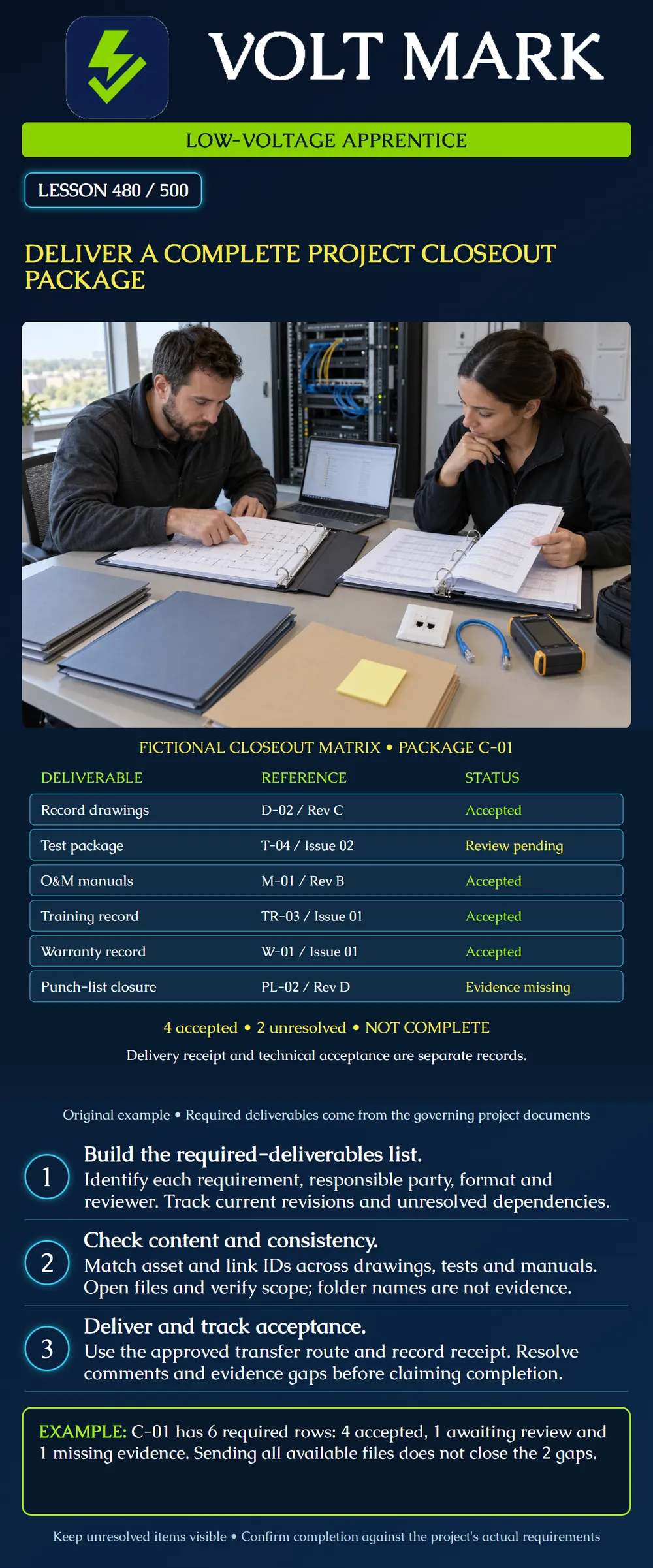
C-01 contains these required teaching-example rows: Record drawings D-02 revision C: accepted. Test package T-04 issue 02: review pending. Operations and maintenance manuals M-01 revision B: accepted. Training record TR-03 issue 01: accepted. Warranty record W-01 issue 01: accepted. Punch-list closure PL-02 revision D: evidence missing.
Four rows are accepted and two are unresolved. Six rows in the index do not establish six completed deliverables. The package remains incomplete under the exercise's requirement that all six be resolved and accepted.
The word “accepted” is fictional status data. A real matrix must point to the appropriate dated review or approval record rather than asserting acceptance without evidence.
Record drawings should represent the verified installed condition within their required scope. Match asset, cable, fiber and endpoint identifiers to the associated schedules and test evidence.
For a copper installation, an indexed report should correspond to the correct link and required test configuration. For fiber, reconcile the specified strand, wavelength, direction and method coverage. A folder containing many reports is not proof that every required test is present.
Resolve inconsistent IDs and unexplained duplicate records. Preserve source test data and relevant retest history according to the agreed delivery requirements. Do not replace a missing test with an unrelated passing report.
In C-01, T-04 is available but still under review. That is different from a missing file, but it is not accepted completion.
Ensure manuals and instructions apply to the actual installed equipment and configuration. Generic brochures alone may not satisfy the required operating and maintenance information.
Where required, include asset records, maintenance bases, approved operating procedures, support information and links to controlled configuration or recovery resources. Keep passwords and sensitive recovery material in the approved secure handover process rather than exposing them in a general manual.
For training records, distinguish attendance from the tasks demonstrated and any remaining follow-up. The required training evidence should identify the relevant system and scope, not simply say “owner trained.”
Provide the actual required warranty documents and support route. Record the applicable equipment or work scope and referenced terms without inventing coverage or start dates.
A manufacturer's warranty, installation warranty and maintenance agreement may cover different matters. Do not merge them into an unsupported promise that every future issue is covered.
If dates or responsible contacts remain unresolved, identify the gap. The fictional W-01 row is accepted, but that exercise status does not establish a universal warranty period.
PL-02 lacks closure evidence. The installer may have reported corrections, but the required verification record is still missing. Link each unresolved item to its responsible action owner and required next step.
Do not erase an unresolved item to make the final count look clean. If the authorized process permits a documented disposition or deferred item, preserve that decision and its conditions. A local note does not waive applicable requirements.
The example requires PL-02's closure evidence before complete acceptance. For actual projects, confirm the governing completion criteria and the authority responsible for each disposition.
Use a clear index with revision references and file locations. Open files from the intended package, check that links work and confirm the selected versions. Avoid ambiguous names such as multiple files all called “final.”
Check readability, searchability and completeness of exports. Native files, readable PDFs, physical materials or other formats may be required. Confirm the actual requirement rather than assuming one ZIP file satisfies everything.
Protect sensitive information and use the approved transfer route. Keep a transmittal identifying the package issue, contents, recipients and outstanding items. Do not substitute a public link for a controlled handover.
A delivery receipt confirms a transfer or acknowledgement within its stated scope. It does not prove every document has been technically reviewed or every system function accepted.
Log review comments, assign responses and preserve revised submissions. Link acceptance evidence to the exact revision accepted. If a later revision changes accepted content, determine what further review is required.
In C-01, sending the six listed files cannot resolve the test review or create missing punch-list evidence. The two outstanding rows need actual resolution under the specified process.
When all required items are resolved, retain the accepted package and its supporting history according to the project record policy. Confirm that the operations team can access and use the delivered material.
Do not infer unrelated approvals from package acceptance. Closeout document acceptance does not automatically establish occupancy authorization, licensing compliance or every separate authority's approval.
The final statement should describe the scope actually completed and any formally documented limitations. If evidence is still missing, report that condition clearly instead of using an unqualified “complete.”
Recreate C-01 and add requirement references, providers and acceptance-evidence fields. Identify what is needed to resolve T-04 and PL-02. Draft a truthful transmittal status stating that four rows are accepted and two remain unresolved.
Answer: Four.
Answer: Two.
Answer: No.
Answer: No.
Answer: No.
[1] WBDG Commissioning Committee, Commissioning Documents: Process, Contents, and Acceptance: https://legacy.wbdg.org/building-commissioning/commissioning-documents Opened October 1, 2026. Used for project-specific documentation, review, acceptance and retention principles. Referenced standards and illustrative responsibility assignments are not presented as universal requirements.
Original fictional closeout matrix. Arithmetic checked: 4 accepted + 1 review pending + 1 evidence missing = 6 required rows; 2 remain unresolved.
Mistake: Calling six indexed documents six accepted deliverables. Correction: Report each required row's actual state; C-01 has four accepted and two unresolved rows.
Mistake: Treating delivery acknowledgement as technical acceptance. Correction: Link the actual review decision to the exact document issue and keep receipt separate.
Mistake: Removing a punch item because the installer says it is corrected. Correction: Retain the missing closure-evidence gap and obtain the required verification or authorized disposition.
Texas journeyman, 15 questions, scored by topic against the 70% mark. No card, and no account needed to start.
Free study material for low-voltage apprentices. This is a national foundation course: requirements differ by state and by local jurisdiction, and a practice that is common in one place is not a rule everywhere. Nothing here is a licence, a certification, or authority to work unsupervised, and completing it does not count as apprenticeship hours or continuing-education credit. Check the codes adopted where you are working, the licensing authority for that work, and your employer's safety programme. VoltMark is not affiliated with, endorsed by, or sponsored by NFPA, OSHA, NICET, BICSI, FOA, or any state or local licensing authority.
Electrician licensing exam prep: practice questions, timed exam simulations, and step-by-step help finding every answer in the NEC.