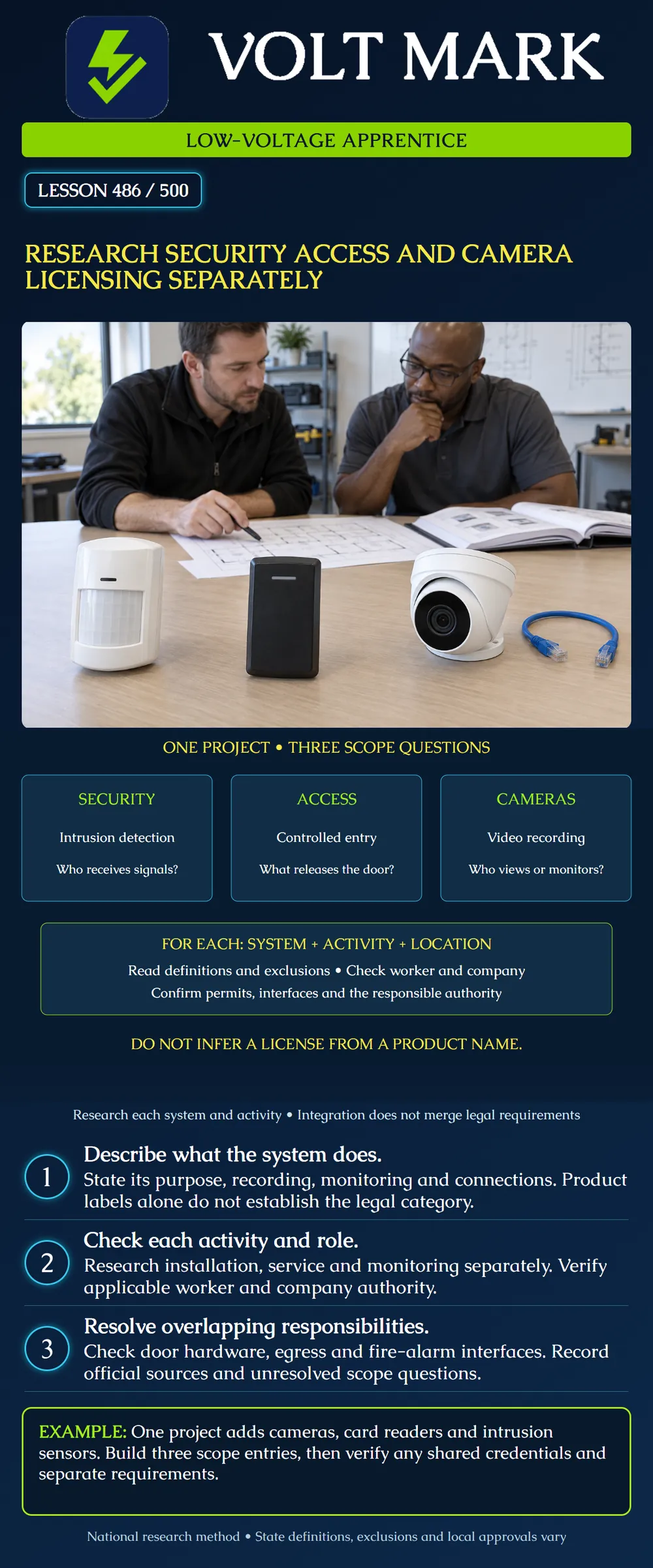
Describe security, access-control and camera systems in terms useful for licensing research. Separate the system from the activity and the worker or company role. Recognize that definitions can include devices whose product names do not sound like the legal category. Preserve a traceable source record.
This lesson teaches a method for any U.S. project location. It does not say that every state requires three separate licenses or that one credential always covers all three systems. Some requirements overlap; others differ. Determine the actual rules, exemptions and local approval process for the proposed work.
A manufacturer certificate, a general low-voltage job title and a customer's purchase order do not establish all applicable authority. This course does not grant a license or permission to change a security system.
For intrusion security, describe what is detected, where signals go and whether monitoring is part of the proposed service. For access control, describe the controlled opening, reader, controller, locking hardware and relevant interfaces. For cameras, identify whether the system records, archives, displays or is monitored, along with the proposed installation or service.
These descriptions are research inputs, not design instructions. Avoid reducing the whole project to “network equipment” merely because the devices use Ethernet. The communication medium does not by itself determine licensing scope.
The poster's three cards deliberately keep the questions separate. They do not predetermine the answer. After researching each entry, a project lead may find overlapping authority or additional requirements, but that conclusion needs evidence.
List what the company intends to do: sell, install, configure, maintain, repair, monitor or provide another defined service. Read the official definitions of those activities. Do not assume that the law treats initial installation and ongoing monitoring identically.
Describe whether the proposed work is limited to passive infrastructure or includes connecting and commissioning the devices. Do not create an exemption by calling a complete security installation “just cable.” Equally, do not invent a licensing requirement from a vague title without checking the actual rule.
Use official licensing resources to verify the required company authority and individual role separately. Match names, applicable categories, status and any required affiliation. Check whether the proposed service falls within the listed authority.
A company license covering one service does not establish that all possible security services are included. A worker credential also does not automatically establish the company's authority to contract for the work. Record the source and limits of each conclusion.
Texas DPS lists alarm installers, alarm monitors, electronic access-control device installers and locksmiths among its individual license categories. Its company-license page separately describes business categories and included service types. These pages illustrate distinct company and individual questions; they are not a complete eligibility determination.
Texas Occupations Code 1702.002 defines an alarm system in a way that can include specified camera systems and computer-based access equipment. The section also contains exclusions and a separate electronic access-control-device definition. Consequently, a device does not necessarily fall outside a legal alarm category merely because it is marketed as a camera or door product.
This is a Texas example only. Read the complete conditions and any applicable exemptions before applying it to real work. No claim is made here that every camera, gate operator or card reader has the same legal treatment, or that Texas categories apply to another state.
An access-control installation can raise questions about door hardware, egress and connections to a fire-alarm system. Assign responsibility for each part through the authorized project process. Do not assume the security installer may modify every connected system.
The research record should distinguish equipment work, design responsibility and project approvals. A valid trade credential does not prove that a proposed locking arrangement is approved. A drawing approval does not establish the worker's credential. This lesson does not teach bypassing locks, disabling protection or changing an egress sequence.
Monitoring and stored video also create operational responsibilities that should be assigned by the owner and responsible project staff. Do not use access to customer systems as a way to investigate legal scope. Use approved descriptions and drawings, and keep sensitive details in the authorized project location.
For each system, record the location, purpose, proposed activity, interfaces, worker role, company role, official source, section, date checked, relevant conditions and remaining questions. Keep uncertainty visible.
A useful question might be: “For the described camera installation that records at this address, which company and individual categories apply?” Provide the facts needed to answer it. Do not request a blanket determination for every future job based on one incomplete example.
If an official response depends on monitoring arrangements or a particular connection, preserve that condition. If the project changes, revisit the conclusion. Obtain clarification through the responsible agency or qualified project representative rather than silently extending an earlier answer.
A fictional campus project contains eight cameras, two card-controlled doors and an intrusion panel. All devices connect to the same network. The estimator assumes that a networking credential covers the complete scope.
Prepare three worksheet entries and identify the actual installation, configuration and monitoring tasks. Check the applicable official definitions, individual and company requirements, and any local reviews. Record door and fire-alarm interfaces as separate coordination questions.
The common network is a technical relationship, not evidence that legal authority is identical. The exercise ends with a documented research plan, not an approved installation or a simulated licensing decision.
Answer: No. Read the governing definitions and conditions.
Answer: No.
Answer: No. Research the jurisdiction and scope.
Answer: Check every condition and any related provisions before relying on it.
Answer: Not by itself. Verify the separate project requirements.
Texas DPS, Types of Individual Licenses: https://www.dps.texas.gov/section/private-security/types-individual-licenses Texas DPS, Types of Company and School Licenses: https://www.dps.texas.gov/section/private-security/types-company-and-school-licenses Texas Legislature, Occupations Code Chapter 1702, especially 1702.002: https://tcss.legis.texas.gov/resources/oc/htm/oc.1702.htm Examples are limited to the distinctions described. Worksheet and practice scenario are original. No exhaustive fifty-state or local legal determination is claimed.
Mistake: Classifying a recording camera solely by its product label. Correction: Read the applicable legal definitions, including conditions and exclusions, for the actual recording and service arrangement.
Mistake: Treating a common Ethernet network as one licensing scope. Correction: Research intrusion, controlled doors and cameras by task and entity/worker role before determining overlap.
Mistake: Assuming a security credential approves changes to door egress. Correction: Obtain the separately applicable design, door/fire-interface and project approvals through the responsible roles.
Texas journeyman, 15 questions, scored by topic against the 70% mark. No card, and no account needed to start.
Free study material for low-voltage apprentices. This is a national foundation course: requirements differ by state and by local jurisdiction, and a practice that is common in one place is not a rule everywhere. Nothing here is a licence, a certification, or authority to work unsupervised, and completing it does not count as apprenticeship hours or continuing-education credit. Check the codes adopted where you are working, the licensing authority for that work, and your employer's safety programme. VoltMark is not affiliated with, endorsed by, or sponsored by NFPA, OSHA, NICET, BICSI, FOA, or any state or local licensing authority.

Electrician licensing exam prep: practice questions, timed exam simulations, and step-by-step help finding every answer in the NEC.