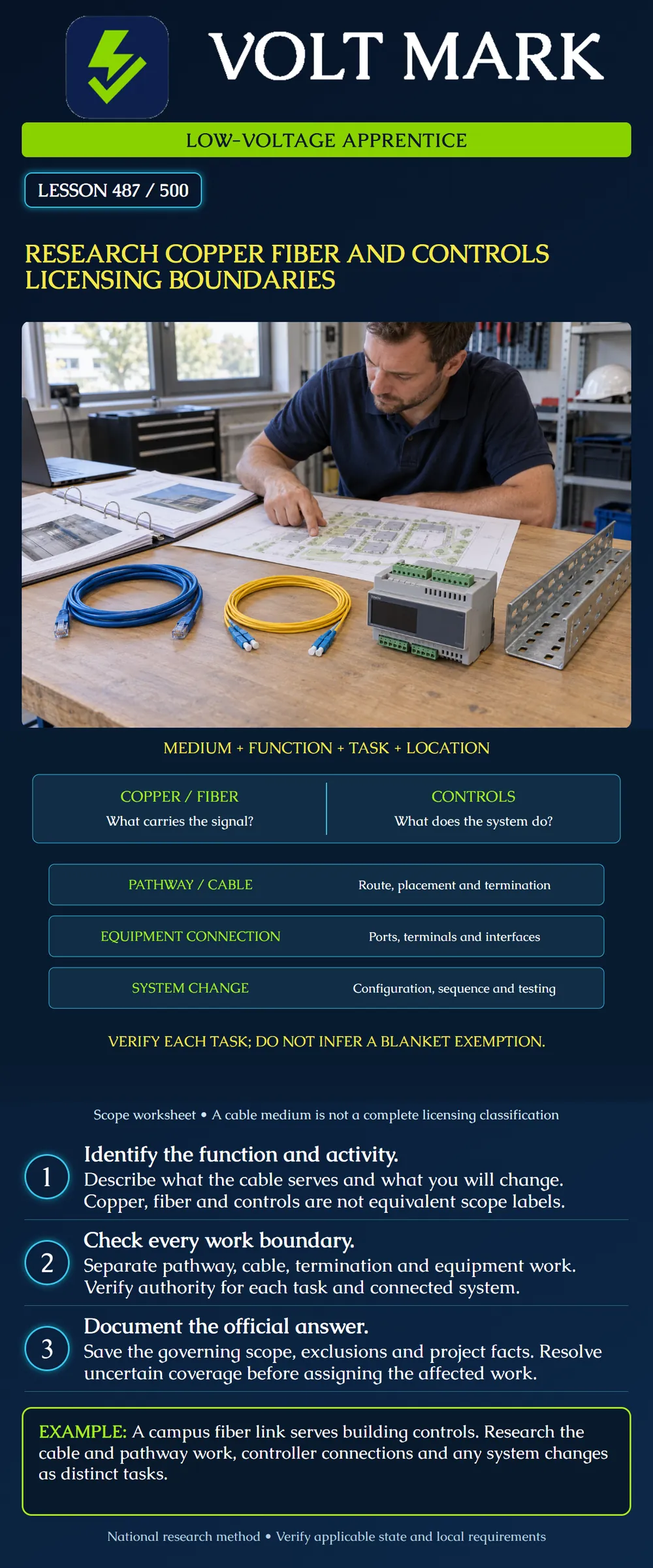
Distinguish the cable medium from the system function. Break a combined communications or controls project into researchable tasks. Verify licensing boundaries with official sources, preserving conditions and unresolved questions.
This lesson teaches a research process usable across the United States. It does not determine the license required for every copper, fiber or controls job. Rules depend on location, activity, system and role. A classification in one state is not a national credential.
Copper and optical fiber tell us something about how a connection carries information. They do not fully describe the legal scope of the work. Identify what the connection serves: ordinary communications, security, fire alarm, building controls or another function. Also describe any power-carrying components and equipment connections.
Do not assume optical fiber is outside contractor licensing simply because the optical signal is not an electrical current. Equally, do not assume all copper work belongs to one licensing category. Determine the applicable rule rather than using the material name as a legal conclusion.
“Controls” can refer to a range of system functions and activities. A network link serving a controller, a field-sensor connection and an alteration to a control sequence are different proposed tasks. State clearly which work is included.
The fact that equipment communicates over a familiar network does not establish authority to change the controlled system. Likewise, experience terminating cable does not prove eligibility to alter every terminal or interface at its ends. Research the actual scope and assign the work through the authorized project process.
Begin with the pathway and route. Is the work placing cable in an existing pathway, installing new pathway, entering another building or crossing a public right-of-way? Describe these facts without assuming the same rules apply to all of them.
Next identify cable placement, splicing, termination, testing and documentation. Then identify equipment connections and configuration. Finally identify any changes to system operation. The poster groups these into three research rows; it is not an exhaustive construction checklist or a claim that each row requires a separate license.
Keep work outside the low-voltage assignment clearly identified for coordination. Do not expand an apprentice's task into supply-side electrical work, equipment modification or other trade work simply because it is physically nearby.
Use the responsible licensing agency and governing legal sources. Read definitions, listed work, exclusions and cross-references. Verify the actual company and worker requirements separately from project permits and inspections.
A familiar classification name is a starting point. It does not answer whether an installation involving several systems is fully covered. If the work crosses scope boundaries, ask the responsible authority a question that includes the project facts and activities. Keep its answer attached to the question that was asked.
Nevada NAC 624.200(2)(d) includes fiber-optic systems, computer networking, instrumentation and temperature controls within its C-2d description. This illustrates that fiber and specified controls work can appear expressly in a state contractor classification. The broader C-2 provisions and actual license scope also need consideration.
California CSLB's C-7 description includes communication systems and instrumentation and temperature controls within its stated energy and voltage limits. The same section excludes low-voltage fire alarm systems. Thus, a controls or communications label should not erase an explicit exclusion.
These examples are limited to the cited text. They do not establish that the same classification numbers or boundaries apply in other states, or that every controller, industrial installation or related project task falls within these descriptions. They are not a complete permit or licensing determination.
Use approved drawings, equipment descriptions and a written task list. Identify which party owns the interface and which qualified personnel are responsible for each side. Do not operate a live system to find out whether the licensing boundary matters.
If an interface is unclear, record the uncertainty and route it through the project lead. The right research output may be a pending question rather than an approval. Do not convert a contractor's previous experience into a legal determination for a different site or system.
A fictional campus requests a fiber link between two buildings so its building-controls network can communicate. The work order also mentions a new pathway section, connections at controllers and a revised operating sequence.
Make separate rows for pathway work, fiber installation and termination, equipment connections, and the sequence change. Record the location, system purpose, proposed activity, worker and company roles, official source and open questions. Identify any route that crosses property or jurisdiction boundaries.
Do not assume the fiber contractor has authority for every row. Also do not assume a separate license is necessarily required for every row. The assignment is to collect the evidence and obtain a scope determination through the responsible authority and project process.
The exercise performs no configuration, live test, agency communication or application. The project remains fictional and does not authorize field work.
A useful entry names the source and section, date checked, relevant conditions, project facts and conclusion. For example: “The reviewed Nevada classification expressly mentions fiber; coverage of the proposed controller modification is not yet resolved.” That finding is more accurate than a broad statement that “all controls are covered.”
Update the record when the task, location or system changes. Keep old findings for traceability, but do not apply them beyond their documented scope.
Answer: No. Check the applicable scope and rules.
Answer: No. Controls describes function; fiber describes a medium.
Answer: No.
Answer: Separate tasks, system purposes, locations, roles, sources and unresolved boundaries.
Answer: No.
Nevada Legislature, NAC 624.200, especially subsection 2(d): https://www.leg.state.nv.us/Division/Legal/LawLibrary/NAC/NAC-624.html California CSLB, C-7 Low Voltage Systems Contractor: https://cslb.ca.gov/about_us/library/licensing_classifications/Licensing_Classifications_Detail.aspx?Class=C-7 The examples are scoped to these descriptions. Original worksheet and practice case are not agency determinations.
Mistake: Treating fiber as exempt merely because it carries optical signals. Correction: Check the actual classification text and system purpose; the Nevada example expressly includes fiber-optic systems.
Mistake: Extending cable-termination authority to changing controller sequences. Correction: Separate pathway, medium installation, endpoint connection and operating-sequence work in the research record.
Mistake: Assuming every research row requires its own license. Correction: Use the rows to identify scope questions, then establish overlap or separation from the applicable official sources.
Texas journeyman, 15 questions, scored by topic against the 70% mark. No card, and no account needed to start.
Free study material for low-voltage apprentices. This is a national foundation course: requirements differ by state and by local jurisdiction, and a practice that is common in one place is not a rule everywhere. Nothing here is a licence, a certification, or authority to work unsupervised, and completing it does not count as apprenticeship hours or continuing-education credit. Check the codes adopted where you are working, the licensing authority for that work, and your employer's safety programme. VoltMark is not affiliated with, endorsed by, or sponsored by NFPA, OSHA, NICET, BICSI, FOA, or any state or local licensing authority.

Electrician licensing exam prep: practice questions, timed exam simulations, and step-by-step help finding every answer in the NEC.