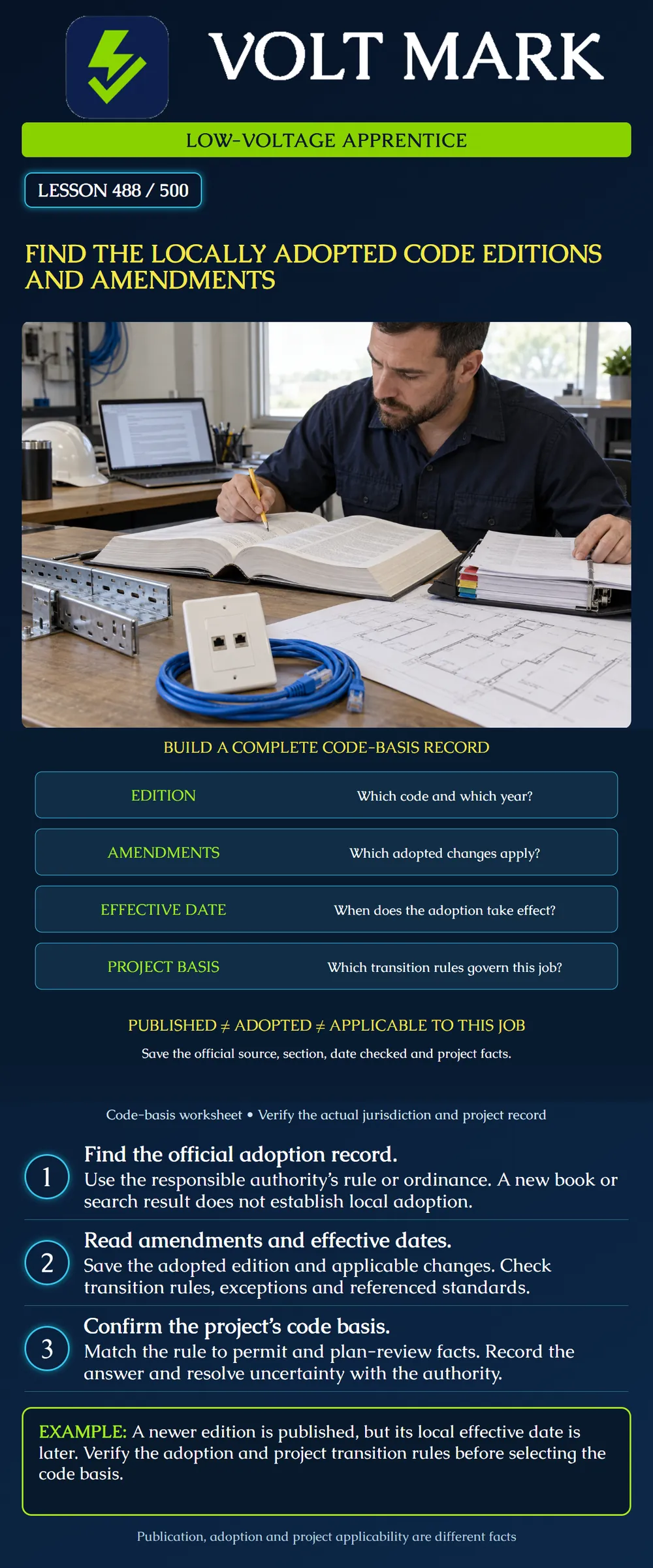
Find the official source establishing the applicable code edition. Identify amendments and effective dates. Distinguish publication from adoption and from applicability to a particular project. Preserve a code-basis record that can be checked by the responsible project team.
The newest code book is not automatically the governing edition in every state or county. Identify the actual location, responsible authority and relevant system. Use this process nationwide, but obtain the answer for the particular jurisdiction and project.
This lesson does not select a code basis for a real permit. It does not replace qualified design, code interpretation or inspection review.
Start with the authority identified for the job. Locate its official code-adoption rule, ordinance or other governing record. A government summary page can help locate the record, but read the adoption text and references before drawing a conclusion.
Record the code name and edition separately. Electrical, building, fire and other applicable codes may carry different edition years. Do not assume that one year applies to every book because a webpage refers broadly to a code update.
A published model code is a technical document. The adoption mechanism establishes its role under the applicable jurisdiction's rules. A proposed adoption, draft amendment and final operative requirement are not interchangeable.
Find the state and local changes that apply within the governing framework. Do not simply combine every amendment found online. Determine which authority adopted each change, whether it is in effect and whether it applies to this site and scope.
An amended code may add, delete or change provisions. A summary of significant changes is useful orientation but is not necessarily a complete amendment set. Keep the adopted text and relevant amendment references together so that a learner does not consult only an unamended model-code paragraph.
Do not assume that “use the stricter rule” resolves every conflict. Follow the applicable hierarchy and interpretation process. Refer an apparent conflict to the responsible project lead and authority with the exact provisions identified.
Record the adoption effective date. Then read how the rule applies to projects during a transition. The relevant event might involve a permit, plan-review submission or another defined milestone. The governing text determines the event; this lesson does not supply a universal date rule.
A project may have several dates: application, acceptance for review, permit issuance, revision and construction start. Preserve the actual records. Do not substitute the date the crew arrives merely because it is easiest to find.
Also check conditions attached to exceptions or transition provisions. An old drawing title block is evidence of a prior design basis, not proof that the same basis remains valid after a scope change or permit event. Have the responsible authority resolve uncertain applicability.
Washington WAC 296-46B-010 is an example of an adoption rule that identifies standards, a future replacement date, conflict provisions and project transition exceptions. The reviewed text names the 2023 NEC and states that the 2026 NEC replacement takes effect December 31, 2026. It relates application to permit issuance with specified exceptions involving building permits and accepted plan review.
This example illustrates the need to read the complete adoption language. It does not establish a code basis for all Washington projects, Seattle-specific amendments or any other state's work. Recheck the current rule and applicable local requirements before using it on a real project.
Seattle's September 5, 2024 official update article described different edition years for different code families and a planned effective date. It also described the adoption ordinance as still moving through approval. That historical article is useful evidence of an announced transition, but by itself it is not proof of the complete final amendment text or the code applicable to a present project.
This is an original source-evaluation exercise: identify what a document actually proves. Do not upgrade an announcement into a final adoption record because it comes from a government website.
Create one entry for each relevant code family. Record jurisdiction, system or work scope, adopted code and edition, adoption citation, amendments, effective date, transition conditions, project dates and source location. Add the date checked and the person responsible for resolving open questions.
Keep the code-basis record with the approved project documents. If a requirement is included by reference, determine which version is invoked by the governing provision. Avoid automatically choosing the newest edition of every referenced standard without checking how it is incorporated.
A fictional project folder contains a recently purchased code book, a city announcement discussing a future update, and a permit record issued before that proposed date. A supervisor asks which edition applies.
Do not choose solely from the book cover or permit date. Find the final adoption record, check the actual effective date and transition provisions, and match the permit and plan-review facts to them. Identify any relevant state or local amendments. If the final record is not accessible, record the missing evidence and request the applicable basis through the authorized project process.
A second part of the exercise adds a revised system scope. Determine whether that change creates an applicability question requiring confirmation. Do not silently assume the original basis carries forward.
Answer: No.
Answer: Yes; verify each applicable family.
Answer: No.
Answer: No. Read the governing applicability provisions.
Answer: The missing source, unresolved question and responsible follow-up, not a fabricated conclusion.
Washington Legislature, WAC 296-46B-010: https://app.leg.wa.gov/wac/default.aspx?cite=296-46B-010 Opened for the limited adoption and transition example.
Seattle SDCI, September 5, 2024 historical update: https://buildingconnections.seattle.gov/2024/09/05/the-seattle-construction-codes-are-being-updated/ Opened for the source-evaluation example; not presented as a final current project determination.
Seattle's electrical-code page and quick-reference PDF, and California BSC Bulletin 25-01 PDF, returned access errors. Their full contents were not reviewed or used to establish a final adopted code basis.
Mistake: Selecting the newest book because it is available for purchase. Correction: Find the operative adoption record and match the project's facts to its applicability and transition provisions.
Mistake: Treating a government update announcement as the final amendment set. Correction: Locate the adopted text and complete applicable amendments; retain an announcement only for what it actually proves.
Mistake: Using construction start as the universal edition-selection date. Correction: Read the rule's controlling event and exceptions and record the actual permit or plan-review facts it requires.
Texas journeyman, 15 questions, scored by topic against the 70% mark. No card, and no account needed to start.
Free study material for low-voltage apprentices. This is a national foundation course: requirements differ by state and by local jurisdiction, and a practice that is common in one place is not a rule everywhere. Nothing here is a licence, a certification, or authority to work unsupervised, and completing it does not count as apprenticeship hours or continuing-education credit. Check the codes adopted where you are working, the licensing authority for that work, and your employer's safety programme. VoltMark is not affiliated with, endorsed by, or sponsored by NFPA, OSHA, NICET, BICSI, FOA, or any state or local licensing authority.
Electrician licensing exam prep: practice questions, timed exam simulations, and step-by-step help finding every answer in the NEC.