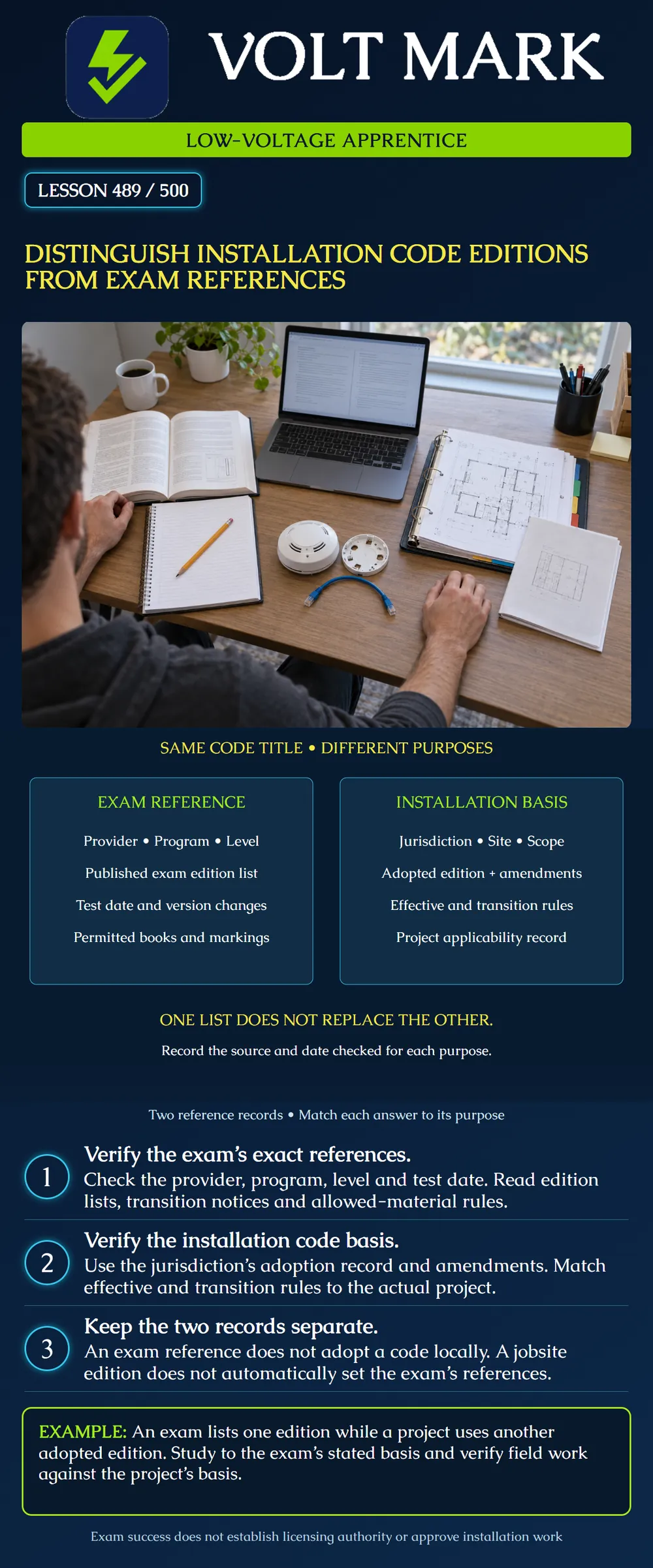
Identify the authority that sets examination references. Identify the authority and records establishing a project's installation code basis. Avoid transferring an edition from one context into the other without verification.
This lesson applies to low-voltage learners preparing for examinations while working on real projects. It is not an examination bulletin, an adopted code, or a licensing approval. Examination providers and jurisdictions can select different editions for different purposes.
For an examination, ask: Which references and edition years govern this program, level and scheduled test version? For installation work, ask: Which code edition, amendments and applicability rules govern this site, scope and project?
The same publication title can appear in both records without the edition years matching. Conversely, the years may match while the project still has adopted amendments that are not part of the exam reference. Do not reduce either record to the name of a single book.
Locate the official provider's current candidate information and reference list. Confirm the exact program and level. Similar exam names can cover different activities or use different lists.
Record the edition year beside every relevant title. Read transition announcements and determine which version applies to the scheduled examination. A projected update date is not necessarily a confirmed changeover date. Recheck close to booking and again when the provider instructs candidates to do so.
Separate references used to develop exam content from materials allowed during the examination. A useful study book may not be admitted to the test room. Likewise, permission to bring a different edition does not mean the questions were written using it. Read the actual rules for the delivery format, including any restrictions on notes or reference format.
Do not import one provider's rules into another examination. Do not assume an online exam and a testing-center exam allow identical materials. Ask the provider to resolve unclear instructions.
Use the applicable adoption rule or ordinance, amendments and project records. Confirm the jurisdiction and relevant code family. Read effective dates and transition conditions rather than assuming the newest published edition controls.
Retain the actual project facts used to determine applicability, such as relevant permit or accepted plan-review dates where the governing rule uses those facts. An exam study guide cannot establish those dates or replace the adopting authority's rules.
Check amendments and applicable referenced standards. A project can require attention to several code families and other governing documents. This lesson does not provide a complete installation compliance checklist.
NICET's references page states that exam questions use the listed editions and separately describes which references candidates may bring. The reviewed Fire Alarm Systems entries list NFPA 72 (2022) and NFPA 70 (2020), among other level-dependent references. These are examples from the opened list, not a promise about every future test appointment.
NICET's Fire Alarm Systems page also describes an update process. That reinforces the need to check program-specific notices rather than selecting books from an undated recommendation. This lesson does not prescribe a future transition date.
Washington WAC 296-46B-010 illustrates a separate installation adoption process: it identifies adopted standards and provisions governing their application to projects. It is not an exam reference list. These sources demonstrate different purposes; they do not determine the code basis for a particular learner's job or exam.
Label learning notes with the edition and purpose. If comparing provisions across editions, keep a clear record of which statement belongs to which edition. Section numbers and requirements can change. Do not copy a remembered exam answer directly into a field decision without checking the governing project basis.
Keep exam preparation separate from approved construction documents. A comparison worksheet is a learning tool, not authority to change the design. Route discrepancies through the project's established review process.
A fictional learner's provider lists Edition A for an examination. The project code-basis record identifies Edition B with local amendments. A coworker says the learner should replace both with the newest book available.
Create two records. The exam record identifies the provider, program, level, test version and official reference list. The installation record identifies the jurisdiction, site, scope, adoption citation, amendments and project applicability. Verify each independently.
If the exam permits another edition at the candidate's risk, distinguish that permission from the exam's stated question basis. If the project documents conflict with the adoption record, ask the responsible project lead and authority to resolve the issue. Do not choose an edition by preference.
The letters A and B are fictional placeholders. They do not imply that any specific pair of real editions governs a real project.
Passing an exam does not by itself prove that a license or certification has been issued, remains current or covers the intended role. Complete the issuer's applicable process and verify the actual credential record. Equally, possession of a credential does not approve every installation detail or replace required project reviews.
This course helps develop understanding. It does not claim approved continuing-education credit, examination equivalency or legal authority to perform regulated work.
Answer: No.
Answer: No.
Answer: Compare edition, purpose and applicable amendments; do not assume the records are identical.
Answer: No. Check provider rules.
Answer: No. Confirm the applicable provider instructions and transition.
Answer: No. Credential issuance, scope and project requirements remain separate.
NICET, References: https://www.nicet.org/exams/references/ NICET, Fire Alarm Systems: https://www.nicet.org/certification-programs/electrical-and-mechanical-systems/fire-alarm-systems/ Washington Legislature, WAC 296-46B-010: https://app.leg.wa.gov/wac/default.aspx?cite=296-46B-010 These sources support the limited distinctions described. This is original instruction, not a reproduction of an exam or an endorsement by NICET.
The fictional exam record names Edition A, while the project's confirmed installation basis is Edition B with amendments. The learner keeps two labeled reference records instead of substituting the newest purchased book for both. Exam preparation follows the provider's applicable question basis and permitted-material rules. Field decisions use the project's governing basis and review process. If another edition is allowed in the exam, that permission does not change the edition used to write the questions.
Texas journeyman, 15 questions, scored by topic against the 70% mark. No card, and no account needed to start.
Free study material for low-voltage apprentices. This is a national foundation course: requirements differ by state and by local jurisdiction, and a practice that is common in one place is not a rule everywhere. Nothing here is a licence, a certification, or authority to work unsupervised, and completing it does not count as apprenticeship hours or continuing-education credit. Check the codes adopted where you are working, the licensing authority for that work, and your employer's safety programme. VoltMark is not affiliated with, endorsed by, or sponsored by NFPA, OSHA, NICET, BICSI, FOA, or any state or local licensing authority.

Electrician licensing exam prep: practice questions, timed exam simulations, and step-by-step help finding every answer in the NEC.