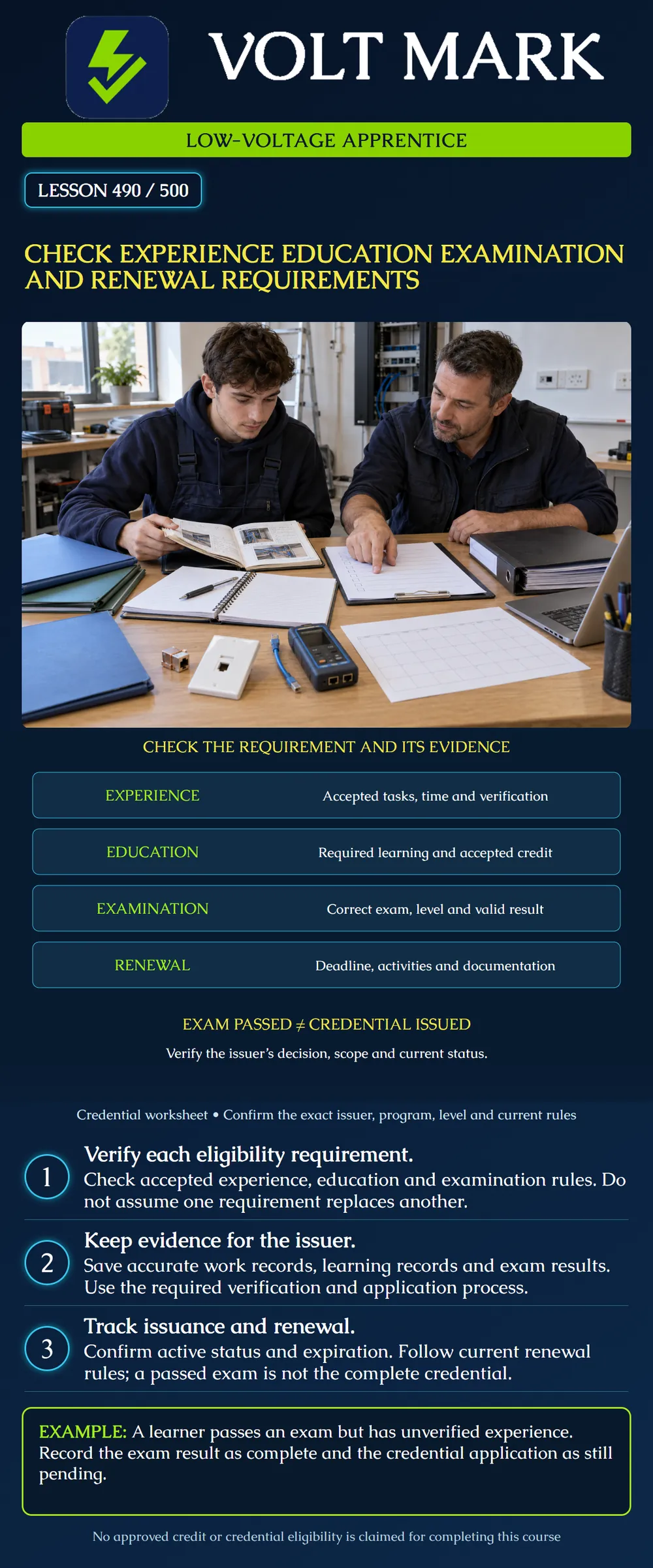
Find the issuer's complete eligibility requirements. Separate experience, education and examination evidence. Distinguish passing a test from credential issuance. Track renewal without assuming that continuing-education rules are identical across credentials.
Use this method for a particular license or certification, issuer, jurisdiction and level. Not every credential requires every item shown on the poster. The worksheet is a set of questions to verify, not a universal four-part eligibility rule.
This course does not determine that a learner is eligible, award work experience or promise approved education credit. The responsible issuer decides under its applicable rules.
Write the full credential name, level, issuer and scope. A company registration, individual license and professional certification can require different evidence. Avoid collecting documents for the wrong program because its name sounds similar.
Locate the current official requirements, application instructions and renewal information. Check effective dates and any transition provisions. A coworker's old application can help suggest questions, but it does not establish today's requirements.
Read what work counts, how time is measured, which duties must be included and who may verify it. Do not assume that calendar time with an employer equals the same amount of accepted experience. Part-time work, overlapping assignments and mixed duties may need careful accounting under the issuer's method.
Record your own actual tasks and time. Preserve dates, role descriptions and required verifier information. Do not claim the full crew's hours as your individual experience or describe observation as independent performance. Where a form asks for detailed duties, provide an accurate description rather than a broad job title.
If an issuer permits related experience or a substitution, read its limits. Do not generalize an allowance from one level to another. Mark uncertain credit as pending review rather than counting it as accepted.
Determine whether education is required, optional, substitutable for some experience, or relevant only to renewal. Check what documentation and provider recognition are required for the specific purpose.
Course completion and issuer acceptance are different facts. Keep the course title, dates, actual learning time and completion record, but do not label them approved credit unless that status is established. Education accepted by one organization need not be accepted by another.
This VoltMark course is a learning resource. No approved credit, experience substitution or eligibility determination is claimed here.
Confirm the correct examination, program level, prerequisites and result requirements. Use the official reference list and application instructions. Passing an exam may satisfy one requirement while experience verification or other application steps remain incomplete.
Record the actual result and date. Do not announce that a license or certification has been awarded merely because the testing screen says pass. Verify the issuer's decision and current credential record.
Some systems allow examination before every certification requirement is satisfied; others have different sequencing. Do not assume the order without reading the relevant instructions.
Track the application separately from its component evidence. A useful record can say “exam passed; work history submitted; verification pending; credential not yet issued.” This is more precise than a single checked box labeled certified.
After issuance, verify name, number, scope, level, status and expiration information where applicable. Retain the official notice in the approved personal or employer record system. Do not publish private identifying information in a learning portfolio.
Read the current renewal cycle, acceptable activities, documentation rules and deadlines. Initial eligibility requirements and renewal requirements serve different purposes. A credential's continuing-education hours or development points are not automatically interchangeable with another program's measures.
Record activities as they occur and retain supporting evidence. A reminder is useful, but do not rely only on receiving a renewal notice. If status expires or becomes uncertain, verify the issuer's process and the effect on the intended work before relying on the credential.
NICET's Fire Alarm Systems requirements combine examination, verified performance and documented work history, with additional requirements at some levels. This is an example of why a test result alone does not prove the complete certification has been earned.
NICET's recertification guidance separately describes continuing professional development and documentation over a certification period. Its education guidance states that NICET does not pre-approve training efforts and describes evidence for relevant learning activities. These are NICET-specific examples, not rules for all licenses or a claim of credit for this course.
Read the full current issuer requirements for the actual certification and level. This lesson does not reproduce a complete application or renewal checklist.
A fictional learner has an exam pass notice, several course completion records and a work-history draft. The required supervisor verification has not been completed.
Create separate entries for the exam, education, experience, verification and application decision. Mark only the documented facts complete. Record the verifier follow-up and any education-credit question as pending. Do not change the overall status to issued.
After the fictional issuer approves the credential, add its scope and expiration record. Create a renewal worksheet using that issuer's requirements rather than copying another credential's cycle. No real application or reminder automation is created by this exercise.
Answer: No.
Answer: No.
Answer: No; record actual individual work according to the issuer's rules.
Answer: No.
Answer: Identify what is complete, what is unresolved and whose decision or evidence is still needed.
Answer: No. It provides questions for verification.
NICET, Fire Alarm Systems Certification Requirements: https://www.nicet.org/certification-programs/electrical-and-mechanical-systems/fire-alarm-systems/certification-requirements/ NICET, Recertify: https://www.nicet.org/recertify/ Sources support the limited issuer examples. Worksheet and practice scenario are original instruction, not NICET endorsement or a certification decision.
Mistake: Calling an exam pass an issued credential. Correction: Track the result separately from verified work history, application review and the issuer's actual award.
Mistake: Counting every course completion as approved credit. Correction: Verify the specific provider, course, purpose and documentation rules with the relevant issuer.
Mistake: Copying renewal points or cycles from another credential. Correction: Use the exact issuer and level's current renewal requirements and retain supporting activity records as they occur.
Texas journeyman, 15 questions, scored by topic against the 70% mark. No card, and no account needed to start.
Free study material for low-voltage apprentices. This is a national foundation course: requirements differ by state and by local jurisdiction, and a practice that is common in one place is not a rule everywhere. Nothing here is a licence, a certification, or authority to work unsupervised, and completing it does not count as apprenticeship hours or continuing-education credit. Check the codes adopted where you are working, the licensing authority for that work, and your employer's safety programme. VoltMark is not affiliated with, endorsed by, or sponsored by NFPA, OSHA, NICET, BICSI, FOA, or any state or local licensing authority.
Electrician licensing exam prep: practice questions, timed exam simulations, and step-by-step help finding every answer in the NEC.