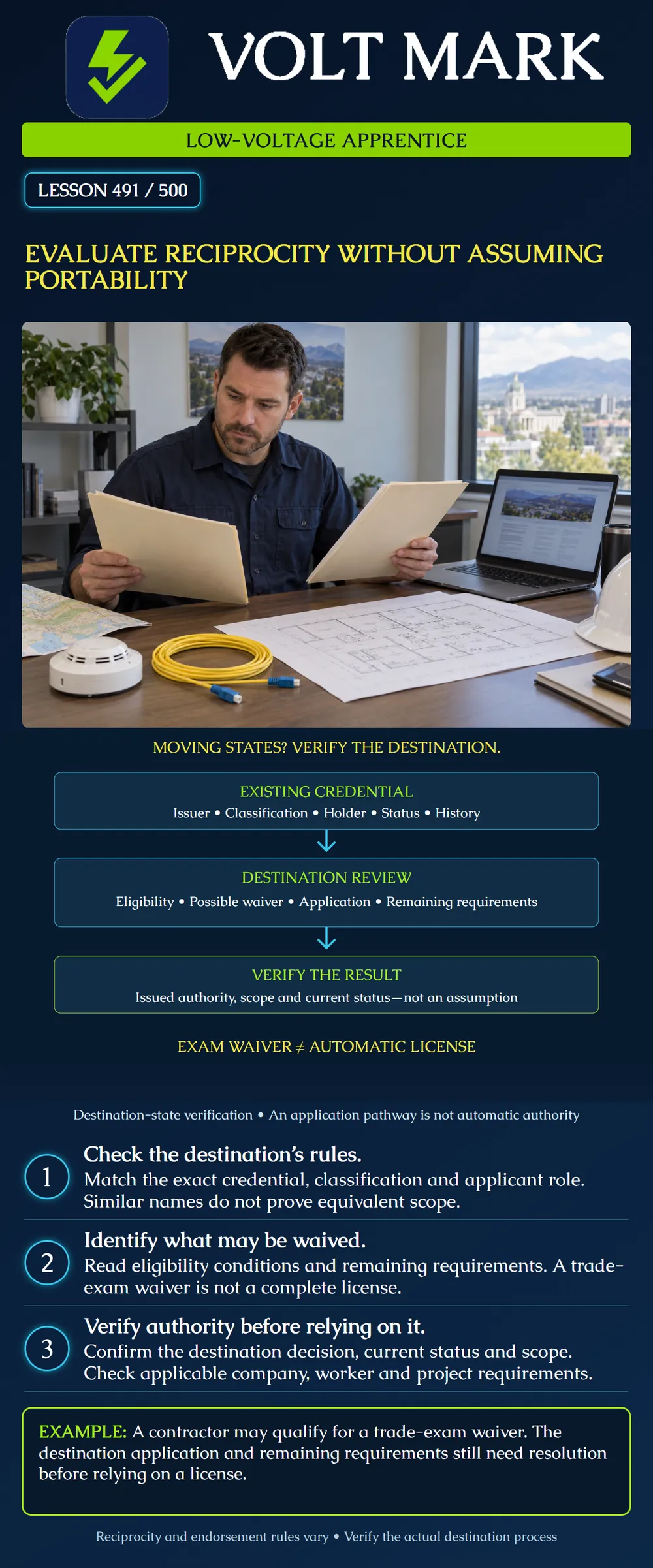
Distinguish a reciprocity or endorsement application pathway from automatic work authority. Determine what a destination jurisdiction recognizes and what remains required. Keep source-state and destination-state credential records separate.
This lesson provides a research process for moving work across jurisdictions. It does not claim that every state offers reciprocity, that all credentials transfer, or that no special recognition pathway exists. The destination's current law and issuing authority determine the available process and its conditions.
Identify the issuing state, credential type, classification, holder and current status. Determine whether the record belongs to a worker, qualifying person or company. A business's contractor license and an employee's certification are different records.
Record relevant history accurately. An active credential may still have scope limitations. An older license, an expired credential and an examination score are not interchangeable evidence. Do not omit restrictions or disciplinary history when an application requests them.
Write the proposed location, system and activity. Security, fire alarm, communications and controls work may have different requirements. Do not assume that a source-state low-voltage classification maps to an identically named destination category.
Ask which destination body addresses the worker and company requirements. Check local project obligations separately. A statewide licensing pathway does not itself answer every municipal permit, inspection or owner-access question.
The term can describe a limited benefit in an application process. Determine whether the destination recognizes examination results, accepts specified experience evidence, offers another form of endorsement or provides some other defined route.
Do not replace the official language with “my license transfers.” State precisely what is recognized and under which conditions. A waiver of one examination component does not necessarily waive another examination, application review, fees, documentation or other applicable requirement.
Also determine whether recognition is directional. Evidence that State A recognizes a State B credential does not by itself prove that State B provides the reverse arrangement. Use the destination's actual list and conditions.
Read any equivalency chart and its notes. A chart may distinguish experience equivalency from examination equivalency. Similar labels do not establish that every activity in the source classification is included at the destination.
If a proposed scope crosses categories, keep separate research entries. Ask the responsible authority to resolve uncertain equivalence. Avoid selecting the broadest-sounding label merely to simplify the application.
Nevada State Contractors Board's endorsement guidance describes circumstances in which trade-examination and/or experience-qualification requirements may be waived. It also says other required application documentation remains necessary and identifies a Nevada Business and Law examination requirement. This illustrates limited recognition within a destination application process.
California CSLB's reciprocity guidance describes possible waiver of a trade examination under its conditions and retains the ability to require that exam. This is not automatic issuance.
These are limited state examples, not a complete current equivalency chart or eligibility decision for a particular low-voltage applicant. This lesson does not claim that a named source license qualifies for either state's pathway. Confirm the current destination rules for the exact classification and applicant.
Record the source credential, intended destination classification, official source, date checked, eligibility conditions, recognized evidence, possible waivers and remaining requirements. Separate requested, approved and issued statuses.
For example, “waiver requested” is not “waiver granted.” “Application accepted for processing” is not necessarily “license issued.” Keep the actual official correspondence and record what each document proves.
After an approval or issuance, verify the destination credential's holder, scope and status. Do not assume the new authority has the same limitations, renewal dates or qualifying-person rules as the source credential.
An apprentice should route licensing questions through the authorized employer representative or responsible agency. Do not advertise, bid, contract or perform regulated activities on the assumption that a pending reciprocity application supplies permission. Verify the rules for the particular activity before relying on a credential.
If a jurisdiction offers a temporary or other special pathway, verify its actual terms rather than assuming either that it exists or that it never can. Record its limits and dates. This lesson grants no such authority.
A fictional contractor holds a current communications classification in State A and receives a request for a mixed fiber and fire-alarm job in State B. A colleague finds an online statement that the states have reciprocity.
Break the proposal into system and activity entries. Locate State B's official requirements and any equivalency provisions. Identify whether the source classification is included, which applicant or qualifier must satisfy conditions and what might be waived. List remaining company, individual and project questions.
The correct research outcome may be that the available pathway applies to only part of the proposed scope, or that eligibility is unresolved. Do not invent a favorable result. No application, agency message or job authorization is performed in this exercise.
Recheck requirements if the source license changes, the destination scope expands or an application is delayed. Maintain separate renewal records for each issued credential. Do not assume renewing the source automatically renews the destination authority.
Answer: No; read the destination process.
Answer: Not necessarily.
Answer: No.
Answer: No.
Answer: A request is pending until the responsible authority decides.
Answer: No; it teaches how to verify it.
Nevada State Contractors Board, Licensure by Endorsement: https://www.nvcontractorsboard.com/licensing/licensure-by-endorsement/ California CSLB, Journeymen Reciprocity: https://www2.cslb.ca.gov/Contractors/Journeymen/Journeymen_Reciprocity.aspx The examples support limited recognition versus issuance. They are not a reproduced equivalency chart or a complete legal determination.
For the fictional mixed fiber and fire-alarm job, first make two destination scope rows. Attach the source communications credential to the fiber row as evidence to evaluate, not as an approval. The fire-alarm row remains unresolved because the source label does not establish that scope. Next record any destination examination waiver as requested until a decision exists. Even a granted waiver changes only that requirement; the destination license and project obligations still require their own evidence. The result is a documented application checklist, not permission to start either portion of the job.
Mistake: Treating a reciprocal-classification listing as an issued destination license. Correction: Record the listing as potential eligibility evidence. Separately verify the applicant's conditions, actual waiver decision and issued credential before relying on work authority.
Mistake: Extending recognition of communications work to the fire-alarm part of a mixed project. Correction: Compare each system and activity against the destination scope. Keep uncovered or unclear activities unresolved instead of broadening the source license by inference.
Mistake: Assuming an agreement works in reverse with identical conditions. Correction: Read the destination authority's current provisions for each direction. Keep separate application and renewal records for each issued credential.
Texas journeyman, 15 questions, scored by topic against the 70% mark. No card, and no account needed to start.
Free study material for low-voltage apprentices. This is a national foundation course: requirements differ by state and by local jurisdiction, and a practice that is common in one place is not a rule everywhere. Nothing here is a licence, a certification, or authority to work unsupervised, and completing it does not count as apprenticeship hours or continuing-education credit. Check the codes adopted where you are working, the licensing authority for that work, and your employer's safety programme. VoltMark is not affiliated with, endorsed by, or sponsored by NFPA, OSHA, NICET, BICSI, FOA, or any state or local licensing authority.

Electrician licensing exam prep: practice questions, timed exam simulations, and step-by-step help finding every answer in the NEC.