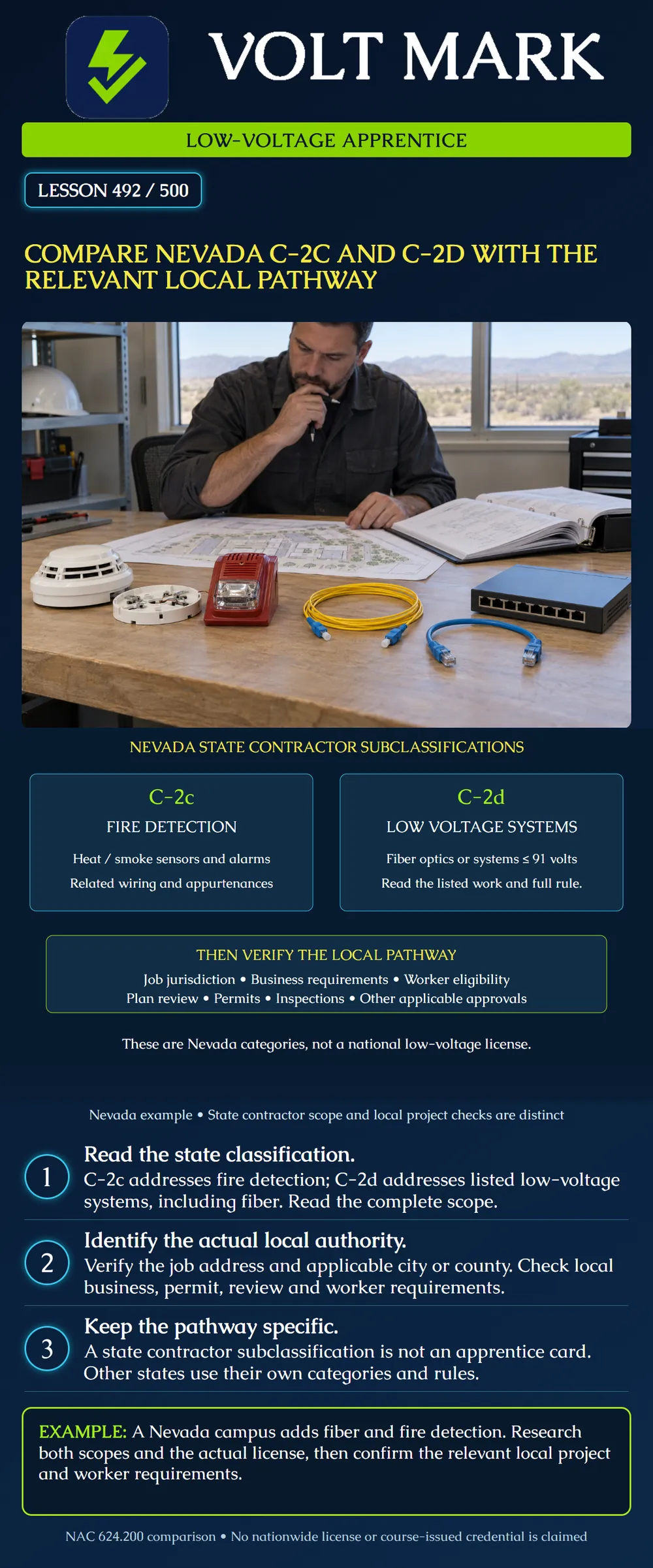
Distinguish Nevada's C-2c and C-2d contractor subclassifications. Separate state contractor scope from local business, worker and project requirements. Use the comparison as a research model without treating Nevada categories as national licenses.
Nevada NAC 624.200 identifies C-2 electrical contracting and its subclassifications. C-2c addresses installation, alteration and repair of heat- and smoke-detection sensors and alarms, including associated items and wiring. C-2d addresses installation, alteration and repair of systems using fiber optics or not exceeding 91 volts, with examples including communications, networking, instrumentation and temperature controls.
Read the complete rule and the actual license record. The broader C-2 classification also authorizes work described by its subclassifications. This poster does not claim that holding both narrow subclassifications is the only possible authority for a combined project.
These are state contractor classifications. They are not names for an apprentice course-completion certificate or a universal individual worker card.
A short classification summary does not determine every requirement for a job. Establish the actual entity, license scope and status. Separately investigate applicable fire-system requirements, worker eligibility and project approvals.
The voltage expression in the Nevada example is classification language. It is not a universal definition of safe voltage, a national low-voltage boundary or an exemption for every other system. The inclusion of fiber also shows why optical media should not automatically be assumed outside contractor licensing.
Use the exact job address and scope. A postal city name is not enough. Determine whether the responsible authority is the county, a municipality or another agency for the proposed work.
Clark County's official information page links to a jurisdiction locator. Use official location resources and confirm uncertain boundaries. Do not assume all jobs in the Las Vegas area are administered through the same permit office.
For a campus route, identify both buildings and any route crossing a jurisdiction or public right-of-way. Keep separate entries when responsibilities differ. Do not extrapolate one property's answer to a second property without verification.
Clark County's licensing/payment page distinguishes state contractor licensing from a local multi-jurisdictional business license and the permit-account process for contractors. This illustrates additional local administrative checks; it does not make a business license equivalent to the state trade license.
Check the current applicable submission requirements for the actual permit type. The permit application, issuance, plan approval and completed inspection are different stages. A portal account or linked contractor number does not prove a project is approved.
This lesson does not reproduce every Clark County permitting requirement or decide whether a particular task needs a permit. Use the responsible local authority's current instructions.
Ask which individual qualifications, registration, card or supervision requirements apply to the assigned task and location. Keep that question separate from the contractor's C-2c or C-2d classification.
Do not advertise this course as issuing a Nevada license, a Clark County card or approved apprenticeship status. A learner can develop knowledge here while still needing the employer's training, supervised experience and the applicable official credential process.
If an official local source contains older code references, do not treat every paragraph as a current rule without checking adoption and applicability. Record the source date and unresolved questions.
When the project includes fire detection, describe the actual activities: planning, installation, alteration, service or testing. Verify any applicable state fire-marshal and local fire-prevention requirements through the responsible authorities.
Do not assume that a low-voltage communications scope covers fire-detection work merely because both use small conductors or share a pathway. Also do not conclude that a classification comparison alone supplies the entire approval process.
This lesson provides no live-system test, impairment or restoration procedure. Such operations remain within the authorized site's qualified process.
A fictional Nevada campus requests a fiber connection and additional fire-detection devices. The estimator sees C-2d on a company record and assumes the entire project is covered.
Create separate scope entries for the fiber work and fire detection. Read NAC 624.200 and verify the actual license, including any broader classification or restrictions. Identify the local jurisdiction, business requirements, worker pathway and project approvals.
Record unresolved coverage rather than approving the work from the classification label. Ask the proper authority through the authorized project representative. No real licensing decision, application or agency communication is made in this exercise.
For another state, start with that state's official classifications and the site's local process. Do not search only for “C-2c equivalent” and assume a matching label exists. Compare system purpose, activity, company authority, worker role and local project requirements.
The transferable lesson is the method of separating responsibilities. The Nevada names and numeric classification limit remain Nevada-specific.
Answer: No.
Answer: Nevada C-2d.
Answer: No. Check the complete scope and actual license.
Answer: No.
Answer: No.
Answer: Research its actual categories and local requirements rather than transferring Nevada labels.
Nevada Legislature, NAC 624.200: https://www.leg.state.nv.us/Division/Legal/LawLibrary/NAC/NAC-624.html Clark County, Licensing / Payment Requirements: https://www.clarkcountynv.gov/government/departments/building___fire_prevention/permit_issuance/licensing-requirements Clark County, How Do I?: https://www.clarkcountynv.gov/government/departments/building___fire_prevention/how-do-i The last page supports jurisdiction and process navigation only. Its older technical/code examples were not adopted as current requirements. No worker-card or complete fire-system eligibility determination is claimed.
In the campus exercise, the company record initially shows C-2d. Put the fiber connection in one scope row and the added fire-detection devices in another. NAC 624.200 expressly includes fiber in C-2d, while C-2c describes fire detection; check the complete actual license for broader C-2 authority or restrictions before concluding coverage. Next identify the job's governing local jurisdiction from its address and route. A linked permit account proves only an administrative setup step. The completed worksheet therefore distinguishes classification evidence, unresolved fire scope, local process and worker requirements; it does not approve the project.
Mistake: Using the 91-volt wording to claim that any small-conductor fire system is covered by C-2d. Correction: Read the system purpose and the complete classifications, including C-2c and any broader authority on the actual license. Voltage alone does not settle mixed-project eligibility.
Mistake: Using a Las Vegas mailing address as proof of the permit authority. Correction: Confirm the actual property jurisdiction and any route boundary crossings through official location resources. Record the responsible authority for each affected scope.
Mistake: Treating a local business license or permit account as the contractor's trade authorization. Correction: Keep state license scope, local business requirements, worker qualifications and issued project approvals as separate evidence items.
Texas journeyman, 15 questions, scored by topic against the 70% mark. No card, and no account needed to start.
Free study material for low-voltage apprentices. This is a national foundation course: requirements differ by state and by local jurisdiction, and a practice that is common in one place is not a rule everywhere. Nothing here is a licence, a certification, or authority to work unsupervised, and completing it does not count as apprenticeship hours or continuing-education credit. Check the codes adopted where you are working, the licensing authority for that work, and your employer's safety programme. VoltMark is not affiliated with, endorsed by, or sponsored by NFPA, OSHA, NICET, BICSI, FOA, or any state or local licensing authority.
Electrician licensing exam prep: practice questions, timed exam simulations, and step-by-step help finding every answer in the NEC.