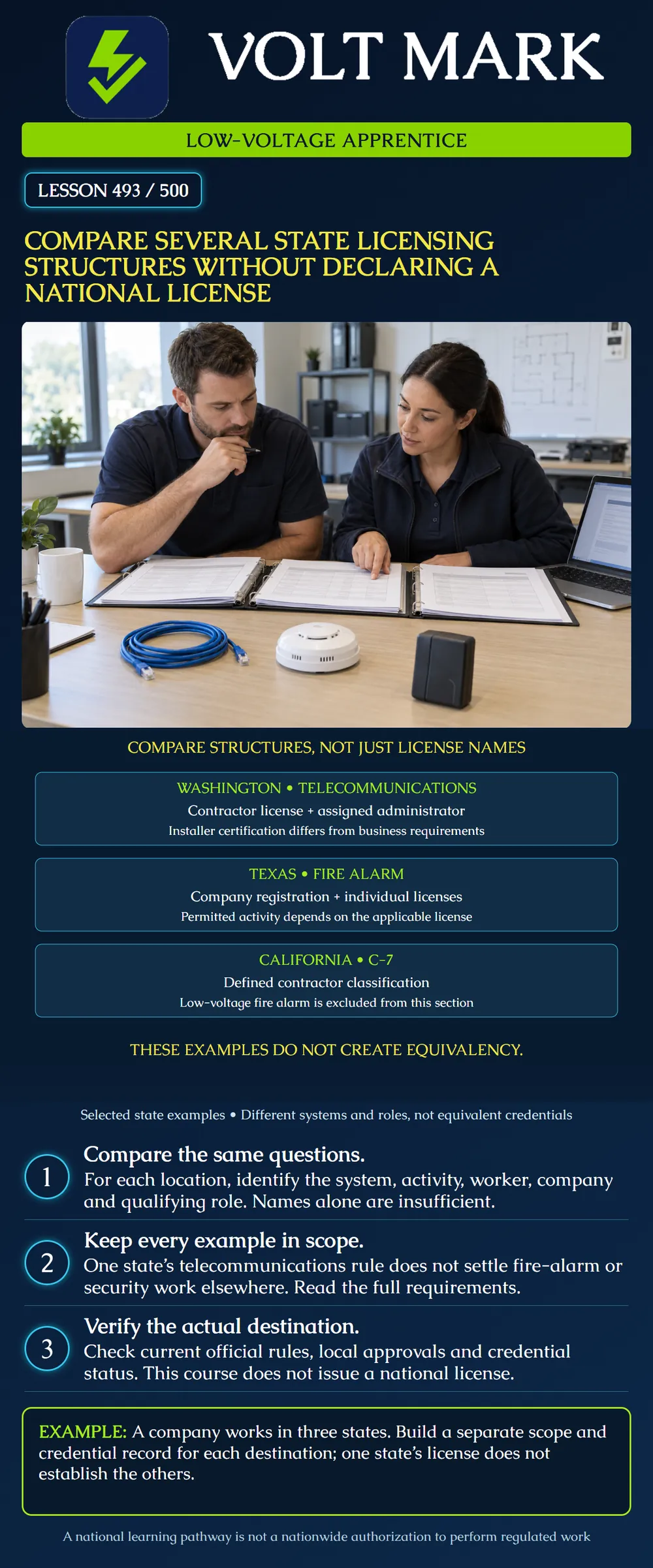
Compare how several states organize particular low-voltage requirements. Distinguish contractor, individual and designated-role records. Use the same research questions nationwide without claiming that the answers or credentials are nationwide.
This lesson compares selected official examples from Washington, Texas and California. The examples concern different regulated systems and show structural differences; they are not equivalent licenses or an exhaustive comparison of those states.
A course can teach national fundamentals while requiring location-specific verification before regulated work. Completing these lessons does not issue a national low-voltage license, establish reciprocity or satisfy every local requirement.
For each destination, record the actual job location, system and activity. Then ask who regulates the business, which individual requirements apply, whether a designated qualifying role exists, and what project approvals are required.
These questions help organize research without assuming each state has the same credential categories. Some functions may be combined in one process, while others are handled by different agencies. Do not fill an unfamiliar column with a guessed license name.
Washington L&I's telecommunications contractor page describes a contractor license and an assigned certified telecommunications administrator. It separately states that individuals performing telecommunications installations do not have a certification requirement under the described program, while business requirements remain.
The distinction is between the installer and the regulated business structure for that scope. It is not a statement that every person performing any low-voltage work in Washington is exempt from individual requirements. Fire alarm, security and other work must be classified under their applicable rules.
Texas Department of Insurance's fire-alarm guidance separates company registrations from individual licenses. It explains that the company's permitted work depends on the licenses held by its employees.
This structure requires reading both entity and individual scope. It does not mean that a fire-alarm company registration covers every security, communications or controls activity in Texas. The example is limited to the described fire-alarm program.
California CSLB defines a C-7 communication and low-voltage contractor classification. Its description includes listed systems within stated limits and expressly excludes low-voltage fire alarm systems from that section.
The important comparison is that a broad-sounding classification title can still have a specific exclusion. This one page does not determine every California individual, company or project requirement. Do not convert a contractor classification into a universal worker card.
The poster intentionally labels the system beside the state. Comparing Washington telecommunications with Texas fire alarm does not prove a difference for the exact same task; it shows how distinct official programs organize responsibilities.
A valid task-to-task comparison would require the same proposed activity and system to be researched in each destination, including definitions and exceptions. Do not claim equivalence from the poster or rank the states by difficulty using these short examples.
Avoid saying one state has “no licensing” merely because a particular individual credential is not required for a described task. Business licensing, other system categories and local processes can still matter.
Create a separate worksheet for each state and job location. Include company identity, proposed scope, assigned worker role, required qualifying relationship if applicable, official source, date checked and unresolved questions.
Add local business and project requirements after confirming the actual jurisdiction. County and city boundaries, special properties and route changes can affect where questions belong. A state agency's licensing answer does not automatically settle project permit or inspection requirements.
Record the status of evidence precisely: source found, requirement confirmed, application pending, credential issued, or scope unresolved. These statuses are not interchangeable. Retain official responses with the facts that were submitted.
If the company or worker holds a credential elsewhere, investigate the destination's current recognition or endorsement process. A similar name or a shared exam reference does not establish automatic portability.
A nationally available certification can be useful evidence of professional development and may be recognized for a particular purpose. That recognition must be established by the applicable authority, employer or contract. It does not itself create a nationwide trade license.
A fictional company proposes three projects: a communications installation, a fire-alarm alteration and a camera/access project in different states. Its manager puts “low-voltage licensed” beside all three because the company holds one credential.
Replace that statement with three separate scope records. Identify the system and activity in each destination. Find the official business and individual requirements, any qualifying role, and the local project process. Verify the actual credential holder and current status.
Do not copy the examples in this lesson as the final answer. A camera/access project is not the Texas fire-alarm example, and the other rows may also differ from the proposed tasks. Mark missing research rather than inventing approval.
For a state not shown here, begin with its official licensing and legal sources. Use the same questions and document the actual answers. No state is assumed to follow one of the three examples exactly.
This approach supports learners in all states without claiming that a handful of examples covers every county's rules. Requirements should be rechecked when the jurisdiction, scope, role or credential status changes.
Answer: No; they describe selected programs with different scopes.
Answer: No.
Answer: No.
Answer: The same system and activity researched against each destination's current rules.
Answer: No.
Answer: Research its official requirements using the same structured questions.
Washington L&I, Telecommunications Contractor: https://www.lni.wa.gov/licensing-permits/electrical/electrical-licensing-exams-education/telecommunications-contractor Texas Department of Insurance, Fire alarm registration, license, and test information: https://www.tdi.texas.gov/fire/information-fire-alarm-registration-license-test.html California CSLB, C-7 classification: https://cslb.ca.gov/about_us/library/licensing_classifications/Licensing_Classifications_Detail.aspx?Class=C-7 Examples are explicitly limited to these source descriptions. No exhaustive all-state legal survey is claimed.
Mistake: Comparing Washington telecommunications and Texas fire alarm as though they regulate the identical task. Correction: Label the system and activity in every row. To compare the same proposed job across states, research that exact job in each state instead of treating these teaching examples as equivalent credentials.
Mistake: Reading the Washington telecommunications installer statement as an exemption for every low-voltage worker. Correction: Limit that statement to the described telecommunications program. Verify the business structure and research fire, security or other system categories under their own applicable rules.
Mistake: Listing a nationally available certification as the company's nationwide license. Correction: Record the certification as its actual issuer's credential. Verify separately what each destination authority, employer and project recognizes, including the legal business and individual requirements.
Texas journeyman, 15 questions, scored by topic against the 70% mark. No card, and no account needed to start.
Free study material for low-voltage apprentices. This is a national foundation course: requirements differ by state and by local jurisdiction, and a practice that is common in one place is not a rule everywhere. Nothing here is a licence, a certification, or authority to work unsupervised, and completing it does not count as apprenticeship hours or continuing-education credit. Check the codes adopted where you are working, the licensing authority for that work, and your employer's safety programme. VoltMark is not affiliated with, endorsed by, or sponsored by NFPA, OSHA, NICET, BICSI, FOA, or any state or local licensing authority.

Electrician licensing exam prep: practice questions, timed exam simulations, and step-by-step help finding every answer in the NEC.