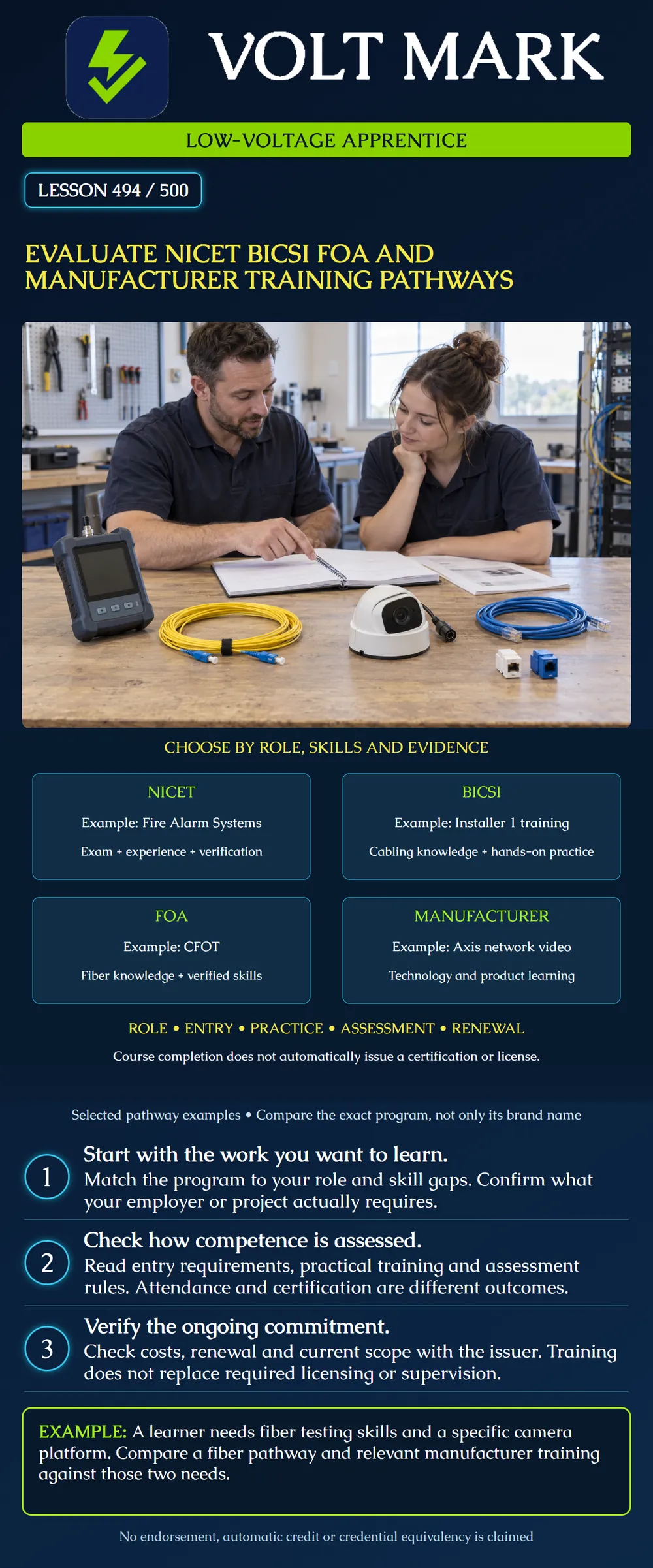
Compare training and certification options by the work they support. Separate training attendance from assessed competence and credential issuance. Verify prerequisites, practical learning, assessment and maintenance requirements using the exact issuer's information.
NICET, BICSI, FOA and manufacturers offer different programs. They are not interchangeable credentials. This lesson uses selected examples to teach comparison, not to rank organizations or recommend a purchase for every learner.
Identify the precise program, level and outcome. An organization name alone is not a complete training plan. A short introductory course, professional certification and product-specific workshop can all have value while serving different needs.
Describe the skill gap in practical terms. Examples include documenting a fiber loss test, terminating structured cabling, understanding fire-alarm responsibilities or configuring a particular video product under authorized supervision.
Ask the employer or project lead what evidence is required for the intended role. Distinguish mandatory credentials from preferred development. Do not spend money based only on an attractive badge or a claim that a program is “recognized everywhere.”
NICET's Fire Alarm Systems program combines examinations with work-history and performance requirements, and additional requirements at some levels. It is an example of a credential that requires more than attending a class or passing one test.
Compare the exact level and relevant role. The program information also distinguishes Fire Alarm Systems from Inspection and Testing of Fire Alarm Systems. Do not assume similarly named programs have identical requirements or serve the same experience profile.
These points concern the reviewed NICET program, not every NICET certification. Confirm current eligibility and maintenance requirements directly.
BICSI's Installer 1 blended-training page describes self-paced learning followed by an instructor-led hands-on component. It lists entry-level cabling skills and identifies the course as preparation relevant to the Installer 1 examination.
This demonstrates the value of checking what practical activity is included in training. It does not prove that buying or completing the course automatically issues certification. Verify the separate current credential requirements and assessment process.
The main BICSI Technician certification page returned an access error during this lesson's research. Detailed Technician eligibility and exam claims are therefore not used here. Do not substitute a training-course page for a credential handbook.
FOA's CFOT description combines fiber knowledge with demonstrated skills and/or verified experience. It describes approved-school training and an experience-based direct route. Fiber U learning can support preparation, but a learning completion record is distinct from CFOT certification.
A learner should identify the route that fits actual experience and the skills needed. A broad fiber credential does not prove competence in every specialized industrial, campus or outside-plant task. Check any additional training or specialist requirements relevant to the assignment.
Axis describes a network-video certification program based on its examination, with preparation resources addressing technology, solutions and products. This is an example of a manufacturer pathway that can complement broader trade learning.
Other manufacturers have their own structures. Check the specific platform, product generation and course outcome. Do not assume one manufacturer's course qualifies a person on a different system or supplies every field skill needed for installation.
Use five questions for each exact offering: What role or task does it support? What entry requirements and prior experience apply? What supervised practice is included? How are knowledge and practical competence assessed? What maintenance, renewal or version-update obligations follow?
Also determine the total commitment. Verify current course and exam costs, included materials, equipment needs, travel, scheduling and any separate renewal costs. No fixed price is taught in this lesson because program offerings change.
Ask whether the learner will perform the relevant tasks, receive feedback and demonstrate the required standard. Watching a demonstration is different from completing a task. A written exam and a practical assessment can provide different evidence.
Do not invent practical testing where the program does not claim it. Conversely, do not dismiss a structured experience-verification process just because it is not a classroom lab. Record the actual assessment method and its limitations.
A credential may be relevant to an employer, specification, authority or manufacturer relationship. Verify that recognition for the actual purpose. A nationally available program is not automatically a nationwide legal license.
Training also does not override site supervision, safe-work procedures or project authorization. An apprentice may still need supervised practice on the specific equipment after completing a course.
A fictional learner is preparing for fiber-test documentation and a camera-platform assignment. Create two task descriptions and compare relevant fiber learning with the actual manufacturer's offering.
For each option, record program name, issuer, prerequisites, hands-on component, assessment, credential outcome and ongoing requirements. Mark unanswered questions pending. Ask the employer which outcomes meet the proposed assignment before choosing paid training.
Do not enroll, pay, claim credit or represent the learner as certified during this exercise. It is a comparison worksheet only.
Choose the next learning step that addresses a documented gap and is appropriate to the learner's current experience. Combine theory with authorized supervised practice and accurate evidence. Revisit the plan when the work role or product platform changes.
Do not accumulate unrelated certificates merely to increase a count. The useful outcome is better understanding and demonstrated ability for the intended work, with requirements and limitations clearly recorded.
Answer: No; identify the exact program, level and outcome.
Answer: No.
Answer: No.
Answer: No.
Answer: Record the missing evidence and verify with the issuer; do not infer it from a course advertisement.
NICET Fire Alarm Systems: https://www.nicet.org/certification-programs/electrical-and-mechanical-systems/fire-alarm-systems/ BICSI Installer 1 Blended Training: https://shop.bicsi.org/bicsi-installer-1-blended-training FOA CFOT: https://www.thefoa.org/cfot.htm Axis Certification Program: https://www.axis.com/learning/axis-certification-program BICSI Technician's main certification page returned 403; its full contents were not reviewed. Selected examples above stay within successfully opened sources.
The fictional learner needs fiber-test documentation and work on a particular camera platform. Split the plan into two outcomes: produce a traceable fiber test record in supervised practice, and explain the selected camera platform's configuration workflow. The FOA row records the exact learning route and how skills or experience are verified; an online completion record alone does not establish CFOT. The manufacturer row records its named program, exam outcome and platform coverage. Ask the employer which evidence each assignment needs. Unverified prerequisites or hands-on components remain open questions, so no enrollment or certification status is invented.
Mistake: Comparing only organization names, such as NICET versus BICSI, without naming programs or levels. Correction: Compare the exact offering against the intended task, entry requirements, assessment and outcome. Different programs from one issuer can serve different roles.
Mistake: Recording Fiber U completion or a training attendance certificate as an issued professional certification. Correction: Use the exact name of the earned record and verify the issuer's certification requirements separately, including any exam, skills or experience evidence.
Mistake: Assuming a camera certification demonstrates fiber testing or competence on every manufacturer's platform. Correction: Match the credential's stated coverage to the actual assignment. Plan supervised practice and additional assessment for skills or products outside that coverage.
Texas journeyman, 15 questions, scored by topic against the 70% mark. No card, and no account needed to start.
Free study material for low-voltage apprentices. This is a national foundation course: requirements differ by state and by local jurisdiction, and a practice that is common in one place is not a rule everywhere. Nothing here is a licence, a certification, or authority to work unsupervised, and completing it does not count as apprenticeship hours or continuing-education credit. Check the codes adopted where you are working, the licensing authority for that work, and your employer's safety programme. VoltMark is not affiliated with, endorsed by, or sponsored by NFPA, OSHA, NICET, BICSI, FOA, or any state or local licensing authority.

Electrician licensing exam prep: practice questions, timed exam simulations, and step-by-step help finding every answer in the NEC.